

ヒメソウゲンライチョウ 対 オジロライチョウ
Tympanuchus pallidicinctus 対 Lagopus leucura
ヒメソウゲンライチョウとオジロライチョウのクイズ
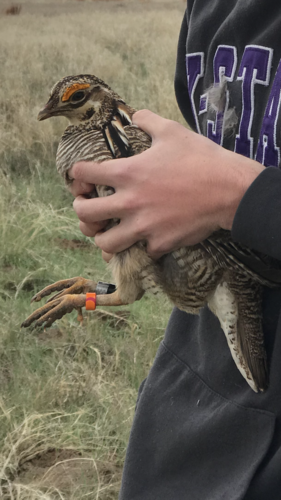 ヒメソウゲンライチョウ
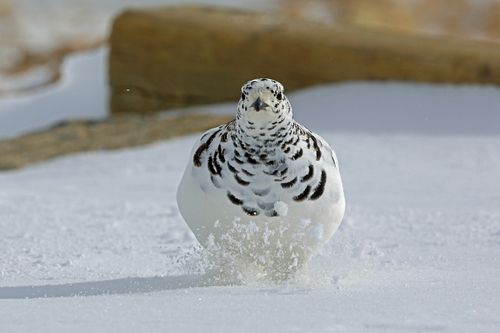 オジロライチョウ
要点
The most reliable field mark to separate Lesser Prairie-Chicken from White-tailed Ptarmigan is the ptarmigan’s all-white wings and tail in every plumage, especially obvious in flight, versus the prairie-chicken’s barred, earth-toned wings and tail. White-tailed Ptarmigan also undergoes dramatic seasonal color changes, being completely white in winter and finely barred grayish in summer, while Lesser Prairie-Chicken remains consistently brown and barred. Structurally, the prairie-chicken is much heavier and bulkier, with a larger body and longer legs. Habitat offers a strong clue: prairie-chickens stick to open grasslands, while ptarmigan are only found in alpine tundra above treeline. If you see a small, cryptically colored grouse in high mountains with white wings and tail, it’s a ptarmigan; a larger, brown-barred bird on the plains is a prairie-chicken.
識別のコツ
- White wings and tail (all ages/seasons): Only White-tailed Ptarmigan shows pure white wings and tail in every plumage, including juveniles and immatures. If you see a grouse with white wings/tail in flight or at rest, it is ptarmigan.
- Barred, earth-toned wings/tail: Lesser Prairie-Chicken always shows barred brown, buff, and black wings and tail, never white. This is true for all ages and sexes.
- Seasonal color change: White-tailed Ptarmigan molts from finely barred grayish-brown in summer to entirely white in winter. If you see a grouse that is pure white (except for bill/eye), it is ptarmigan; prairie-chicken never turns white.
- Red eyecombs: Male ptarmigan have small red eyecombs above the eye year-round, which prairie-chicken lacks. This is subtle but diagnostic at close range.
- Body size and shape: Prairie-chicken is much larger and bulkier, with a more robust body and longer legs. Ptarmigan is compact and dainty by comparison.
- Bill: Ptarmigan has a small, black bill; prairie-chicken’s bill is proportionally larger and less contrasting.
- Leg feathering: Ptarmigan has feathered legs and toes, an adaptation to cold alpine environments. Prairie-chicken has less extensive feathering, mostly on the upper legs.
- Habitat context: If you are in alpine tundra above treeline, only ptarmigan is likely. Prairie-chicken is never found in such habitats; it is a bird of open grasslands.
- Behavior: Prairie-chicken may be seen displaying in groups on open ground (leks), often with loud booming calls. Ptarmigan is solitary or in small groups, often crouching or walking quietly among rocks, rarely vocalizing.
- Flight style: Ptarmigan avoids flight and may flush only at close range, flying short distances low to the ground. Prairie-chicken may fly more readily, especially when disturbed on leks.
- Vocalizations: Loud, deep booming calls indicate prairie-chicken. Ptarmigan is mostly silent, with only soft hoots or clucks.
- Plumage pattern: Prairie-chicken is always heavily barred above and below, with no white except possibly on the underwing coverts (not visible in normal views). Ptarmigan’s upperparts are finely barred in summer, never as coarsely patterned as prairie-chicken.
- Tail shape: Ptarmigan’s tail is square-ended and all white; prairie-chicken’s tail is more rounded and barred.
- Feet: Ptarmigan’s feet are fully feathered to the toes, visible at close range; prairie-chicken’s toes are bare.
- Contextual clues: Consider location, season, and elevation. Prairie-chicken is a lowland grassland specialist; ptarmigan is an alpine tundra specialist. If you are in the wrong habitat, reconsider your ID.
大きさ
Lesser Prairie-Chicken is substantially larger and heavier, averaging 685.5g [wikidata], while White-tailed Ptarmigan is the smallest grouse, averaging only about 325g [wikipedia]. Prairie-chicken is bulkier and longer-legged, with a more robust build. In the field, ptarmigan will look noticeably smaller and more compact, especially when seen side-by-side with other grouse.
羽色
- Juvenile/Immature/Non-breeding: White-tailed Ptarmigan is unique in having all-white wings and tail at all ages and in all seasons, even as its body plumage changes from finely barred gray-brown in summer to pure white in winter. Lesser Prairie-Chicken never shows white wings or tail; its upperparts, wings, and tail are always barred with brown, buff, and black, regardless of age or season.
- Adult Breeding: Prairie-chicken is consistently brown and heavily barred above and below, with no white in the wings or tail. Ptarmigan in summer shows a finely barred gray-brown upperpart with white belly, wings, and tail; in winter, it is entirely white except for the black eye and bill. Males of ptarmigan have red eyecombs year-round, which prairie-chicken lacks.
- Flight: In flight, the ptarmigan’s white wings and tail flash conspicuously, while prairie-chicken shows barred, earth-toned wings and tail. This is the most immediate separation in all ages and seasons.
行動
Lesser Prairie-Chicken is famous for its elaborate lekking displays on open ground, with males gathering in groups to perform booming calls and dances in spring and, to a lesser extent, fall. They are more likely to be seen walking or running in open grassland, sometimes using man-made structures for display. White-tailed Ptarmigan is much more secretive, often crouching or walking quietly among rocks and alpine vegetation. Ptarmigan avoid flight when possible, especially in winter, and may roost in snowbanks. Their behavior is generally more subdued and cryptic, focused on blending in with their environment.
生息環境
Habitat is a strong separator. Lesser Prairie-Chicken is restricted to open, shortgrass prairies and grasslands of the southern Great Plains, never venturing into mountains or tundra. White-tailed Ptarmigan is found exclusively in alpine tundra above treeline, in high mountains of western North America. If you are above treeline in rocky, windswept terrain, only ptarmigan is likely; if you are in open lowland grassland, only prairie-chicken is expected.
声
Lesser Prairie-Chicken males produce deep, booming calls during lekking displays, which are loud and carry over long distances. White-tailed Ptarmigan is generally silent, but may give quiet, low-pitched hoots and soft clucking noises. In the field, hearing a loud boom points to prairie-chicken, while ptarmigan is unlikely to be detected by voice alone.
ヒメソウゲンライチョウ · オジロライチョウ · 苦手な鳥