

インドブッポウソウ 対 ホンセイインコ
Coracias benghalensis 対 Psittacula krameri
インドブッポウソウとホンセイインコのクイズ
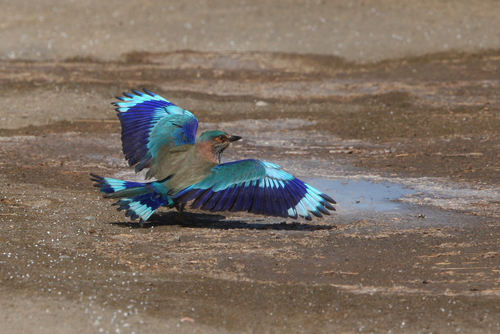 インドブッポウソウ
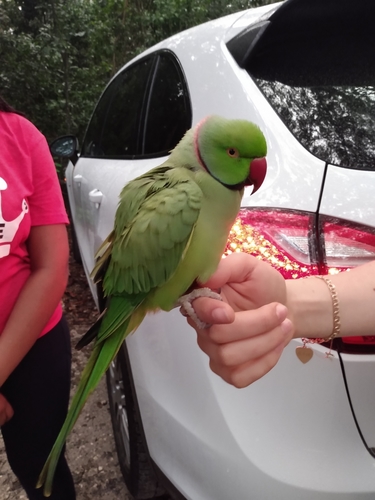 ホンセイインコ
要点
The most reliable field mark to separate Indian Roller from Ring-necked Parakeet is overall structure and coloration: the Roller is a bulky, broad-winged bird with a short tail and a striking mix of browns and blues, while the Parakeet is slender, long-tailed, and bright green with a red bill. In flight, the Roller shows vibrant blue and purple wing and tail patches, especially on the underwing, whereas the Parakeet remains green with blue in the tail and no contrasting wing patches. Juvenile Rollers are duller and browner but never green, while juvenile Parakeets are always green and lack the adult male's neck ring. Bill color is also a giveaway: Rollers have a dark or brownish bill, Parakeets always have a red bill. Both species are common in open country but have very different flight styles and silhouettes.
識別のコツ
- Structure: Indian Roller is bulky, broad-winged, and short-tailed; Parakeet is slender, long-tailed, and slim-bodied. This is obvious both perched and in flight.
- Bill color: Roller has a dark or brownish bill; Parakeet always has a red bill (all ages).
- Overall color: Roller is brown and blue with pinkish face/throat; Parakeet is bright green overall with blue in the tail.
- Tail: Roller’s tail is short and square-tipped with blue and purple; Parakeet’s tail is long, pointed, and blue-tinged, making up nearly half its length.
- Wing pattern in flight: Roller shows vibrant blue and purple patches and pale blue bands on the wings and tail, especially on the underwing; Parakeet’s wings are green above and below, lacking any contrasting blue or purple panels.
- Juvenile plumage: Juvenile Rollers are duller, browner, and never green; juvenile Parakeets are green and lack the adult male’s neck ring, but always have a red bill.
- Sexual dimorphism: Parakeet adult males have a clear pink and black neck ring; females and immatures lack this or show only a faint shadow. Roller shows no sexual dimorphism.
- Perching behavior: Roller perches upright on wires or posts, often alone or in pairs; Parakeet is usually in flocks, perching or feeding in trees.
- Flight style: Roller’s flight is strong, direct, and heavy with broad wings; Parakeet’s flight is swift, undulating, and graceful with long tail trailing.
- Vocalizations: Roller gives harsh, crow-like calls; Parakeet is much noisier, with loud, screeching, parrot-like calls.
- Habitat context: Both can be found in open country, but Parakeet is more likely in urban parks and gardens, often in groups; Roller is more solitary and favors exposed perches in open areas.
- Iris color: Roller has grey-brown iris; Parakeet’s eye color is less distinctive in the field but not brown.
- Leg color: Roller has yellow-brown legs and feet; Parakeet’s legs are greyish, but this is rarely diagnostic at distance.
- Confusion risk: Distant or backlit views may make Rollers appear all-dark or Parakeets less green, but tail length and bill color remain reliable.
- Season: No significant seasonal change in either species’ adult plumage; juvenile and immature marks are most useful for separating young birds.
大きさ
Indian Roller is shorter overall (30–34 cm) but heavier and bulkier (166–176 g), with a broad body, short neck, and relatively short tail. Ring-necked Parakeet is longer (37–43 cm), but much of this is tail; it is lighter (104–143 g in Asian birds), with a slender build and a long, pointed tail. In the field, the Roller appears stocky and robust, while the Parakeet is slim and elongated, especially when perched or in flight.
羽色
- Juvenile/Immature: Juvenile Indian Rollers are duller and browner than adults, with a greenish crown and blue-tinged belly, but never green overall. Juvenile Parakeets are bright green, lacking the adult male's neck ring, and have a red bill. No blue or purple wing/tail patches as in Roller.
- Adult: Adult Indian Rollers have a complex mix of brown, turquoise, and blue, with pinkish face/throat, brown head/back, and vibrant blue and purple on wings and tail (especially in flight). The underwing is pale blue. The Parakeet is uniformly green with a blue tail, red bill, and (in adult males) a pink and black neck ring. Females and immatures lack the neck ring or show only a faint shadow. Parakeet wings are green above and below, lacking the Roller’s blue/purple panels.
- Flight: Roller’s blue and purple wing/tail patches are most obvious in flight, with pale blue bands across the primaries and underwing coverts. Parakeet shows green wings and body, blue in the tail, and no wing pattern.
行動
Indian Rollers are often seen perched upright on exposed wires or posts, scanning for prey, and perform dramatic aerial displays with rolling and diving flights during courtship. Their flight is strong, direct, and somewhat heavy, with broad, rounded wings. Parakeets are gregarious, often in noisy flocks, and fly with rapid, shallow wingbeats and long, pointed tails trailing behind. They feed in trees or on crops, and their flight is swift and undulating, with a more graceful, parrot-like jizz compared to the Roller’s crow-like robustness.
生息環境
Both species occur in open country, farmland, and urban edges in South Asia, but the Roller is more often seen alone or in pairs on exposed perches, while the Parakeet is usually in groups and is a familiar bird in city parks, gardens, and plantations. Parakeets are more likely to be seen feeding in trees or flying in flocks, while Rollers are solitary or paired and favor open perches for hunting.
声
Indian Roller gives harsh, repeated, crow-like calls, especially during display flights. The call is described as a harsh 'rak rak rak.' Ring-necked Parakeet is much noisier, with loud, screeching, squawking calls that are higher-pitched and more piercing than the Roller’s. Parakeet calls are unmistakably parrot-like and often heard from flocks in flight or feeding.