

インドコウライウグイス 対 コウライウグイス
Oriolus kundoo 対 Oriolus chinensis
インドコウライウグイスとコウライウグイスのクイズ
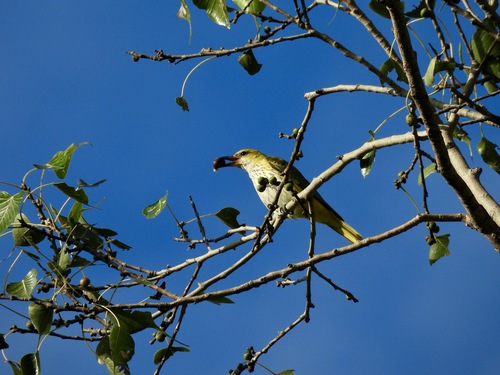 インドコウライウグイス
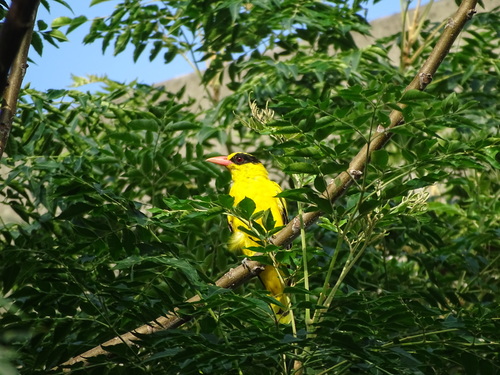 コウライウグイス
要点
The most reliable field mark to separate Indian Golden Oriole from Black-naped Oriole is the pattern of the black eye-stripe: Indian Golden Oriole has a narrow stripe that extends just behind the eye, while Black-naped Oriole's black stripe is much broader, widening and connecting across the nape. In adult males, this difference is striking even at a distance. Females and immatures are trickier, but Indian Golden Oriole females show sharper streaking below and more yellow in the tail, while Black-naped Oriole females are greener above and have a broader black mask. Juvenile and immature birds of both species are streaked below, but subtle differences in wing and tail pattern can help. Both species are similar in size and shape, but Black-naped Oriole is typically a bit heavier. Habitat overlap is possible, but Black-naped Oriole is more widespread in Southeast Asia, while Indian Golden Oriole is more restricted to the Indian subcontinent and Central Asia.
識別のコツ
- Black Stripe Pattern: The single best mark is the black facial stripe. Indian Golden Oriole has a narrow eye-stripe that extends just behind the eye; Black-naped Oriole's black mask is much broader, widening and joining across the nape to form a 'black nape.' This is most obvious in adult males but also visible in females and some immatures.
- Tail Color: Indian Golden Oriole has more yellow in the tail overall, especially noticeable in flight. Black-naped Oriole's central tail feathers are tipped yellow, but the lateral ones are more broadly yellow; the difference is subtle but can help when seen well.
- Bill Color: Black-naped Oriole has a strong pinkish bill, while Indian Golden Oriole's bill is paler red. This is a supporting mark and best used at close range.
- Female/Immature Streaking: Female and immature Indian Golden Orioles have sharper, more distinct streaks on the underparts than Black-naped Oriole. Juvenile Black-naped Orioles are dull greenish with brown streaks, yellowish head and nape, and yellow undertail coverts.
- Mantle and Back Color (Females): Female Black-naped Oriole is more greenish or olive on the mantle and tail, while Indian Golden Oriole females are yellower above.
- Wing Pattern: Indian Golden Oriole (all ages) has a large carpal patch and wide yellow tips to the secondaries and tertiaries, which can show as a yellow panel in the wing, especially in flight. Black-naped Oriole's wing pattern is more variable, with yellow spots on the secondaries in northern birds but not in southern populations.
- Eye Color: Indian Golden Oriole has a paler red iris; this is subtle and rarely diagnostic in the field.
- Flight Jizz: Both species have a strong, dipping flight, so this is not a reliable separator.
- Habitat and Range: In the Indian subcontinent, Indian Golden Oriole is more widespread, while Black-naped Oriole is more likely in the northeast and peninsular India during winter. Black-naped Oriole is much more widespread in Southeast Asia.
- Subspecies Confusion: Some Black-naped Oriole subspecies (e.g., Andaman, Nicobar) have all-black wings or a very broad nape band, but these are unlikely to overlap with Indian Golden Oriole.
- Size: Black-naped Oriole is slightly heavier, but this is not a practical field mark.
- Voice: Both have fluty, melodious songs and nasal calls; voice is not a reliable separator unless highly familiar with both.
- Seasonal Overlap: In winter, Black-naped Oriole may appear in parts of India where Indian Golden Oriole is resident; check facial pattern and wing/tail color carefully.
- Pitfalls: Immature birds of both species are streaked below; rely on facial pattern, mantle color, and wing/tail markings rather than underpart streaking alone.
- Context: If seen in Southeast Asia (outside India), Black-naped Oriole is far more likely; in most of India, Indian Golden Oriole is the default except in the northeast or during winter influxes.
大きさ
Both species are medium-sized orioles with similar overall proportions. The Black-naped Oriole is slightly heavier on average (body mass about 82 g [wikidata]), but this is not easily judged in the field. Indian Golden Oriole may be marginally smaller, with a shorter wing length in adult males (136–144 mm for Indian Golden Oriole vs. the larger Eurasian Golden Oriole; Black-naped Oriole's wing length is not specified here but is likely similar to or slightly larger than Indian Golden Oriole). Bill size and shape are similar, though Black-naped Oriole's bill is described as 'strong pinkish.'
羽色
-
Juvenile/Immature: Both species have streaked underparts as juveniles, but Indian Golden Oriole females and immatures show sharper streaks below than Black-naped Oriole. Juvenile Black-naped Oriole is described as dull greenish with brown streaks, yellowish head and nape, and yellow undertail coverts. Wing pattern differences are subtle; Indian Golden Oriole has wide yellow tips to the secondaries and tertiaries, which may be more prominent in flight, while Black-naped Oriole's northern populations can show yellow spots on the tips of the secondaries, but southern populations lack these.
-
Adult Male: Indian Golden Oriole male has a narrow black eye-stripe that extends just behind the eye, a large carpal patch on the wing, and more yellow in the tail. The iris and bill are a paler red. Black-naped Oriole male has a broad black mask that widens and joins across the nape, a strong pinkish bill, and the central tail feathers tipped yellow with lateral ones more broadly yellow. The back is more golden overall.
-
Adult Female: Indian Golden Oriole female is similar to the male but duller, with sharper streaks below and more yellow in the tail. Black-naped Oriole female is greener or more olive on the mantle and tail, with a broad black mask and less prominent yellow on the wings and tail. Southern Black-naped Oriole females are especially greenish and lack yellow spots on the secondaries.
-
Subspecies Variation: Black-naped Oriole shows considerable variation across its range, with some island forms having all-black wings or a very broad nape band, but these are unlikely to overlap with Indian Golden Oriole.
行動
Both species have a strong, dipping flight and are often seen moving between trees in open woodland, parks, or gardens. Indian Golden Oriole has been recorded bathing by flying into pools, while Black-naped Oriole is noted for feeding on large flowers and sometimes preying on smaller birds' nests. Both species are partial migrants, with some populations resident and others migratory. Their nesting behavior is similar, often building nests near black drongos and defending them from predators.
生息環境
Indian Golden Oriole is found in the Indian subcontinent and Central Asia, favoring open deciduous forests, semi-evergreen forests, woodland, forest edge, mangroves, open country with scattered trees, parks, gardens, orchards, and plantations. Black-naped Oriole is more widespread across Asia, including India, Southeast Asia, and many islands. It occupies similar habitats but is especially common in Southeast Asia, including gardens and urban parks. In India, Black-naped Oriole is more likely in the northeast and peninsular regions in winter, while Indian Golden Oriole is more widespread in the subcontinent.
声
Both species have fluty, melodious songs and nasal calls, but the notes do not provide a clear, field-diagnostic difference between their vocalizations. Black-naped Oriole's usual call is described as a nasal 'niee' or 'myaa,' and its song as a fluty 'iwee wee wee-leeow.' Calls of some Black-naped Oriole subspecies differ, but these are not likely to be confused with Indian Golden Oriole in most of their overlapping range.
インドコウライウグイス · コウライウグイス · 苦手な鳥