

ハイイロガン 対 オカヨシガモ
Anser anser 対 Mareca strepera
ハイイロガンとオカヨシガモのクイズ
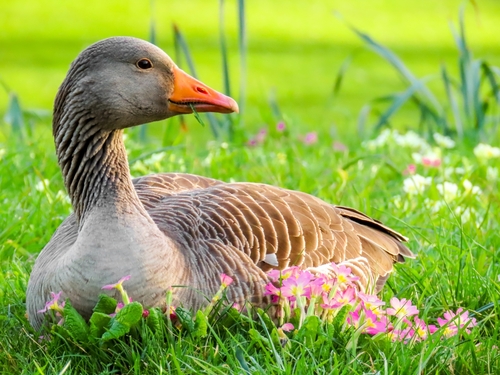 ハイイロガン
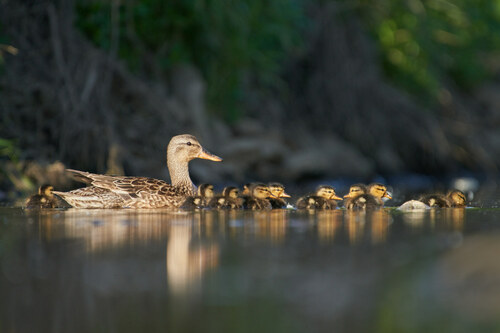 オカヨシガモ
要点
The most reliable way to separate Greylag Goose from Gadwall is by size and structure: Greylag is a massive, heavy-bodied goose with a thick orange bill and pink legs, while Gadwall is a medium-sized duck with a much slimmer profile, shorter neck, and a dark bill (female with orange edges). In flight, Greylag shows pale grey forewings and rump with a white flank line, while Gadwall of all ages displays a crisp white wing speculum, often visible at rest or in flight. Juvenile Greylags lack black belly spots and have greyish legs, but still dwarf any Gadwall. If seen on water, Greylag's bulk and upright posture contrast with Gadwall's lower, sleeker carriage. Voice is also a clue: Greylag's loud cackling is nothing like the soft quacks and grunts of Gadwall.
識別のコツ
- Size is the quickest check: Greylag Goose is much larger and heavier than any Gadwall, even at a distance or among mixed flocks.
- Bill color and shape: Greylag has a thick, blunt orange bill; Gadwall has a slimmer, dark bill (female with orange edges). This is visible even at moderate range.
- Leg color: Greylag's legs are pink (greyish in juveniles), while Gadwall's are duller and never pink.
- Neck length and posture: Greylag has a long, thick neck, often held upright, with a 'concertina' pattern of feather folds in adults. Gadwall's neck is shorter and slimmer, and it sits lower on the water.
- Wing pattern in flight: Greylag shows pale grey forewings and rump, with a white line along the upper flanks; Gadwall always shows a crisp white speculum, often with chestnut wing patches in males. This is diagnostic for all ages.
- Juvenile marks: Juvenile Greylags lack black belly spots and have greyish legs but still show the pale forewing and white flank line; juvenile Gadwalls look like duller females but always have the white speculum.
- Body pattern: Adult Greylag is mottled and barred grey and white, with a paler breast and variable black spotting on the belly. Gadwall males are finely patterned grey with a black rear, females are mottled brown with a white belly.
- Flight silhouette: Greylag is heavy, with broad wings and slow, deep wingbeats; Gadwall is more compact and agile, with quicker wingbeats.
- On land vs water: Greylag is often seen grazing on land; Gadwall is almost always on water or at the edge.
- Vocalizations: Greylag's loud cackling is very different from Gadwall's quiet quacks and grunts.
- Habitat context: If you see a large goose in a field, it's almost certainly a Greylag; Gadwall rarely leaves the water.
- Sex differences: Male Gadwall in breeding plumage is grey with a black rear and chestnut wing patches; female Gadwall is brown with a white belly and orange-edged bill. Greylag sexes are similar, with only subtle differences.
- Eclipse plumage: Male Gadwall in eclipse looks like the female but keeps the white speculum; Greylag does not have a comparable eclipse plumage.
- Group behavior: Greylag forms larger, noisier flocks, especially outside breeding season; Gadwall is less gregarious.
- Potential pitfalls: Distant views of a lone Gadwall may seem larger, but the bill, wing pattern, and posture will always separate them from Greylag.
大きさ
Greylag Goose is much larger and heavier than Gadwall. Greylag averages about 3465g in body mass and measures 74–91 cm in length, making it one of the largest wild geese. Gadwall is a medium-sized duck, with males averaging around 990g and females 850g, and a length of 47–58 cm. Even a juvenile Greylag is more than three times the mass of an adult Gadwall. In the field, Greylag's size is unmistakable when both species are present, and its long neck and bulky body stand out against the more compact, short-necked Gadwall.
羽色
Juvenile Greylag Geese are greyish brown overall, lacking the black belly spots of adults, and have greyish legs, but still show the pale grey forewing and rump in flight, plus a white line along the upper flanks. Their wing coverts are light, contrasting with darker flight feathers. Gadwall of all ages and sexes shows a distinctive white speculum on the wing, which is especially obvious in flight but can also be seen at rest. Adult male Gadwall in breeding plumage is finely patterned grey with a black rear and chestnut wing patches, while females are mottled brown, similar to female Mallards but with a white belly and orange-edged dark bill. Neither sex of Gadwall shows the pale grey forewing or the concertina neck feathering of Greylag. In eclipse (non-breeding) plumage, male Gadwall resembles the female but retains the white speculum. Greylag adults have an orange bill and pink legs, while Gadwall bills are dark (female with orange edges) and legs are duller. The Greylag's pale rump and white flank line are visible in flight, contrasting with Gadwall's more uniform back and the sharp white wing patch.
行動
Greylag Goose is typically seen in pairs or family groups, often grazing on land or swimming in open water, and is generally more conspicuous and bold. It stands upright and moves with a heavy, waddling gait. Gadwall is less gregarious than some ducks, often in small flocks, and tends to feed by dabbling or diving for plant material, sometimes stealing food from coots. Gadwall sits lower on the water and is less likely to be seen grazing on land. In flight, Greylag is powerful and direct, with slow, deep wingbeats, while Gadwall is quicker and more agile, with shallower wingbeats.
生息環境
Greylag Goose favors open wetlands, lakes, and marshes, often with adjacent grassland or agricultural fields for grazing. It is more likely to be seen on land, especially in flocks feeding in fields. Gadwall also prefers open wetlands and marshes with dense fringing vegetation but is less likely to venture far from water and rarely grazes on land. Both species can overlap in large wetland reserves, but Greylag is more terrestrial in its habits.
声
Greylag Goose is loud and vocal, with a distinctive cackling call ('aahng-ung-ung') that can be heard both on the ground and in flight. The sound of a flock is reminiscent of baying hounds. Gadwall is much quieter; the female gives a high-pitched quack, while the male utters a soft grunt ('mep') and a whistle, mostly during courtship. The two species' vocalizations are not likely to be confused.