

ハイイロヒレアシシギ 対 ユリカモメ
Phalaropus fulicarius 対 Chroicocephalus ridibundus
ハイイロヒレアシシギとユリカモメのクイズ
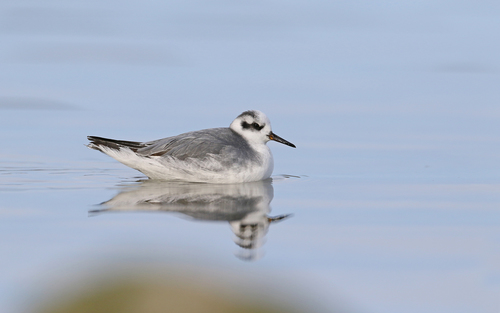 ハイイロヒレアシシギ
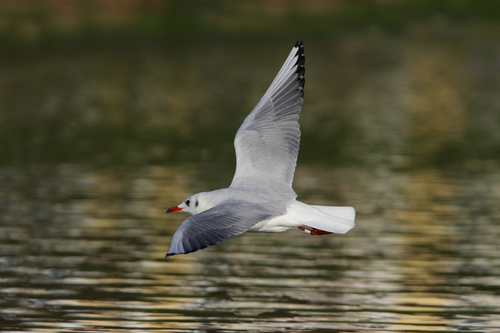 ユリカモメ
要点
The most reliable field mark to separate Grey Phalarope (Red Phalarope) from Black-headed Gull is overall structure and size: Grey Phalarope is much smaller, with a short, straight, and relatively thick bill, and is often seen swimming daintily, sometimes spinning in circles, while Black-headed Gull is a medium-sized gull with a longer, thinner bill and longer wings. In flight, juvenile and first-winter Black-headed Gulls show a distinctive black tail band and a brown carpal bar on the upperwing, which Grey Phalarope never shows at any age. Adult Black-headed Gulls in summer have a dark brown hood, while Grey Phalarope in breeding plumage is brick red below with a white face. In winter, Grey Phalarope is pale grey and white with a black eyepatch, while Black-headed Gull loses its hood but retains two dark spots on the head. Habitat and behavior also help: Grey Phalarope is often seen swimming on water, even at sea, while Black-headed Gull is rarely far from land and is usually seen standing or flying with other gulls.
識別のコツ
- Size and Structure: Black-headed Gull is much larger and longer-winged than Grey Phalarope. If seen together, the size difference is obvious; if alone, look for the compact, dumpy shape of the phalarope versus the elongated, graceful gull.
- Bill Shape: Grey Phalarope has a short, straight, and relatively thick bill (yellow with black tip in breeding, all black in winter); Black-headed Gull has a longer, thinner, red bill in adults.
- Leg Color: Black-headed Gull adults have red legs; Grey Phalarope legs are not as brightly colored and are less noticeable in the field.
- Juvenile/First-winter Flight Pattern: Juvenile and first-winter Black-headed Gulls show a dark carpal bar (across the bend of the wing) and a black tail band—Grey Phalarope never shows these features at any age.
- Adult Summer Head Pattern: Black-headed Gull has a full chocolate-brown hood (not truly black) in summer; Grey Phalarope has a white face with a dark cheek patch and brick-red underparts (breeding female).
- Adult Winter Head Pattern: Black-headed Gull loses its hood in winter, showing a white head with two dark spots behind the eye; Grey Phalarope always shows a black eyepatch on a white face.
- Underparts: In breeding season, Grey Phalarope is strikingly red below; Black-headed Gull is always white below.
- Upperwing in Flight: Black-headed Gull (all ages) shows a white leading edge to the outer wing; Grey Phalarope has plain grey and white wings without strong contrast.
- Tail Pattern: Black-headed Gull juveniles/first-winter have a strong black tail band; Grey Phalarope has plain white tail in all plumages.
- Behavior: Grey Phalarope often swims and spins in circles; Black-headed Gull rarely swims for long and never spins in this way.
- Habitat: Grey Phalarope is most often seen on water, sometimes at sea; Black-headed Gull is rarely far from land and often stands on the ground or perches.
- Flock Size: Black-headed Gull is usually in large flocks; Grey Phalarope is typically solitary or in small groups when seen inland.
- Approachability: Grey Phalarope is often very tame and approachable; Black-headed Gull is wary but can be confiding in urban areas.
- Voice: Grey Phalarope gives a short 'beek' call; Black-headed Gull has a range of typical gull calls, often more raucous.
- Seasonal Pitfalls: In winter, both species are pale-headed, but only Grey Phalarope keeps a black eyepatch; beware of distant Black-headed Gulls with faint head spots, but note the larger size and longer wings.
大きさ
Black-headed Gull is substantially larger than Grey Phalarope. Black-headed Gull measures 34–39 cm in length with a wingspan of 100–110 cm and an average adult mass of about 280 g [wikidata], while Grey Phalarope is much smaller at about 21 cm in length (no mass given, but much lighter and more compact) [wikipedia]. In the field, Black-headed Gull looks like a typical medium-sized gull, whereas Grey Phalarope is a small, dumpy, wader-like bird, closer in size and jizz to a small sandpiper than any gull.
羽色
- Juvenile/First-winter: Black-headed Gull juveniles have a brown mottled pattern on the upperparts, a distinct black tail band, and a brown carpal bar on the inner wing, which is retained into first-winter plumage. Grey Phalarope juveniles are light grey and brown above with buff underparts and a dark eye-stripe, but lack the black tail band and carpal bar.
- Adult summer: Black-headed Gull has a chocolate-brown hood, white underparts, pale grey upperwings with black wingtips, and red bill and legs. Grey Phalarope breeding females are dark above, with bright red underparts and white cheek patches; males are duller but still reddish below.
- Adult winter: Black-headed Gull loses its hood, showing white head with two dark spots behind the eye; upperparts remain pale grey, underparts white. Grey Phalarope becomes pale grey above, white below, but always shows a black eyepatch and a black bill.
- In flight: Black-headed Gull (all ages) shows a white leading edge to the outer wing and, in juveniles/first-winter, a dark carpal bar and black tail band. Grey Phalarope in all plumages has plain grey and white wings, lacking any strong carpal bar or tail band.
行動
Grey Phalarope is often seen swimming, sometimes spinning rapidly in tight circles to stir up food—a unique feeding behavior among waders. It is very tame and approachable, often found in small flocks, especially at sea. Black-headed Gull is a typical gull: often seen standing on the ground, loafing in flocks, or flying with slow, deep wingbeats. It is highly gregarious, especially outside the breeding season, and rarely swims in tight circles like a phalarope. Black-headed Gull is not pelagic and is seldom seen far from land, while Grey Phalarope is often found far offshore during migration and winter.
生息環境
Grey Phalarope breeds in Arctic tundra regions and is highly migratory, wintering at sea on tropical oceans. It is most often encountered away from land during migration or after storms, sometimes appearing on inland lakes or coastal waters. Black-headed Gull breeds in colonies in marshes, reedbeds, or islands in lakes across Europe and Asia, and winters in milder coastal and inland areas, rarely far from land. In winter, Black-headed Gull is abundant on lakes, rivers, and coasts, often in large flocks, while Grey Phalarope is rare and usually solitary or in small groups when seen inland.
声
Grey Phalarope gives a short, sharp 'beek' call. Black-headed Gull has a variety of typical gull calls, often higher-pitched and more varied than the phalarope's simple call. In the field, vocalizations are rarely the main separation point, but the gull's calls are more raucous and frequent.
ハイイロヒレアシシギ · ユリカモメ · 苦手な鳥