

Motmot

ハイイロヤケイ 対 ベンガルショウノガン

Gallus sonneratii 対 Houbaropsis bengalensis

ハイイロヤケイとベンガルショウノガンのクイズ
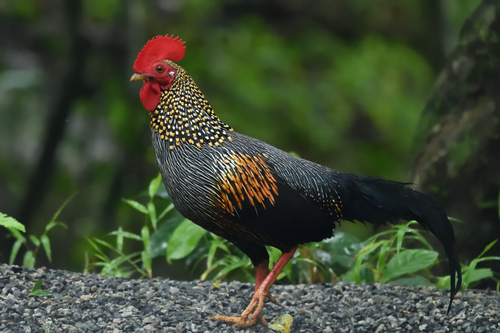
ハイイロヤケイ (Gallus sonneratii) ハイイロヤケイ
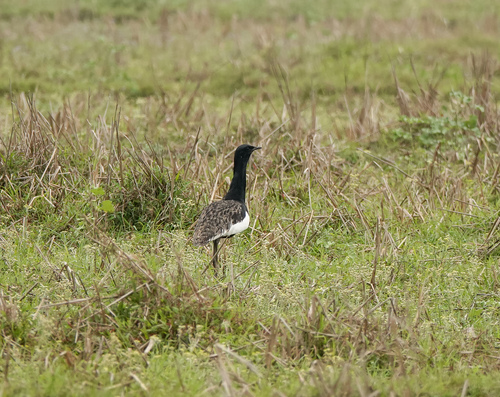
ベンガルショウノガン (Houbaropsis bengalensis) ベンガルショウノガン

メディア

読み込み中…

要点

The most reliable field mark between Grey Junglefowl and Bengal Florican is the striking white wing patch of the male Bengal Florican, which appears as a broad white panel in flight—completely absent in Grey Junglefowl of any age or sex. Juvenile and female Bengal Floricans lack the bold white, but still show a buff-brown, streaked appearance, while Grey Junglefowl females are more heavily streaked below and have yellow legs. Structurally, Bengal Florican is a tall, upright bustard with a long neck and legs, much larger and lankier than the chicken-like, short-legged Grey Junglefowl. In the field, habitat and behavior also help: Bengal Florican prefers open tall grasslands and is extremely rare, while Grey Junglefowl is a forest-edge ground bird, often in groups. Vocalizations differ sharply, with the junglefowl giving loud, chicken-like calls and the florican mostly silent except for metallic 'chik-chik-chik' when flushed.

識別のコツ

  1. Male Bengal Florican in flight shows a broad, pure white wing patch (coverts to remiges), contrasting with black body—never seen in Grey Junglefowl of any age or sex.
  2. Female and immature Bengal Florican are buff-brown above with fine streaking and barring, and underparts are pale with minimal streaking; female Grey Junglefowl is more heavily streaked below and has yellow legs.
  3. Grey Junglefowl males have a black cape with ochre spots, finely patterned grey body, and unique neck hackles ending in yellowish plates—these hackles are absent in florican.
  4. Grey Junglefowl males have red wattles and combs (less developed than Red Junglefowl); Bengal Florican has no comb or wattles.
  5. Leg color: Grey Junglefowl males have red legs with spurs; females have yellow legs, usually without spurs. Bengal Florican has yellow legs in both sexes, no spurs.
  6. Structure: Bengal Florican is tall, upright, long-necked and long-legged, with a bustard-like jizz; Grey Junglefowl is compact, chicken-shaped, with a low stance and short legs.
  7. Tail: Grey Junglefowl males have long, sickle-shaped central tail feathers; Bengal Florican has a short, straight tail.
  8. Size: Bengal Florican is nearly twice as heavy as Grey Junglefowl and stands much taller.
  9. Behavior: Grey Junglefowl is usually in small groups, forages on ground, and flies up to trees to roost; Bengal Florican is solitary or in pairs, stands motionless in grass, and flushes with strong, level flight.
  10. Habitat: Grey Junglefowl prefers forest edge, scrub, and wooded foothills; Bengal Florican is restricted to open tall grasslands.
  11. Voice: Loud, chicken-like calls indicate Grey Junglefowl; florican is mostly silent, but may give a metallic 'chik-chik-chik' when flushed.
  12. Season: Male Bengal Florican is most conspicuous in breeding season (March–August) due to display and white wings; Grey Junglefowl males may be duller in eclipse plumage after breeding (summer).
  13. If you see a bird with a black head, neck, and underparts, and a long crest, it is a male Bengal Florican; junglefowl never shows this combination.
  14. If seen in dense forest or near villages, it is almost certainly Grey Junglefowl; in open, treeless grassland, Bengal Florican is possible but extremely rare.
  15. Juvenile Bengal Florican can be confused with female junglefowl, but note the less streaked underparts and more uniform buff coloration, and check for habitat and structure clues.

大きさ

Bengal Florican is much larger and heavier than Grey Junglefowl, with an average adult mass of about 1725 g versus 857.5 g for the junglefowl [wikidata]. Florican stands taller (up to 55 cm at the shoulder, 66–68 cm in length), with a long neck and legs, giving a lanky, bustard-like profile. Grey Junglefowl is more compact and chicken-shaped, with a lower stance and shorter legs. In direct comparison, the florican is nearly twice the mass and appears far more elongated and upright.

羽色

The most diagnostic plumage difference is in adult males: Bengal Florican males have a jet-black head, neck, and underparts, with a long crest and elongated neck plumes, and a conspicuous white patch from the wing coverts to the remiges. In flight, the male's wings look almost entirely white except for dark primary tips—this bold white is never shown by Grey Junglefowl of any age or sex. Female and immature Bengal Floricans are buff-brown above with fine streaking and barring, lacking the male's black and white contrast but still paler and less patterned below than female Grey Junglefowl, which show heavy black and white streaking on the underparts and yellow legs. Grey Junglefowl males have a finely patterned grey body, black cape with ochre spots, and unique neck hackles ending in yellowish plates; their wings are never boldly white in flight. Both sexes of Grey Junglefowl have red or yellow legs (red in males, yellow in females), while Bengal Florican legs are yellow in both sexes. Juvenile Bengal Florican resembles the female, so beware confusion with female junglefowl, but note the less streaked underparts and more uniform buff coloration.

行動

Grey Junglefowl is typically seen foraging on the ground in small groups, often near forest edges or in clearings, and quickly flies up to trees to roost or escape danger. Their flight is brief and direct, with rounded wings and a short, arched trajectory. Bengal Florican is usually solitary or in pairs, standing upright and motionless in tall grass, and is more likely to flush with a strong, level flight showing the white wings. Floricans are most conspicuous during the breeding season (March–August), when males perform elaborate displays in open grassland. Junglefowl are more approachable and often seen in groups, while floricans are wary and rarely seen except when flushed.

生息環境

Habitat is a strong separator: Grey Junglefowl is a forest-edge and scrub bird, found in wooded foothills and open forest with nearby cover, often near villages or cultivated areas. Bengal Florican is strictly a bird of open tall grasslands, especially those dominated by Imperata, Saccharum, or Tripidium grasses, and avoids dense forest. Florican is now extremely rare and local, mostly in protected grassland reserves, while Grey Junglefowl is relatively common in its range. If seen in tall, treeless grassland, Bengal Florican is far more likely; in forest or scrub, Grey Junglefowl is expected.

声

Grey Junglefowl gives loud, distinctive 'Ku-kayak-kyuk-kyuk' calls, especially at dawn and dusk, and does not precede the call with wing-flapping (unlike Red Junglefowl). Bengal Florican is mostly silent, but when flushed gives a metallic 'chik-chik-chik' call; displaying males produce croaks and a deep humming sound. If you hear a loud, chicken-like call, it is Grey Junglefowl; florican is unlikely to vocalize unless disturbed.

より良い説明を送る

比較と同じ項目を使ってください。文章はすぐに公開されます。

The most reliable field mark between Grey Junglefowl and Bengal Florican is the striking white wing patch of the male Bengal Florican, which appears as a broad white panel in flight—completely absent in Grey Junglefowl of any age or sex. Juvenile and female Bengal Floricans lack the bold white, but still show a buff-brown, streaked appearance, while Grey Junglefowl females are more heavily streaked below and have yellow legs. Structurally, Bengal Florican is a tall, upright bustard with a long neck and legs, much larger and lankier than the chicken-like, short-legged Grey Junglefowl. In the field, habitat and behavior also help: Bengal Florican prefers open tall grasslands and is extremely rare, while Grey Junglefowl is a forest-edge ground bird, often in groups. Vocalizations differ sharply, with the junglefowl giving loud, chicken-like calls and the florican mostly silent except for metallic 'chik-chik-chik' when flushed.

  1. Male Bengal Florican in flight shows a broad, pure white wing patch (coverts to remiges), contrasting with black body—never seen in Grey Junglefowl of any age or sex.
  2. Female and immature Bengal Florican are buff-brown above with fine streaking and barring, and underparts are pale with minimal streaking; female Grey Junglefowl is more heavily streaked below and has yellow legs.
  3. Grey Junglefowl males have a black cape with ochre spots, finely patterned grey body, and unique neck hackles ending in yellowish plates—these hackles are absent in florican.
  4. Grey Junglefowl males have red wattles and combs (less developed than Red Junglefowl); Bengal Florican has no comb or wattles.
  5. Leg color: Grey Junglefowl males have red legs with spurs; females have yellow legs, usually without spurs. Bengal Florican has yellow legs in both sexes, no spurs.
  6. Structure: Bengal Florican is tall, upright, long-necked and long-legged, with a bustard-like jizz; Grey Junglefowl is compact, chicken-shaped, with a low stance and short legs.
  7. Tail: Grey Junglefowl males have long, sickle-shaped central tail feathers; Bengal Florican has a short, straight tail.
  8. Size: Bengal Florican is nearly twice as heavy as Grey Junglefowl and stands much taller.
  9. Behavior: Grey Junglefowl is usually in small groups, forages on ground, and flies up to trees to roost; Bengal Florican is solitary or in pairs, stands motionless in grass, and flushes with strong, level flight.
  10. Habitat: Grey Junglefowl prefers forest edge, scrub, and wooded foothills; Bengal Florican is restricted to open tall grasslands.
  11. Voice: Loud, chicken-like calls indicate Grey Junglefowl; florican is mostly silent, but may give a metallic 'chik-chik-chik' when flushed.
  12. Season: Male Bengal Florican is most conspicuous in breeding season (March–August) due to display and white wings; Grey Junglefowl males may be duller in eclipse plumage after breeding (summer).
  13. If you see a bird with a black head, neck, and underparts, and a long crest, it is a male Bengal Florican; junglefowl never shows this combination.
  14. If seen in dense forest or near villages, it is almost certainly Grey Junglefowl; in open, treeless grassland, Bengal Florican is possible but extremely rare.
  15. Juvenile Bengal Florican can be confused with female junglefowl, but note the less streaked underparts and more uniform buff coloration, and check for habitat and structure clues.

Bengal Florican is much larger and heavier than Grey Junglefowl, with an average adult mass of about 1725 g versus 857.5 g for the junglefowl [wikidata]. Florican stands taller (up to 55 cm at the shoulder, 66–68 cm in length), with a long neck and legs, giving a lanky, bustard-like profile. Grey Junglefowl is more compact and chicken-shaped, with a lower stance and shorter legs. In direct comparison, the florican is nearly twice the mass and appears far more elongated and upright.

The most diagnostic plumage difference is in adult males: Bengal Florican males have a jet-black head, neck, and underparts, with a long crest and elongated neck plumes, and a conspicuous white patch from the wing coverts to the remiges. In flight, the male's wings look almost entirely white except for dark primary tips—this bold white is never shown by Grey Junglefowl of any age or sex. Female and immature Bengal Floricans are buff-brown above with fine streaking and barring, lacking the male's black and white contrast but still paler and less patterned below than female Grey Junglefowl, which show heavy black and white streaking on the underparts and yellow legs. Grey Junglefowl males have a finely patterned grey body, black cape with ochre spots, and unique neck hackles ending in yellowish plates; their wings are never boldly white in flight. Both sexes of Grey Junglefowl have red or yellow legs (red in males, yellow in females), while Bengal Florican legs are yellow in both sexes. Juvenile Bengal Florican resembles the female, so beware confusion with female junglefowl, but note the less streaked underparts and more uniform buff coloration.

Grey Junglefowl is typically seen foraging on the ground in small groups, often near forest edges or in clearings, and quickly flies up to trees to roost or escape danger. Their flight is brief and direct, with rounded wings and a short, arched trajectory. Bengal Florican is usually solitary or in pairs, standing upright and motionless in tall grass, and is more likely to flush with a strong, level flight showing the white wings. Floricans are most conspicuous during the breeding season (March–August), when males perform elaborate displays in open grassland. Junglefowl are more approachable and often seen in groups, while floricans are wary and rarely seen except when flushed.

Habitat is a strong separator: Grey Junglefowl is a forest-edge and scrub bird, found in wooded foothills and open forest with nearby cover, often near villages or cultivated areas. Bengal Florican is strictly a bird of open tall grasslands, especially those dominated by Imperata, Saccharum, or Tripidium grasses, and avoids dense forest. Florican is now extremely rare and local, mostly in protected grassland reserves, while Grey Junglefowl is relatively common in its range. If seen in tall, treeless grassland, Bengal Florican is far more likely; in forest or scrub, Grey Junglefowl is expected.

Grey Junglefowl gives loud, distinctive 'Ku-kayak-kyuk-kyuk' calls, especially at dawn and dusk, and does not precede the call with wing-flapping (unlike Red Junglefowl). Bengal Florican is mostly silent, but when flushed gives a metallic 'chik-chik-chik' call; displaying males produce croaks and a deep humming sound. If you hear a loud, chicken-like call, it is Grey Junglefowl; florican is unlikely to vocalize unless disturbed.

変更を破棄しますか?

保存していない編集があります。今離れると失われます。

ハイイロヤケイ · ベンガルショウノガン · 苦手な鳥