

シマシャコ 対 キアシアオバト
Ortygornis pondicerianus 対 Treron phoenicopterus
シマシャコとキアシアオバトのクイズ
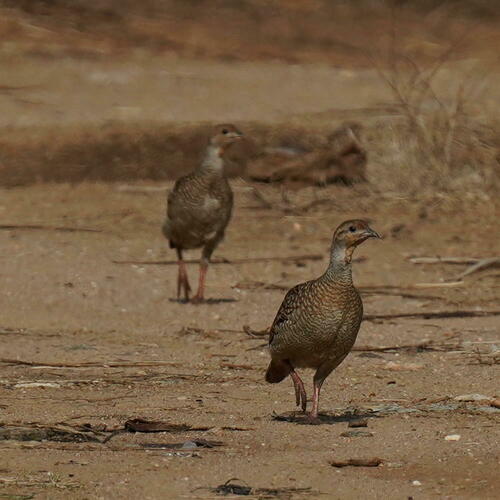 シマシャコ
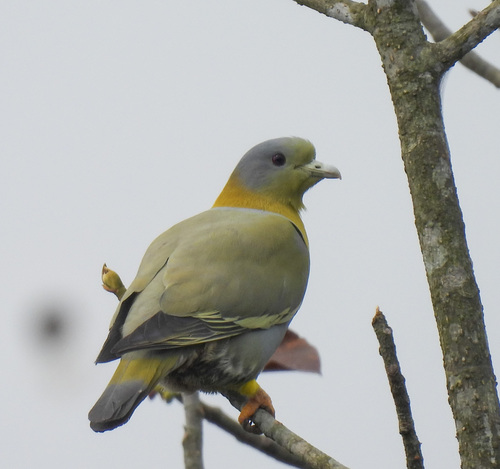 キアシアオバト
要点
The most reliable way to separate Grey Francolin from Yellow-footed Green-Pigeon is by overall shape and posture: francolins are ground-dwelling, chicken-like birds with barred brownish plumage, while green-pigeons are tree-perching, plump birds with smooth greenish and yellow tones and striking yellow legs. In flight, Grey Francolin shows a chestnut tail and dark primaries, whereas Yellow-footed Green-Pigeon appears greenish with broad, rounded wings and lacks any barring. Francolins are typically seen running on the ground or making short, weak flights; green-pigeons perch upright in trees and fly with strong, direct wingbeats. If you spot a bird with a pale face and barred body on open ground, it's a francolin; if it's greenish and perched high with yellow feet, it's a green-pigeon.
識別のコツ
- Barred vs. smooth plumage: Grey Francolin of all ages is heavily barred above and below; Yellow-footed Green-Pigeon is smooth green and yellow with no barring.
- Face pattern: Francolin has a pale face with a thin black border and pale or rufous throat; green-pigeon has a bluish-grey crown and nape, yellowish-green forehead, and no facial border.
- Leg color: Only the green-pigeon has bright yellow or orange legs and feet, visible when perched or in flight. Francolin legs are dull and not striking.
- Tail in flight: Francolin shows a chestnut tail and dark primaries in flight; green-pigeon has a greenish tail and wings, with no chestnut or strong contrast.
- Flight style: Francolin flies weakly and briefly, usually low to the ground; green-pigeon flies strongly and directly between trees.
- Perching behavior: Francolin is almost never seen perched in trees; green-pigeon is almost always perched upright on branches.
- Body shape: Francolin is long-legged, horizontal, and chicken-like; green-pigeon is plump, short-legged, and upright.
- Habitat: Francolin is in open, dry, or cultivated ground; green-pigeon is in trees, groves, or gardens.
- Group size: Francolin is usually solitary or in pairs/small groups; green-pigeon often forms larger flocks.
- Vocalization: Loud, repeated calls indicate francolin; green-pigeon is quiet.
- Bill shape: Francolin has a short, stout bill; green-pigeon has a slender, slightly hooked bill typical of fruit-eating pigeons.
- Sex/age confusion: No age or sex of green-pigeon ever shows barring or facial border; no francolin ever has yellow legs or green/yellow smooth plumage.
- Spurs: Male francolins may show leg spurs, especially if seen well on the ground; green-pigeons never have spurs.
- Context clues: If the bird is flushed from the ground, think francolin; if seen feeding on fruit in a tree, think green-pigeon.
- Pitfalls: In poor light, francolin barring may look less obvious, but the shape and behavior remain distinctive. Green-pigeons may appear duller when young, but never show barring or chicken-like posture.
大きさ
Grey Francolin is a medium-sized ground bird, with males measuring 29–34 cm and females 26–30 cm in length, and weighing 200–340 g. Yellow-footed Green-Pigeon is similar in length at about 33 cm, but is bulkier and more compact, with a plumper body and shorter legs relative to its size. Francolins look longer-legged and more horizontal, while green-pigeons are more rounded and upright. Both are similar in length, but their proportions and posture are very different.
羽色
Juvenile and adult Grey Francolins are barred throughout, with a pale face bordered by a thin black line and a pale or rufous throat depending on subspecies. In flight, all ages show a chestnut tail and dark primaries, with the barring less obvious at distance. Yellow-footed Green-Pigeon, as an adult, has smooth, unbarred plumage: greenish body, bluish-grey crown and nape, yellowish-green forehead and throat, and a broad yellow or olive-yellow collar. The legs and feet are bright yellow or orange, a unique feature. No age of green-pigeon shows barring, facial borders, or chestnut tail. Immature green-pigeons are duller but still lack any barring or facial pattern. Thus, any bird with strong barring and a pale face is a francolin; any bird with smooth green and yellow tones and yellow feet is a green-pigeon.
行動
Grey Francolins are almost always seen on the ground, running or walking in open country, and only fly briefly when flushed, quickly dropping back into cover. Their flight is weak and low. Yellow-footed Green-Pigeons are arboreal, usually seen perched upright in trees, often in groups, and fly with strong, direct wingbeats between trees. They rarely come to the ground. Francolins are solitary or in small groups, while green-pigeons can be quite social.
生息環境
Grey Francolin prefers open cultivated fields, scrub, and drier plains, rarely venturing into dense forest or urban areas. Yellow-footed Green-Pigeon is found in wooded habitats, groves, and gardens, usually where there are fruiting trees. If the bird is in open, dry ground, francolin is much more likely; if in a tree or woodland, especially feeding on fruit, it's almost certainly a green-pigeon.
声
Grey Francolin is very vocal, especially during breeding season, with a loud, repeated 'Ka-tee-tar...tee-tar' call, often given by several birds together. Yellow-footed Green-Pigeon is generally quiet, with only soft cooing or low whistles, rarely drawing attention by voice. If you hear a loud, far-carrying call, it's likely a francolin.