

ブロンズトキ 対 ヘラサギ
Plegadis falcinellus 対 Platalea leucorodia
ブロンズトキとヘラサギのクイズ
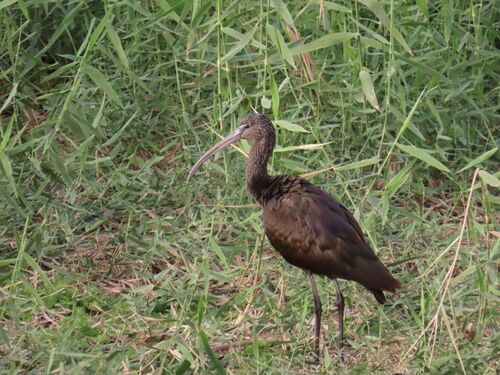 ブロンズトキ
 ヘラサギ
要点
The most reliable way to separate Glossy Ibis from Eurasian Spoonbill is by bill shape: Glossy Ibis has a long, slender, sickle-shaped bill, while Eurasian Spoonbill has a long, straight bill ending in a broad, flat spatula. In flight or at rest, Spoonbill is always white (adults and immatures), while Glossy Ibis is dark reddish-brown with iridescent wings. Juvenile Spoonbills show black tips to the primaries, but never the all-dark look of Glossy Ibis. Both species fly with necks outstretched, but their overall structure and coloration are strikingly different at all ages.
識別のコツ
- Bill shape is diagnostic: Glossy Ibis has a long, slender, strongly decurved (sickle-shaped) bill; Eurasian Spoonbill has a long, straight bill with a broad, flat spatulate tip. This is visible at all ages and distances, even in silhouette.
- Overall color: Glossy Ibis is dark reddish-brown to chocolate-brown at all ages, with iridescent wings in adults. Eurasian Spoonbill is always white (adults and immatures), never dark.
- Juvenile/immature wing pattern: Juvenile Spoonbill is white with black tips to the primaries (visible in flight), but never shows an all-dark wing. Glossy Ibis juveniles are uniformly dark with no white in the wings.
- Adult breeding plumage: Glossy Ibis shows a reddish-brown body with metallic green, bronze, or purple wing sheen, and a subtle white facial band. Spoonbill adults have a yellow breast patch, a bushy crest, and a black bill with a yellow tip.
- Non-breeding/immature plumage: Glossy Ibis becomes duller brown but remains dark; Spoonbill loses crest and breast patch but remains all white except for bill and legs.
- Leg color: Glossy Ibis has red-brown legs; Spoonbill has dark legs. This is subtle but can help at close range.
- Facial skin: Glossy Ibis has dark facial skin bordered in blue-grey (non-breeding) to cobalt blue (breeding), with a narrow white band in breeding adults. Spoonbill has no such facial markings.
- Flight profile: Both fly with necks outstretched, but Spoonbill appears bulkier with broader wings and a flat, paddle-like bill projecting forward. Glossy Ibis is slimmer with a long, curved bill.
- Feeding behavior: Spoonbill sweeps its bill side-to-side in shallow water; Glossy Ibis probes with its curved bill.
- Group size/context: Glossy Ibis often in large, loose flocks or mixed-species roosts; Spoonbill more often in smaller groups or colonies, especially on islands.
- Habitat: Both in wetlands, but Glossy Ibis prefers dense emergent vegetation and can be found in agricultural wetlands; Spoonbill favors open, shallow water and reedbeds.
- Vocalizations: Not useful for separation; Spoonbill is mostly silent, with only occasional bill snapping and grunts at colonies.
- Pitfalls: Immature Spoonbill with black-tipped wings may confuse, but the overall white body and flat bill are unlike any Glossy Ibis. Glossy Ibis never shows white plumage or a flat-tipped bill.
- Seasonality: Both can be migratory or nomadic, but their field marks remain stable across seasons and ages.
- Size impression: Spoonbill is larger and bulkier than Glossy Ibis, but overlap in size can occur; rely on structure and color for ID.
大きさ
Glossy Ibis is a mid-sized ibis, averaging around 633 g in body mass [wikidata], and 48–66 cm in length. Eurasian Spoonbill is larger and bulkier, though precise mass is not provided here. Spoonbill's size is accentuated by its all-white plumage and large, broad bill, making it appear more robust and imposing than the more slender, dark Glossy Ibis.
羽色
- Juvenile/immature birds in flight: Juvenile Eurasian Spoonbill is all white with black tips to the primary flight feathers, and a pale bill. Glossy Ibis juveniles are dark brown overall, with finely streaked white on the head and neck, and lack any white in the wings. There is no confusion in wing pattern: Spoonbill never shows a dark upperwing, and Glossy Ibis never shows a white body or black-tipped white wings.
- Adult breeding: Glossy Ibis is rich reddish-brown with strongly iridescent wings (bottle-green, bronze, or purple in light), and a narrow white facial band (subtle). Eurasian Spoonbill is entirely white with a yellow breast patch and a crest, plus a black bill with a yellow tip.
- Non-breeding/immature: Glossy Ibis becomes duller brown with less iridescence, but remains dark. Spoonbill loses crest and breast patch, but remains all white except for black bill and legs. No age or season brings these two into close plumage similarity.
行動
Both species forage in shallow wetlands and fly with necks outstretched, but their feeding behavior differs: Glossy Ibis probes with its curved bill, often in small flocks, while Spoonbill sweeps its bill side-to-side. Glossy Ibis is more likely to be seen in mixed-species flocks and is highly nomadic, sometimes forming large roosts with other waterbirds. Spoonbill is more likely to be seen alone or in small groups, especially at breeding colonies, and is generally silent except for bill snapping and occasional grunts.
生息環境
Glossy Ibis favors freshwater or brackish wetlands with dense emergent vegetation, often at the margins of lakes, rivers, and marshes, but also uses irrigated farmland and sewage ponds. It is less common in coastal areas. Eurasian Spoonbill occupies a similar range of wetland habitats but is more often associated with open, shallow lakes, lagoons, and reedbeds, and is less tied to dense vegetation. Both species may nest in trees or bushes above water, but Spoonbill colonies are often on islands or predator-free sites.
声
Vocalizations are not a strong field mark for either species. Spoonbill is mostly silent, with occasional bill snapping, deep grunting, and trumpeting at colonies. Glossy Ibis is not described as vocal in the provided notes.