

サンロクツグミマイコドリ 対 エクアドルヒゲハエトリ
Schiffornis aenea 対 Phylloscartes gualaquizae
サンロクツグミマイコドリとエクアドルヒゲハエトリのクイズ
 サンロクツグミマイコドリ
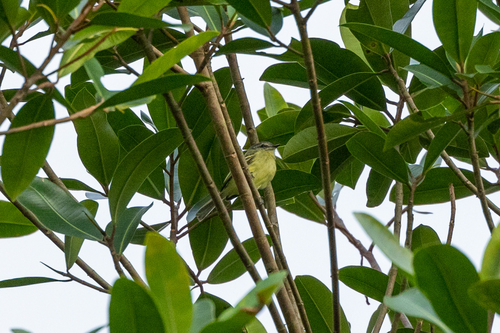 エクアドルヒゲハエトリ
要点
The most reliable way to separate Foothill Schiffornis from Ecuadorian Tyrannulet is by overall size and structure: Schiffornis is much larger and heavier-bodied, with a bulkier build and heavier bill, while the tyrannulet is noticeably small, slim, and active. In plumage, the tyrannulet shows distinct pale wing bars and a whitish supercilium, while the schiffornis is plainer, with a dark face and only a faint pale eye-ring. Behavior and foraging height are also strong clues: schiffornis stays low in the understory, while tyrannulet is almost always high in the canopy. If you see a small, yellowish, wing-barred bird flicking about in the treetops, it's the tyrannulet; a larger, brownish-olive, plain-faced bird in the understory points to schiffornis.
識別のコツ
- Size and Structure: Schiffornis is much larger and bulkier than the tiny, slim tyrannulet. If the bird looks thrush-sized, it’s schiffornis; if it’s warbler-sized, it’s the tyrannulet. This is reliable at all ages and seasons.
- Bill Shape: Schiffornis has a heavy, broad bill; tyrannulet’s bill is short and fine. Look for this in perched birds.
- Wing Bars: Only Ecuadorian Tyrannulet shows two distinct pale wing bars formed by pale tips to the wing coverts. Schiffornis’s wings are plain brown with no bars. This is a key mark for adults and immatures alike.
- Supercilium and Eye-ring: Tyrannulet has a clear whitish supercilium and eye-ring, making the face look bright and patterned. Schiffornis has a plain dark face with only a faint, indistinct pale eye-ring.
- Facial Pattern: Tyrannulet’s face is pale yellow to whitish with a subtle blackish line around the ear coverts; schiffornis’s face is uniformly dark brownish-olive.
- Crown Color: Tyrannulet has a gray crown contrasting with olive back; schiffornis’s crown is not distinct from the rest of the upperparts.
- Underparts: Tyrannulet’s underparts are bright yellow (except for a whitish throat); schiffornis is brown on throat and breast with a golden tinge, and grayish olive on the belly.
- Wing Color: Tyrannulet’s wings are dusky with pale yellow edges and tips; schiffornis’s wings are a warmer brown with no contrasting edges.
- Tail Color: Tyrannulet’s tail is olive, matching the back; schiffornis’s tail is dark brownish-olive.
- Iris Color: Schiffornis has a dark iris; tyrannulet’s iris is brown. This is subtle but may help at close range.
- Leg Color: Tyrannulet has gray to blue-gray legs and feet; schiffornis’s leg color is not specified but is not noted as distinctive.
- Behavior: Tyrannulet is active, often flicking its tail and making quick movements in the canopy; schiffornis is slow, deliberate, and usually low in the forest.
- Foraging Height: Tyrannulet is almost always high in the canopy (10–30 m); schiffornis is in the understory.
- Association with Mixed Flocks: Tyrannulet often joins mixed-species flocks; schiffornis rarely does.
- Perching Posture: Tyrannulet perches horizontally and often cocks its tail; schiffornis tends to sit upright and still.
If you see a small, bright, wing-barred bird actively foraging high up, it’s the tyrannulet. A larger, plain, brownish bird sitting quietly low down is the schiffornis. Wing bars and face pattern are the quickest visual checks, but always consider size and behavior for confirmation.
大きさ
Foothill Schiffornis is significantly larger, measuring 15.5–17.3 cm in length and weighing 28.5–31 g (no AVONET data, but these are adult values) [wikipedia]. In contrast, Ecuadorian Tyrannulet is much smaller at about 11.5 cm and 8 g [wikidata]. This size gap is obvious in the field: schiffornis appears chunky and thrush-like, while the tyrannulet is tiny, slim, and delicate. Bill size also differs: schiffornis has a noticeably heavier, broader bill, whereas the tyrannulet’s bill is fine and short, typical of small flycatchers.
羽色
No age-specific wing pattern is described for either species, so focus is on adult plumage. Foothill Schiffornis is overall dark brownish-olive above with a bronzy sheen, warmer brown wings, and a plain dark face with only a faint pale eye-ring. Underparts are brown with a golden tinge on throat and breast, and grayish olive on the belly and vent. The iris is dark. In contrast, Ecuadorian Tyrannulet is much brighter and more patterned: it has a gray crown, olive upperparts, and a pale yellow to whitish face with a distinct whitish supercilium and eye-ring, plus a subtle blackish line around the ear coverts. Its wings are dusky with pale yellow edges and tips on the flight feathers, and the coverts have pale tips forming two clear wing bars—these are visible even at a distance. Underparts are whitish on the throat and bright yellow below, with an olive wash on the breast. The iris is brown. These differences are consistent in adults and there is no mention of age-related variation.
行動
Foothill Schiffornis forages mostly in the forest understory, rarely joining mixed-species flocks, and typically takes food from vegetation or by making short sallies from a perch. It moves deliberately and is often seen sitting quietly in low, shaded areas. Ecuadorian Tyrannulet, on the other hand, is almost always active in the canopy (10–30 m up), foraging by making quick sallies or hover-gleaning from leaves and twigs. It often joins mixed-species flocks, perches horizontally, and frequently cocks its tail. The tyrannulet’s behavior is much more energetic and conspicuous compared to the schiffornis’s slow, secretive movements.
生息環境
Both species occur in Colombia, Ecuador, and Peru, but their microhabitat preferences differ. Foothill Schiffornis is an understory bird, usually found in the lower levels of humid foothill forests. Ecuadorian Tyrannulet is a canopy specialist, foraging high above the ground, though it may come lower at forest edges. If you see the bird in the lower, dense forest, schiffornis is more likely; if it’s high in the canopy, tyrannulet is the better bet.