

ヨーロッパハチクマ 対 チゴハヤブサ
Pernis apivorus 対 Falco subbuteo
ヨーロッパハチクマとチゴハヤブサのクイズ
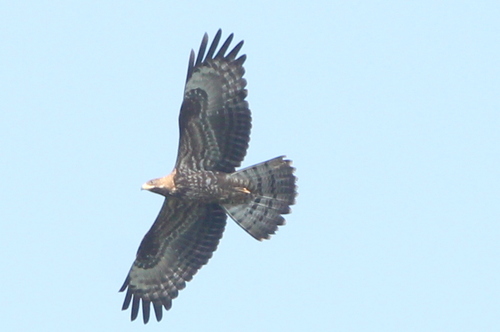 ヨーロッパハチクマ
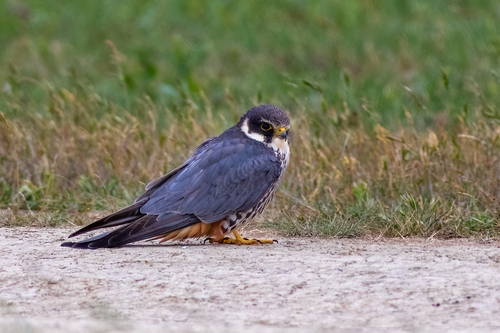 チゴハヤブサ
要点
The most reliable field mark is overall structure in flight: European Honey-buzzard is much larger, longer-winged, and long-tailed, with a small head and flat, straight wings, while Eurasian Hobby is a slim, swift-like falcon with pointed wings and a square tail. Juvenile Honey-buzzards can mimic the plumage of Common Buzzard, but never look like a Hobby. Adult Hobbies have striking rufous 'trousers' and a dark moustache, while Honey-buzzards show a blue-grey (male) or brown (female) head and a longer tail with fewer, broader bars. Both species soar, but their flight style and wing shape are very different. Size, jizz, and wing/tail shape are the most reliable separators at any age.
識別のコツ
- Size and structure: Honey-buzzard is much larger and heavier than Hobby; even a distant silhouette should show a large, long-winged, long-tailed bird versus a small, slim falcon.
- Wing shape: Honey-buzzard has broad, flat wings with straight or slightly downward-angled tips; Hobby has long, narrow, pointed wings, often swept back like a sickle.
- Tail shape: Honey-buzzard's tail is long and rounded with two narrow dark bars and a broad subterminal bar; Hobby's tail is shorter, square-tipped, and lacks broad bars.
- Head and neck: Honey-buzzard shows a small head, long neck, and sometimes an angular chest, especially in direct flight; Hobby has a proportionally larger head for its body, with a short neck and a distinct falcon profile.
- Facial pattern: Hobby shows a dark crown and two black moustache stripes (malar stripes), giving a classic falcon look; Honey-buzzard lacks these, with a plain blue-grey (male) or brown (female) head.
- Underparts: Hobby adults have white underparts with black streaks and rufous thighs/undertail coverts ('red trousers'); Honey-buzzard underparts are more uniform, lacking the rufous or heavy streaking.
- Juvenile confusion: Juvenile Honey-buzzards may mimic Common Buzzard in plumage but never show the falcon-like pointed wings or rufous thighs of Hobby. Juvenile Hobbies are browner but still falcon-shaped.
- Flight style: Honey-buzzard soars with flat wings and a protruding head; Hobby is agile, fast, and often seen chasing insects or birds with rapid, flickering wingbeats and glides.
- Perched posture: Honey-buzzard perches upright with long tail and neck; Hobby perches more horizontally, often on exposed snags or wires, with a compact, falcon-like stance.
- Habitat context: Honey-buzzard is more likely in mature woodland or forest edge, sometimes seen on the ground; Hobby is more likely in open country, marshes, or farmland, hawking in open airspace.
- Sex differences: Only Honey-buzzard shows sexual dimorphism in head color (blue-grey in males, brown in females); Hobby sexes are similar.
- Vocalization: Honey-buzzard's 'peee-lu' call is distinctive if heard; Hobby's call is not described here but is unlikely to be confused.
- Seasonal context: Both are summer migrants in much of Europe, but Honey-buzzard is scarcer and more secretive, especially in Britain.
- Behavior on the ground: Honey-buzzard may be seen digging for wasp nests on the forest floor; Hobby is rarely seen on the ground except when perched.
- Pitfalls: Do not rely solely on plumage color or streaking; always check structure, wing and tail shape, and flight style for a reliable identification.
大きさ
European Honey-buzzard is a much larger bird: 52–60 cm long with a 130–150 cm wingspan, and a body mass of 440–1050 g [wikipedia]. In contrast, Eurasian Hobby is small and slim, 29–36 cm long with a 74–84 cm wingspan, and a body mass of about 211 g [wikidata]. The Honey-buzzard is not only longer but also much heavier and bulkier, though it appears less heavy-bodied than a Buteo buzzard. Hobbies are falcon-sized, much smaller and lighter, and will never be mistaken for a large buzzard-like raptor in direct comparison.
羽色
- Juvenile/immature birds: Juvenile European Honey-buzzards can resemble Common Buzzards (Buteo buteo) in plumage, with brownish tones and banded tails, but they do not show the rufous thighs or the facial pattern of Hobby. Juvenile Hobbies are browner above, with scaled upperparts and streaked buffy thighs and undertail coverts, but still show pointed wings and a falcon jizz.
- Adults: Adult Honey-buzzards have a blue-grey (male) or brown (female) head, a long tail with two narrow dark bars and a broad subterminal bar, and a generally long-necked, small-headed look. Adult Hobbies are slate-grey above, with a dark crown, two short black moustache stripes, white throat, and distinctive rufous 'trousers' (thighs and undertail coverts). Underparts are whitish with black streaks. Hobbies never show the broad tail bars or the long neck of Honey-buzzard.
- Flight feathers: Honey-buzzard wings are broad and flat with straight edges, while Hobby wings are long, narrow, and pointed, giving a sickle-like appearance.
行動
European Honey-buzzard soars with flat, straight wings and a protruding head, often spending time on the forest floor searching for wasp nests. Its flight is buoyant but not rapid or agile. Eurasian Hobby is fast and agile, often hawking insects and small birds in flight, sometimes eating prey on the wing. Hobbies may be seen chasing swallows or swifts, and their flight is swift-like, with rapid, flickering wingbeats and gliding. Hobbies are more aerial and acrobatic than Honey-buzzards, which are more likely to be seen soaring or perched quietly in woodland.
生息環境
European Honey-buzzard breeds in woodlands and is generally inconspicuous except during spring displays, favoring mature forests and spending time on the ground. Eurasian Hobby prefers open country, farmland, marshes, taiga, and savannah, often in lowlands with scattered woods, and is much more likely to be seen in open airspace hunting. If seen in deep forest or on the ground, Honey-buzzard is more likely; if seen hawking over open fields or wetlands, Hobby is more likely.
声
European Honey-buzzard gives a clear 'peee-lu' call, especially during display. Hobby's call is not described in the notes, but is not likely to be confused with Honey-buzzard's. Vocalization is not a primary separator in most field situations.