

カケス 対 ニシクロウタドリ
Garrulus glandarius 対 Turdus merula
カケスとニシクロウタドリのクイズ
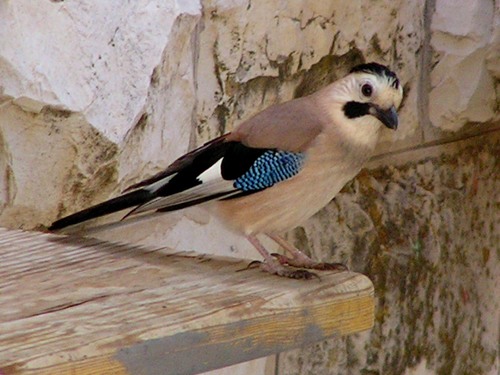 カケス
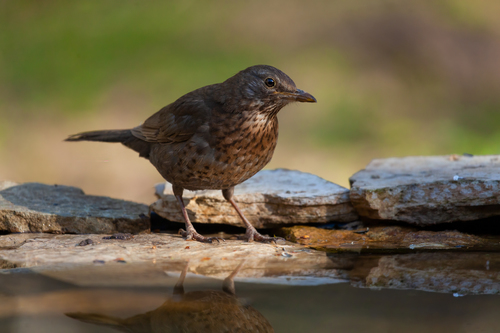 ニシクロウタドリ
要点
The most reliable field mark to separate Eurasian Jay from Eurasian Blackbird is the Jay’s bright blue and black-barred wing patch, visible on perched and flying birds of all ages, and completely absent in Blackbird. Jays show a pinkish-brown body, black tail, and bold black-and-white facial pattern, while Blackbirds are either all-black (adult male), brown and streaky (female/juvenile), and never show blue in the wing or a black tail. Jays are bulkier, with a shorter tail and heavier bill, and prefer woodland, while Blackbirds are more slender, longer-tailed, and often seen on lawns or in gardens. Confusion is most likely with female or juvenile Blackbirds, but even then, the Jay’s blue wing panel and white rump are unique.
識別のコツ
- Blue-and-black barred wing patch (Jay only): Look for a bright blue panel with fine black bars on the upperwing, visible in all ages and both perched and flying Jays. Blackbird never shows blue in the wing.
- White rump (Jay only): Jays have a conspicuous white rump, especially visible in flight. Blackbirds have a uniform dark rump.
- Black tail (Jay): Jay’s tail is solid black and contrasts with its paler body and white rump. Blackbird’s tail is long and matches the body color (black in males, brown in females/juveniles).
- Facial pattern (Jay): Jays have a white throat bordered by a bold black moustache stripe, and a streaked crown. Blackbirds have plain faces: males are all black with a yellow eye-ring, females/juveniles are brown with a pale throat but no bold stripes.
- Overall color: Jay is pinkish-brown to rufous with blue and black in the wing, white rump, and black tail. Blackbird males are all black with yellow bill and eye-ring; females/juveniles are brown with some mottling and no blue or white.
- Bill color and shape: Jay’s bill is heavier and blackish, suited for cracking acorns. Blackbird males have a yellow-orange bill (dark in winter/first-year males), females/juveniles have a dull brownish bill, all thinner than Jay’s.
- Size and build: Jay is larger, bulkier, and has a shorter tail relative to body size. Blackbird is more slender, with a longer tail and smaller head.
- Perched posture: Jay sits more upright and appears heavier, often in trees. Blackbird perches lower, with a more horizontal stance, and is often seen on the ground.
- Flight style: Jay’s flight is direct and heavy, with broad, rounded wings and visible white rump and blue wing panel. Blackbird has rapid, undulating flight with no color flashes in the wing or rump.
- Juvenile confusion: Young Blackbirds are brown and speckled, but lack any blue or white in the wing/rump. Young Jays already show blue wing panel and white rump.
- Habitat: Jays are rarely seen far from woodland or large parks; Blackbirds are common in gardens, lawns, and open spaces.
- Vocalizations: Not diagnostic with the provided notes, but in practice, Jay gives harsh screeches, Blackbird sings melodiously and gives a sharp "tchook" alarm.
- Context: If you see a bird digging in leaf litter in deep woodland, check for Jay’s blue wing. If it’s hopping on a suburban lawn, Blackbird is far more likely.
- Seasonal variation: Blackbird males may have a duller bill in winter, but never show blue/white in the wing or rump. Jay’s key marks are present year-round.
- Sex differences: Jay shows little sexual dimorphism; Blackbird males and females differ greatly, but neither sex ever shows Jay’s blue wing or white rump.
大きさ
Eurasian Jay is notably larger and bulkier than Eurasian Blackbird. Jay measures 34–35 cm in length with a 52–58 cm wingspan [wikipedia], while Blackbird is smaller at 23.5–29 cm length [wikipedia]. In the field, Jay’s heavier build, thicker neck, and proportionally shorter tail stand out compared to the Blackbird’s slimmer, more elongated shape and longer tail. If both species are seen together, the Jay will look almost crow-like in size and structure, while the Blackbird is closer to a large thrush.
羽色
- Juvenile/First-year birds: Jay juveniles already show the blue-and-black barred wing patch and pinkish-brown overall color, with a white rump and black tail. Blackbird juveniles are brown with pale spots above and a speckled breast, lacking any blue or white in the wing or rump. Young Blackbirds have a brown, not black, folded wing and no facial pattern.
- Adult males: Jay remains pinkish-brown with a white throat bordered by a black moustache stripe, blue-and-black barred wing panel, white rump, and black tail. Blackbird adult males are glossy black all over with a yellow-orange bill and eye-ring, lacking any blue, white, or facial stripes.
- Adult females: Jay females are similar to males. Blackbird females are sooty-brown with a dull yellow-brown bill, brownish-white throat, and weak breast mottling, but never show blue in the wing, white rump, or facial stripes.
- In flight: Jay’s blue wing patch and white rump are visible in all ages and sexes; Blackbird shows plain, uniform wings and tail, with no blue or white panels.
行動
Eurasian Jay is more secretive and often stays in woodland, moving with slow, deliberate hops or short flights between trees. It may be seen burying acorns or making short, direct flights with broad, rounded wings. Blackbird is more likely to be seen openly foraging on lawns, hopping or running, and often flicks its tail. In flight, Blackbird uses bursts of rapid wingbeats with a more undulating, thrush-like movement, while Jay’s flight is heavier and more direct. Jays are less likely to be seen in open areas compared to Blackbirds.
生息環境
Jay prefers mixed woodland, especially with oaks, and is rarely found far from trees, though it can venture into parks and large gardens. Blackbird is far more adaptable, commonly found in gardens, parks, hedgerows, and open spaces, as well as woodland. If you see a bird foraging on a lawn or in a small urban garden, it is much more likely to be a Blackbird than a Jay.