

Motmot

ワシミミズク 対 コミミズク

Bubo bubo 対 Asio flammeus

ワシミミズクとコミミズクのクイズ
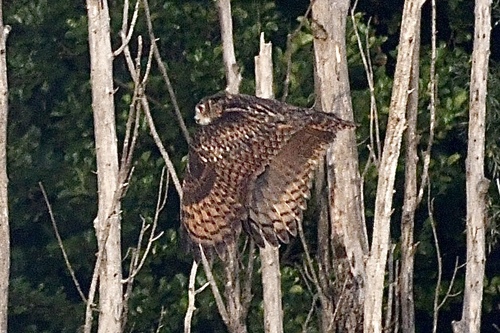
ワシミミズク (Bubo bubo) ワシミミズク
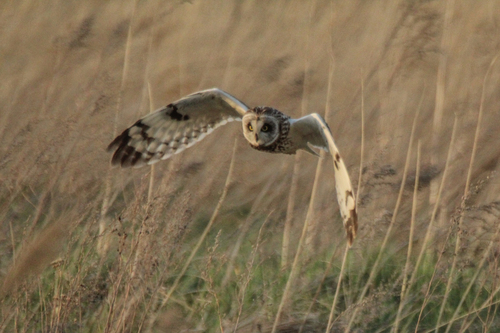
コミミズク (Asio flammeus) コミミズク

メディア

読み込み中…

要点

The most reliable field mark to separate Eurasian Eagle Owl from Short-eared Owl is sheer size: the eagle owl is vastly larger and bulkier, with a massive head, thick body, and huge talons, while Short-eared Owl is a medium-sized, slim, long-winged grassland owl. In flight, Short-eared Owl shows a distinctive floppy, buoyant flight style with long, narrow wings and often a pale trailing edge to the wing, unlike the heavy, powerful, and direct flight of the eagle owl. Plumage differences are also key: Short-eared Owl is paler and sandier overall, with bold face markings and yellow eyes, while Eurasian Eagle Owl is darker, heavily streaked, and has striking orange eyes. Habitat context is helpful—Short-eared Owl is almost always seen hunting over open fields or grasslands, while Eurasian Eagle Owl favors rocky outcrops, forests, or cliffs. Even at a distance, the eagle owl’s size and bulk are unmistakable when compared to the much smaller, lighter Short-eared Owl.

識別のコツ

  1. Size is the single most reliable mark: Eurasian Eagle Owl is enormous, at least four to five times the mass of Short-eared Owl. Even at a distance, the eagle owl’s bulk, thick neck, and huge head are obvious. Short-eared Owl is slim and medium-sized.
  2. Flight style: Short-eared Owl has a floppy, buoyant, moth-like flight with long, narrow wings and irregular wingbeats. Eurasian Eagle Owl flies powerfully and directly, with slow, deep wingbeats and a heavy, purposeful jizz.
  3. Facial disk and eyes: Short-eared Owl has bold, pale facial disks with strong black "mascara" around bright yellow eyes. Eurasian Eagle Owl’s face is less contrasting, with striking orange eyes.
  4. Ear tufts: Both have ear tufts, but those of the eagle owl are much larger and more prominent when raised. Short-eared Owl’s tufts are small, often invisible, and rarely seen in the field.
  5. Plumage color and pattern: Short-eared Owl is paler, sandier, and more mottled, with streaking limited to the upper breast. Eurasian Eagle Owl is darker, more rufous or brown, and heavily streaked all over, especially on the chest and upperparts.
  6. Underwing and upperwing in flight: Short-eared Owl often shows a broad white trailing edge to the wing and bold pale patches on the primaries; tail barring is also bolder. Eagle owl’s wings are uniformly dark and broad, lacking these pale panels or trailing edges.
  7. Bill and feet: Eurasian Eagle Owl has a massive, powerful bill and huge feathered feet with large talons; Short-eared Owl’s bill and feet are much smaller and less robust.
  8. Habitat context: Short-eared Owl is almost always in open country—fields, meadows, marshes. Eurasian Eagle Owl is tied to cliffs, rocky outcrops, or dense woodland. If you see an owl in open grassland, it is almost never an eagle owl.
  9. Perched posture: Eagle owl perches upright, looking massive and broad-shouldered. Short-eared Owl appears slimmer and more delicate, often hunching low to the ground or on a post.
  10. Group behavior: Short-eared Owl may be seen in loose groups, especially in winter. Eurasian Eagle Owl is strictly solitary.
  11. Active times: Short-eared Owl often hunts in daylight, especially at dawn and dusk. Eagle owl is almost always crepuscular or nocturnal, rarely seen flying in full daylight.
  12. Tail and wing proportions: Short-eared Owl has a relatively short tail and very long, slim wings. Eagle owl’s wings are broad and rounded, and its tail is proportionally longer and more robust.
  13. Juvenile confusion: No specific juvenile upperwing patterns are described for either species, but the size and habitat differences remain diagnostic at all ages.
  14. Vocalizations: Not described in the notes, but generally, eagle owl’s deep, booming hoots are very different from the Short-eared Owl’s barks and squeaks.
  15. Pitfalls: At great distance or in poor light, a Short-eared Owl may appear larger than it is, but never approaches the bulk of an eagle owl. Always use multiple marks—size, habitat, flight style, and face pattern together.

大きさ

Eurasian Eagle Owl is one of the world’s largest owls, with an average body mass of 2686 g [wikidata], and a wingspan that can reach up to 168 cm. It appears massive, with a thick neck, broad wings, and a very large head. In contrast, Short-eared Owl is a medium-sized owl, weighing only 206–475 g and with a wingspan of 85–110 cm [wikipedia]. In the field, the eagle owl looks more like a small eagle or buzzard in bulk, while Short-eared Owl is closer to a crow or kestrel in size. This size difference is so extreme that it is diagnostic even at a distance or in poor light.

羽色

No age-specific upperwing pattern is described for either species, but in all plumages, Short-eared Owl is much paler and sandier, with a mottled tawny-brown appearance and bold, pale facial disks. Its underparts are streaked only on the upper breast, with the belly and flanks much cleaner. In flight, Short-eared Owl often shows a broad white trailing edge to the wing and bold pale primary patches, as well as bolder tail barring. Eurasian Eagle Owl, by contrast, is dark brown to rufous with heavy black streaking throughout the upperparts, head, and chest. Its facial disk is less strongly marked, and the eyes are orange rather than yellow. The eagle owl’s plumage is overall darker and more heavily marked, with a more uniform appearance below. Both species have ear tufts, but those of the eagle owl are much larger and more obvious when raised; Short-eared Owl’s are usually inconspicuous or absent.

行動

Short-eared Owl is most often seen flying low over open fields or grasslands, especially at dawn or dusk, with a buoyant, moth-like or bat-like flight and irregular wingbeats. It may also be seen perched on the ground or on low posts. Eurasian Eagle Owl is typically crepuscular or nocturnal, roosting by day on cliffs, rocky outcrops, or in dense woodland, and hunting at night with strong, direct, and powerful flight. It rarely hunts in open fields and is seldom seen in daylight. The eagle owl is solitary and secretive, while Short-eared Owl can be seen in loose groups, especially in winter.

生息環境

Short-eared Owl is a classic open-country species, found in grasslands, meadows, marshes, tundra, and prairies. It avoids dense forest and is rarely found near cliffs or rocky areas. Eurasian Eagle Owl, in contrast, prefers rugged terrain with cliffs, rocky outcrops, or forest edges, and is rarely seen in open grassland. If you see a large owl flying over a wide, open field, it is almost certainly a Short-eared Owl; an owl on a rocky ledge or in deep woodland is far more likely to be an eagle owl.

より良い説明を送る

比較と同じ項目を使ってください。文章はすぐに公開されます。

The most reliable field mark to separate Eurasian Eagle Owl from Short-eared Owl is sheer size: the eagle owl is vastly larger and bulkier, with a massive head, thick body, and huge talons, while Short-eared Owl is a medium-sized, slim, long-winged grassland owl. In flight, Short-eared Owl shows a distinctive floppy, buoyant flight style with long, narrow wings and often a pale trailing edge to the wing, unlike the heavy, powerful, and direct flight of the eagle owl. Plumage differences are also key: Short-eared Owl is paler and sandier overall, with bold face markings and yellow eyes, while Eurasian Eagle Owl is darker, heavily streaked, and has striking orange eyes. Habitat context is helpful—Short-eared Owl is almost always seen hunting over open fields or grasslands, while Eurasian Eagle Owl favors rocky outcrops, forests, or cliffs. Even at a distance, the eagle owl’s size and bulk are unmistakable when compared to the much smaller, lighter Short-eared Owl.

  1. Size is the single most reliable mark: Eurasian Eagle Owl is enormous, at least four to five times the mass of Short-eared Owl. Even at a distance, the eagle owl’s bulk, thick neck, and huge head are obvious. Short-eared Owl is slim and medium-sized.
  2. Flight style: Short-eared Owl has a floppy, buoyant, moth-like flight with long, narrow wings and irregular wingbeats. Eurasian Eagle Owl flies powerfully and directly, with slow, deep wingbeats and a heavy, purposeful jizz.
  3. Facial disk and eyes: Short-eared Owl has bold, pale facial disks with strong black "mascara" around bright yellow eyes. Eurasian Eagle Owl’s face is less contrasting, with striking orange eyes.
  4. Ear tufts: Both have ear tufts, but those of the eagle owl are much larger and more prominent when raised. Short-eared Owl’s tufts are small, often invisible, and rarely seen in the field.
  5. Plumage color and pattern: Short-eared Owl is paler, sandier, and more mottled, with streaking limited to the upper breast. Eurasian Eagle Owl is darker, more rufous or brown, and heavily streaked all over, especially on the chest and upperparts.
  6. Underwing and upperwing in flight: Short-eared Owl often shows a broad white trailing edge to the wing and bold pale patches on the primaries; tail barring is also bolder. Eagle owl’s wings are uniformly dark and broad, lacking these pale panels or trailing edges.
  7. Bill and feet: Eurasian Eagle Owl has a massive, powerful bill and huge feathered feet with large talons; Short-eared Owl’s bill and feet are much smaller and less robust.
  8. Habitat context: Short-eared Owl is almost always in open country—fields, meadows, marshes. Eurasian Eagle Owl is tied to cliffs, rocky outcrops, or dense woodland. If you see an owl in open grassland, it is almost never an eagle owl.
  9. Perched posture: Eagle owl perches upright, looking massive and broad-shouldered. Short-eared Owl appears slimmer and more delicate, often hunching low to the ground or on a post.
  10. Group behavior: Short-eared Owl may be seen in loose groups, especially in winter. Eurasian Eagle Owl is strictly solitary.
  11. Active times: Short-eared Owl often hunts in daylight, especially at dawn and dusk. Eagle owl is almost always crepuscular or nocturnal, rarely seen flying in full daylight.
  12. Tail and wing proportions: Short-eared Owl has a relatively short tail and very long, slim wings. Eagle owl’s wings are broad and rounded, and its tail is proportionally longer and more robust.
  13. Juvenile confusion: No specific juvenile upperwing patterns are described for either species, but the size and habitat differences remain diagnostic at all ages.
  14. Vocalizations: Not described in the notes, but generally, eagle owl’s deep, booming hoots are very different from the Short-eared Owl’s barks and squeaks.
  15. Pitfalls: At great distance or in poor light, a Short-eared Owl may appear larger than it is, but never approaches the bulk of an eagle owl. Always use multiple marks—size, habitat, flight style, and face pattern together.

Eurasian Eagle Owl is one of the world’s largest owls, with an average body mass of 2686 g [wikidata], and a wingspan that can reach up to 168 cm. It appears massive, with a thick neck, broad wings, and a very large head. In contrast, Short-eared Owl is a medium-sized owl, weighing only 206–475 g and with a wingspan of 85–110 cm [wikipedia]. In the field, the eagle owl looks more like a small eagle or buzzard in bulk, while Short-eared Owl is closer to a crow or kestrel in size. This size difference is so extreme that it is diagnostic even at a distance or in poor light.

No age-specific upperwing pattern is described for either species, but in all plumages, Short-eared Owl is much paler and sandier, with a mottled tawny-brown appearance and bold, pale facial disks. Its underparts are streaked only on the upper breast, with the belly and flanks much cleaner. In flight, Short-eared Owl often shows a broad white trailing edge to the wing and bold pale primary patches, as well as bolder tail barring. Eurasian Eagle Owl, by contrast, is dark brown to rufous with heavy black streaking throughout the upperparts, head, and chest. Its facial disk is less strongly marked, and the eyes are orange rather than yellow. The eagle owl’s plumage is overall darker and more heavily marked, with a more uniform appearance below. Both species have ear tufts, but those of the eagle owl are much larger and more obvious when raised; Short-eared Owl’s are usually inconspicuous or absent.

Short-eared Owl is most often seen flying low over open fields or grasslands, especially at dawn or dusk, with a buoyant, moth-like or bat-like flight and irregular wingbeats. It may also be seen perched on the ground or on low posts. Eurasian Eagle Owl is typically crepuscular or nocturnal, roosting by day on cliffs, rocky outcrops, or in dense woodland, and hunting at night with strong, direct, and powerful flight. It rarely hunts in open fields and is seldom seen in daylight. The eagle owl is solitary and secretive, while Short-eared Owl can be seen in loose groups, especially in winter.

Short-eared Owl is a classic open-country species, found in grasslands, meadows, marshes, tundra, and prairies. It avoids dense forest and is rarely found near cliffs or rocky areas. Eurasian Eagle Owl, in contrast, prefers rugged terrain with cliffs, rocky outcrops, or forest edges, and is rarely seen in open grassland. If you see a large owl flying over a wide, open field, it is almost certainly a Short-eared Owl; an owl on a rocky ledge or in deep woodland is far more likely to be an eagle owl.

変更を破棄しますか?

保存していない編集があります。今離れると失われます。

ワシミミズク · コミミズク · 苦手な鳥