

ワタリガラス 対 ホシムクドリ
Corvus corax 対 Sturnus vulgaris
ワタリガラスとホシムクドリのクイズ
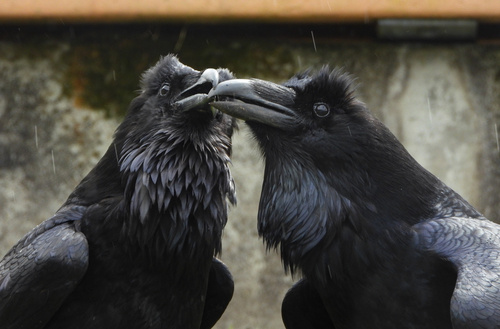 ワタリガラス
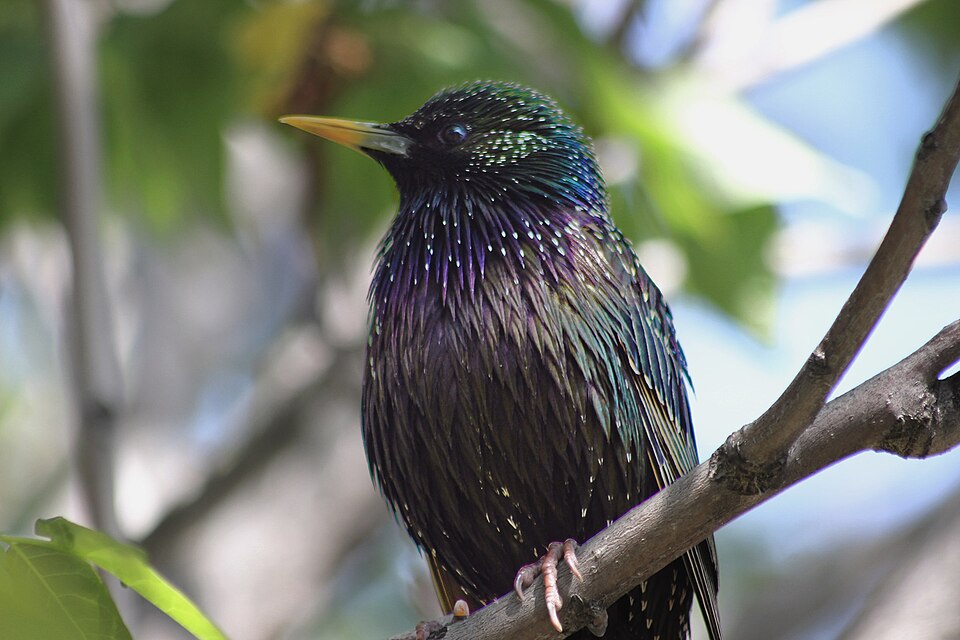 ホシムクドリ
要点
The most reliable way to separate Common Raven from Common Starling in the field is by overall size and structure: ravens are massive, heavy-billed birds with long, wedge-shaped tails and shaggy throat feathers, while starlings are much smaller, short-tailed, and compact with a slender, pointed bill. In flight, ravens show broad wings and a distinctive wedge-shaped tail, whereas starlings have sharply pointed wings and a short, square tail. Adult starlings are iridescent black with seasonal white spotting, while ravens are uniformly black and lack any pale spots. Juvenile starlings are brownish and never approach the size or bulk of a raven. Even at a distance, the difference in flight style and flocking behavior is striking: ravens soar and glide, often alone or in pairs, while starlings fly in tight, coordinated flocks.
識別のコツ
- Size is the clearest separator: Ravens are enormous compared to starlings—if you see a bird the size of a crow or larger, it cannot be a starling.
- Bill shape and size: Ravens have a massive, thick, slightly curved bill; starlings have a thin, straight, pointed bill. This is visible even at a distance with binoculars.
- Tail shape in flight: Raven tails are long and wedge-shaped (diamond or triangular when spread); starling tails are short and square.
- Wing shape: Ravens have broad wings with splayed primaries; starlings have sharply pointed, triangular wings.
- Flight style: Ravens soar and glide with few wingbeats, often alone or in pairs; starlings fly rapidly with frequent wingbeats and glide briefly, usually in tight flocks.
- Plumage details: Adult starlings in winter have white spots all over; ravens are always plain black. In summer, starlings lose most spots but remain smaller and more compact.
- Juvenile confusion: Young starlings are brownish, never black, and always small. Juvenile ravens are dull black but still huge and heavy-billed.
- Throat feathers: Ravens have shaggy, pointed throat feathers (especially visible when calling); starlings' throat feathers are only slightly elongated in males and never shaggy.
- Leg color: Starlings have pinkish or reddish legs; ravens' legs are always black.
- Flocking behavior: Large, swirling flocks are starlings; ravens rarely gather in large groups and never perform starling-like murmurations.
- Perched posture: Ravens are long-necked, heavy-headed, and long-tailed; starlings are compact, round-bellied, and short-tailed.
- Habitat context: In cities, especially in flocks, expect starlings. In wild, open country or mountains, a lone or paired large black bird is more likely a raven.
- Vocalizations: Deep croaks and harsh calls point to raven; varied whistles, clicks, and mimicry indicate starling.
- Bill color (seasonal in starlings): Starling bills are yellow in summer, blackish in winter; raven bills are always black.
- Iris color (close views): Starling iris is rich brown in males, mouse-brown or grey in females; raven iris is dark brown in adults, blue-grey in juveniles (rarely visible in the field).
大きさ
Common Raven is vastly larger than Common Starling. Ravens average about 66 cm in body length and nearly 950 g in mass [wikidata], making them one of the largest passerines. Starlings are only about 20 cm long and weigh 58–101 g [wikipedia], less than a tenth of a raven's mass. In the field, even a distant raven will appear much bulkier and longer-winged than any starling. The raven's bill is also proportionally much larger and heavier than the starling's fine, pointed bill.
羽色
- Juvenile/immature birds: Juvenile starlings are grey-brown overall, lacking the iridescence and white spotting of adults. Juvenile ravens are similar to adults but duller black, with a blue-grey iris and a pinkish gape at first [wikipedia]. Even young ravens are all-black and never show the brown tones or pale spots of young starlings.
- Adults (non-breeding): Adult starlings are glossy black with a metallic purple or green sheen and are heavily spangled with white spots in winter. Ravens are uniformly black with a subtle iridescence but never show white spots. The raven's throat feathers are shaggy and pointed, while the starling's are only slightly elongated in males.
- Adults (breeding): Starlings lose much of their white spotting as feather tips wear off, becoming more uniformly glossy black, but still retain a compact, short-tailed look. Raven plumage remains unchanged: all-black, with a wedge-shaped tail and shaggy throat.
- Bill and legs: Raven's bill is huge, thick, and slightly curved; starling's is narrow, straight, and sharp. Starling legs are pinkish or reddish, while raven legs are black and much stouter.
行動
Ravens are often seen alone or in pairs, soaring or gliding with minimal wingbeats, sometimes performing acrobatic maneuvers. They rarely form large flocks. Starlings are highly gregarious, especially outside the breeding season, forming dense, synchronized flocks that wheel and twist in unison. On the ground, starlings walk or run with a somewhat waddling gait, while ravens stride more powerfully. In flight, ravens are stable and can soar for long periods, while starlings have rapid, direct flight with frequent wingbeats and short glides.
生息環境
Both species are adaptable and widespread, but ravens are more often found in open countryside, mountains, forests, and coastal cliffs, avoiding dense urban areas. Starlings thrive in urban, suburban, and agricultural habitats, often seen in parks, gardens, and fields. If you see a large, black bird in a city flocking with dozens or hundreds of others, it's almost certainly a starling, not a raven.
声
Raven calls are deep, resonant croaks, much lower and more sonorous than any starling sound. Starlings are highly vocal, producing a wide range of whistles, clicks, and mimicry, but never the deep croak of a raven. The difference is especially obvious when both species are calling nearby.