

ダチョウ 対 ムナジロガラス
Struthio camelus 対 Corvus albus
ダチョウとムナジロガラスのクイズ
 ダチョウ
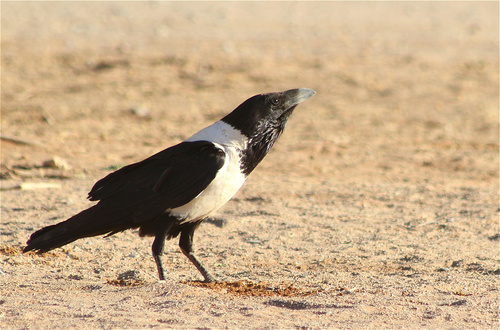 ムナジロガラス
要点
The most reliable way to separate Common Ostrich from Pied Crow is by sheer size and structure: the ostrich is a massive, flightless bird with a long bare neck and legs, while the pied crow is a crow-sized, fully flighted bird with a distinctive black-and-white plumage. Even at a distance, the ostrich’s towering height, long stride, and didactyl (two-toed) feet are unmistakable compared to the much smaller, perching crow. Immature plumages are not easily confused, as young ostriches are fawn with spots while young pied crows show variable black in the white areas. In flight, only the crow will be airborne, as ostriches cannot fly. If you see a large bird running or standing tall on open ground, it is an ostrich; a black-and-white bird flying or perching is a pied crow.
識別のコツ
- Flight vs. terrestrial: Only the pied crow flies; ostriches are strictly flightless. Any large bird in flight is not an ostrich.
- Size: Ostrich is gigantic, standing up to 2.75 m tall and weighing over 100 kg; pied crow is less than 1/20th the height and mass. Even at a distance, the difference is obvious.
- Neck and legs: Ostrich has a long, bare neck and long, bare, scaled legs; pied crow has a short, feathered neck and proportionate legs.
- Feet: Ostrich is didactyl (two toes, one hoof-like), a unique feature visible at close range; pied crow has the typical four-toed crow foot.
- Plumage (adult): Adult male ostrich is black with white primaries and tail; female and young males are greyish-brown and white. Pied crow is always glossy black with a bold white patch on the chest and lower neck.
- Plumage (immature): Juvenile ostrich is fawn with dark spots, never black-and-white. Immature pied crow may have some black in the white areas, but never shows brown or fawn.
- Bill: Ostrich bill is broad, flat, and relatively short for its head; pied crow has a strong, proportionately large, pointed bill typical of crows.
- Eyes: Ostrich eyes are enormous (largest of any land vertebrate), with a small head relative to body; crow eyes are dark brown and proportionate.
- Tail: Ostrich tail is large, fluffy, and used for display; crow tail is straight and black, used in flight.
- Behavior: Ostrich runs and may use wings for balance; crow perches, flies, and may mob raptors.
- Habitat: Ostrich in open grassland or savanna; crow in almost any habitat, including urban areas.
- Vocalization: Crow is noisy, giving harsh caws; ostrich is mostly silent.
- Group size: Ostriches often in small groups or pairs; crows in pairs, small groups, or large flocks at food sources.
- Context: If seen perching on a tree, wire, or building, it is a crow; ostriches do not perch.
- Pitfalls: At extreme distance, a running ostrich might be mistaken for a mammal or large bird, but the upright posture and bare neck/legs are unique. No realistic confusion in flight or perched views.
大きさ
The size difference is extreme: Common Ostrich is the largest living bird, weighing around 107,500 g (over 100 kg) and standing up to 2.75 m tall, with a wing span (though flightless) of about 2 m. Pied Crow is crow-sized, 46–52 cm in length, with a weight of about 520 g and a wingspan of 328–388 mm. Even a juvenile ostrich dwarfs a pied crow. There is no overlap: if the bird is remotely crow-sized, it cannot be an ostrich.
羽色
Juvenile ostriches are fawn with dark brown spots, gradually acquiring greyish-brown and white as they age, while adult males are black with white primaries and tail, and females/young males are greyish-brown and white. Pied Crow, in all plumages, shows a glossy black head, neck, wings, and tail, with a bold white patch from the shoulders down to the lower breast. Immature pied crows may have some black mixed into the white areas, but never approach the overall brown or grey tones of young ostriches. In flight, only the crow is seen airborne, showing black wings and tail with a contrasting white chest and belly. Ostrich wings are soft and fluffy, used for display and maneuvering while running, never for flight. The ostrich’s bare neck and legs are always visible, while the crow’s are feathered and proportionate to its body size.
行動
Common Ostrich is strictly terrestrial, running at high speeds and using its wings for balance and maneuvering, never for flight. It is usually seen striding across open ground, often in small groups. Pied Crow is highly aerial, frequently seen flying, perching, or scavenging, sometimes in pairs or small groups, and may mob raptors. Ostriches do not perch, and their movement is limited to walking or running. Crows are agile, can perch on wires or trees, and exhibit typical corvid curiosity and boldness.
生息環境
Both species are widespread in Africa, but ostriches are found in open savannas, grasslands, and semi-desert areas, avoiding dense forests. Pied Crows are highly adaptable, occurring in a wide range of habitats including towns, villages, farmlands, and open country. If you see a large bird in a city or perched on a building, it is a crow; ostriches are strictly ground-dwellers of open, wild spaces.
声
No confusion: ostriches are generally silent, though they can produce deep booming or hissing sounds, but these are rarely heard by casual observers. Pied Crows are vocal, giving a variety of harsh cawing calls typical of crows. If you hear a loud, raucous caw, it is a crow.