

サヨナキドリ 対 カナリア
Luscinia megarhynchos 対 Serinus canaria
サヨナキドリとカナリアのクイズ
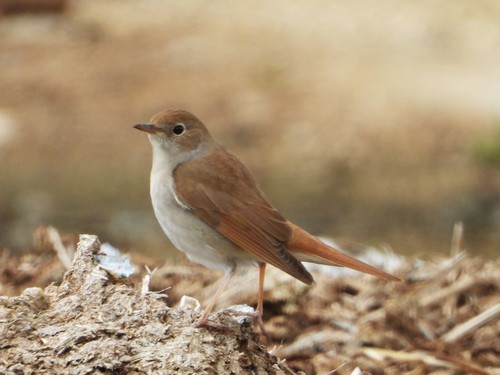 サヨナキドリ
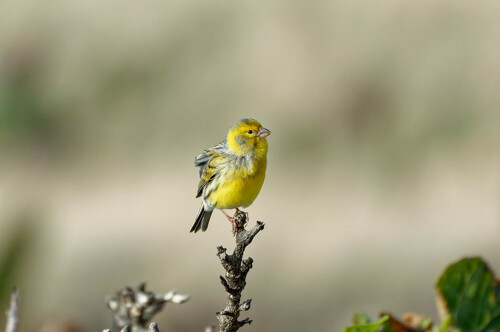 カナリア
要点
The most reliable field mark to separate Common Nightingale from Atlantic Canary is overall coloration and pattern: nightingales are plain brown above with a distinct reddish tail and unmarked pale underparts, while wild Atlantic Canaries are yellow-green with brownish streaking and a yellowish face. Juvenile canaries are streaky and brown, but still show a more patterned appearance than the uniformly brown nightingale. Structurally, nightingales are larger and more robust, with a longer tail and a more thrush-like jizz, while canaries are smaller, shorter-tailed, and distinctly finch-like. Voice is also a strong separator: nightingales deliver rich, powerful, varied songs, while canaries produce a silvery, twittering series of notes.
識別のコツ
- Juvenile plumage: Juvenile Atlantic Canaries are brown with heavy dark streaking above and below; Common Nightingale juveniles are plain brown above with a reddish tail and pale, unmarked underparts. If you see a streaky juvenile, it's a canary; if plain, it's a nightingale.
- Adult upperparts: Nightingales are plain brown above with a warm rufous tail; canaries are yellow-green or grey-green above with dark streaks and a dull yellow rump.
- Underparts: Nightingales are buff to white below, always unmarked; canaries have yellow-green underparts with some streaking on the sides, and the lower belly/undertail is whitish.
- Facial pattern: Canaries show a yellowish face and supercilium (especially males), while nightingales are plain-faced, though some eastern nightingales may show a faint pale supercilium.
- Tail: Nightingale's tail is longer and distinctly rufous, often flicked; canary's tail is shorter, less colorful, and not rufous.
- Bill: Nightingale has a straight, slender, insect-eater's bill; canary has a short, conical, seed-eater's bill typical of finches.
- Size and structure: Nightingale is larger (15–16.5 cm), bulkier, and more elongated; canary is smaller (10–12 cm), compact, and finch-like.
- Flight style: Canaries show a bounding, undulating flight typical of finches; nightingales have a more direct, steady flight.
- Perching behavior: Canaries often perch openly on wires or treetops; nightingales prefer to stay low in dense cover and rarely perch in the open.
- Habitat: Nightingales are found in dense scrub and thickets, rarely in open areas; canaries use open woodland, gardens, and urban parks.
- Vocalization: Nightingale's song is loud, rich, and varied, often at night; canary's song is a silvery, twittering series of notes.
- Sociality: Canaries are often seen in small groups or flocks; nightingales are solitary or in pairs.
- Season and location: If you are in the native range of the canary (Macaronesian islands), a yellow-green finch is almost certainly a canary; nightingales are widespread in Europe and western Asia, but always in dense, low vegetation.
- Sex differences: Both species have subtle sexual dimorphism, but female canaries are duller and greyer than males; nightingale sexes are similar.
- Pitfalls: Beware of dull or juvenile canaries, which may appear brownish, but always show some streaking; nightingales never show streaking at any age.
大きさ
Common Nightingale is noticeably larger than Atlantic Canary. Nightingales measure 15–16.5 cm in length, compared to the canary's 10–12 cm. Both species have similar average body mass (around 15 g), but the nightingale's longer body and tail make it appear bulkier and more elongated. The canary has a shorter, more compact body and wings, typical of finches. In the field, this size difference is usually apparent, especially if both species are seen in similar habitat.
羽色
Juvenile and immature birds are a common source of confusion. Juvenile Atlantic Canaries are brown with heavy dark streaking above and below, giving them a distinctly patterned look, while Common Nightingale juveniles are plain brown above with a rufous tail and pale, unmarked underparts—never streaked. Adults of both sexes in nightingale are uniformly brown above (with a reddish tail) and buff to white below, lacking any facial or body streaking. By contrast, adult male canaries have a yellow-green head and underparts, a yellower face and supercilium, and grey-green streaked upperparts with a dull yellow rump; females are similar but duller and greyer. The canary always shows some patterning or yellowish tones, even in dull birds, and never the plain, warm brown and rufous combination of the nightingale. The nightingale's eastern subspecies may show a pale supercilium, but this is subtle compared to the canary's facial pattern. In flight, neither species shows a distinctive wing panel or contrasting upperwing pattern, but the nightingale's rufous tail can be a helpful clue.
行動
Common Nightingale is more terrestrial, often seen low in dense scrub or on the ground, moving with a thrush-like hop and tail flick. It is usually shy and skulking, rarely perching in the open. Atlantic Canary, in contrast, is more likely to be seen perched prominently on bushes, wires, or treetops, and often feeds higher in vegetation. Canaries show typical finch behavior: active, social, and sometimes in small flocks, with a bounding, undulating flight. Nightingales are solitary or in pairs and have a more direct, less undulating flight.
生息環境
Common Nightingale favors dense, low scrub, thickets, and woodland edges, often near water, especially in lowland areas. It is rarely found in open or urban habitats. Atlantic Canary inhabits a wider range of open habitats, including semi-open woodland, gardens, orchards, and even urban parks, especially in its native islands. If you see a streaky, yellowish finch in an open or semi-open setting, it is much more likely to be a canary; a plain brown bird skulking in dense scrub is likely a nightingale.
声
Common Nightingale is famous for its loud, rich, and varied song, with powerful whistles, trills, and repeated phrases, often delivered from deep cover and sometimes at night. The song is considered one of the most beautiful among birds. Atlantic Canary, by contrast, produces a silvery, twittering song, rapid and high-pitched, lacking the nightingale's depth and variety. Calls are also different: canaries have typical finch-like chips and twitters, while nightingales give harsher, more abrupt calls.