

シラコバト 対 ベニバト
Streptopelia decaocto 対 Streptopelia tranquebarica
シラコバトとベニバトのクイズ
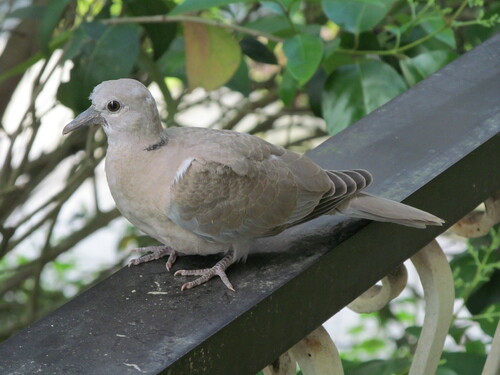 シラコバト
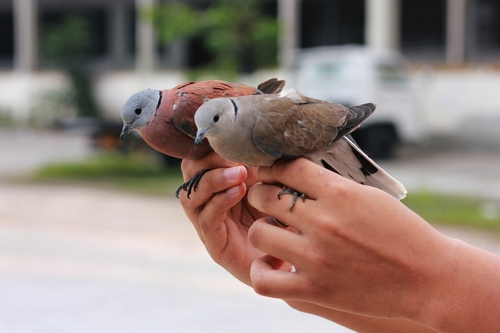 ベニバト
要点
The most reliable field mark is overall color: adult male Red Collared Doves are distinctly red-brown with a blue-grey head, while Collared Doves are always uniform grey-buff to pinkish-grey with no reddish tones. Females and immatures of Red Collared Dove are trickier, as they're pale brown and can resemble Collared Dove, but remain noticeably smaller and more compact. Both species have a black nape collar, but Collared Dove’s is edged with white and stands out on a paler neck. Size, structure, and subtle plumage differences—especially in the head and upperparts—are key for separating females and juveniles.
識別のコツ
- Overall color (adults): Male Red Collared Dove is unmistakably red-brown with a blue-grey head; Collared Dove is always uniform grey-buff to pinkish-grey with no reddish tones. This is the quickest field mark for adult males.
- Size and structure: Collared Dove is much larger and bulkier, with a longer tail and broader wings. Red Collared Dove is smaller, more compact, and lighter in build. Use direct comparison or mental size benchmarks if both are not present.
- Collar pattern: Collared Dove’s black nape collar is edged with white and stands out on a pale neck. Red Collared Dove’s collar is plain black and less sharply defined, especially in females and juveniles.
- Tail pattern: Collared Dove shows a broad white tip to the tail, visible both above and below, especially in flight. Red Collared Dove’s tail is less distinctly white-tipped.
- Head color (males): Only Red Collared Dove males have a blue-grey head contrasting with the reddish body. Collared Dove’s head is the same color as the body.
- Female/immature confusion: Female and juvenile Red Collared Doves are pale brown and can resemble Collared Dove, but are smaller and often show a pinkish wash. Collared Dove females and juveniles are always grey-buff, never truly brown or pinkish.
- Eye color (juveniles): Juvenile Collared Doves have a brown iris, while adults have a reddish iris (appearing dark at a distance). Red Collared Dove iris color is not specified, but this may help with close views of Collared Dove juveniles.
- Leg color: Both species have red legs, so this is not a useful field mark.
- Bill color: Both species have a black bill; not diagnostic.
- Flight style: Collared Dove’s display flight is distinctive: a steep climb, then a gliding descent with wings held in an inverted 'V'. Red Collared Dove’s flight is not described as such.
- Habitat context: Collared Dove is strongly associated with human habitation, often in towns and suburbs. Red Collared Dove prefers wooded farmland and plantations, avoiding urban areas and deserts.
- Geographic range: Collared Dove is widespread in Europe, North Africa, and much of Asia, especially near people. Red Collared Dove is a tropical Asian species, absent from Europe and North Africa.
- Group behavior: Red Collared Dove often arrives in small flocks and then pairs off; Collared Dove is more likely to be seen singly or in pairs in settled areas.
- Voice: Not described in the sources, so do not rely on vocalizations for separation in this context.
- Pitfalls: Female and immature Red Collared Doves are the most likely to be confused with Collared Dove, especially at a distance or in poor light. Always check for size, collar edging, and overall color tone.
大きさ
Collared Dove is significantly larger and heavier (average body mass 193 g, length 32 cm) than Red Collared Dove (length 20.5–23 cm, weight ~104 g). This difference is obvious in the field: Collared Dove appears bulkier, with a longer tail and broader wings, while Red Collared Dove is noticeably smaller and more delicate. When perched together, Collared Dove will dominate in size and presence.
羽色
- Adult males: Red Collared Dove males have a blue-grey head and a rich red-brown body, making them strikingly different from the uniform grey-buff Collared Dove. Collared Dove males and females are identical, always grey-buff to pinkish-grey, with a slight pinkish wash but never red-brown.
- Adult females: Female Red Collared Doves are pale brown and can look similar to Collared Dove, but usually show a pinkish tint and are smaller. Collared Dove females are identical to males, with no strong pink or red tones.
- Juveniles: Juvenile Collared Doves lack a well-developed collar and have a brown iris, but otherwise resemble adults. Juvenile Red Collared Doves are not described in detail, but likely resemble pale females, remaining smaller and browner than Collared Dove juveniles.
- Collar: Both species have a black nape collar, but Collared Dove’s is edged with white, making it more obvious against the paler neck. Red Collared Dove’s collar is plain black, often less crisply defined, especially in females and immatures.
- Tail: Collared Dove shows a broad white tip to the tail (both above and below), while Red Collared Dove’s tail pattern is less prominent and not described as strongly white-tipped.
行動
Collared Dove often associates closely with human habitation, nesting near buildings and feeding in urban or suburban settings. It is more likely to be seen in pairs or small groups, and its display flight involves a steep climb and gliding descent with wings held in an inverted 'V'. Red Collared Dove prefers wooded tracts and cultivated areas, often arriving in small flocks before pairing off to breed. It is less tied to human settlements and avoids open desert or rocky hills. Both species feed on the ground, but Collared Dove is more likely to be seen in urban parks or gardens.
生息環境
Collared Dove is widespread in Europe, Asia, and North Africa, strongly favoring areas near human habitation—suburbs, farms, and towns. Red Collared Dove is a tropical Asian species, preferring plains with good tree cover, such as canal or roadside plantations, and is less likely in urban environments or deserts. If you see a dove in a city or town in Europe or North Africa, it is almost certainly a Collared Dove; in wooded farmland or plantations in tropical Asia, Red Collared Dove is more likely.