

ミゾハシクロムクドリモドキ 対 クロハゴロモガラス
Gnorimopsar chopi 対 Agelasticus cyanopus
ミゾハシクロムクドリモドキとクロハゴロモガラスのクイズ
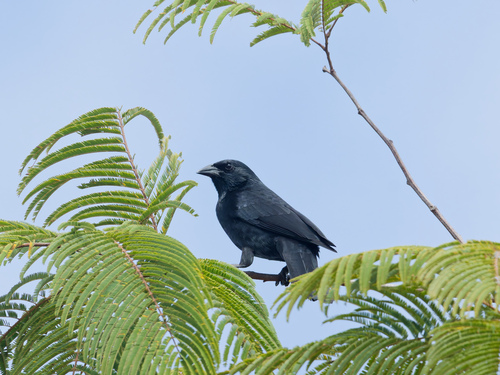 ミゾハシクロムクドリモドキ
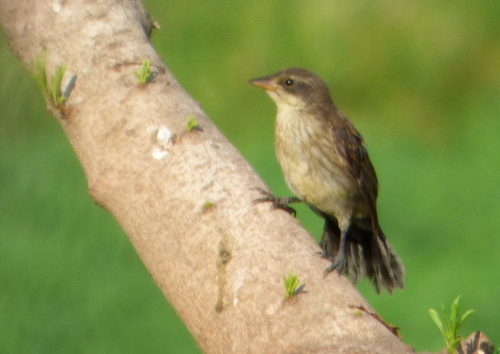 クロハゴロモガラス
要点
The most reliable field mark is the presence of brown and yellow tones in female and juvenile Unicoloured Blackbird, which are never shown by the entirely black Chopi Blackbird. If you see a blackbird with any brown, rufous, or yellowish on the head, underparts, or wings, it is not a Chopi. Adult males of both species are all-black, but Chopi Blackbird is larger, heavier-billed, and has a subtly curved bill with a groove along the lower mandible. In flight or perched, check for size, bill shape, and any hint of color on the body or wings. Habitat can also help: Unicoloured Blackbird is strongly tied to marshes and wet grasslands, while Chopi Blackbird uses a wider range of open habitats.
識別のコツ
- Juvenile and female Unicoloured Blackbirds are never all black: Look for brown upperparts, yellowish underparts, and rufous or pale edges on the wings. Chopi Blackbird of any age or sex is always entirely black.
- Adult male Unicoloured Blackbird vs Chopi Blackbird: Both are all black, but Chopi is larger and has a heavier, subtly curved bill with a groove along the lower mandible. Unicoloured male is smaller, slimmer, and has a faint bluish gloss.
- Bill shape: Chopi Blackbird has a thicker, slightly decurved bill with a visible groove on the lower mandible. Unicoloured Blackbird's bill is slimmer and straighter, especially in females.
- Size: Chopi Blackbird is significantly larger and bulkier than Unicoloured Blackbird. If the bird looks small and slim, especially in marshy habitat, suspect Unicoloured.
- Wing pattern in flight (immatures/females): Unicoloured Blackbird females and juveniles may show rufous or pale edges on the wings and a brownish tone above; Chopi is plain black in all plumages.
- Underparts color: Any yellowish, buff, or pale color on the underparts points to Unicoloured Blackbird (female/juvenile); Chopi is always black below.
- Head pattern: Female Unicoloured Blackbird (nominate) shows a thin yellowish supercilium and brown crown; Chopi never shows these marks.
- Tail and legs: Both species have blackish tails and legs, not useful for separation.
- Iris color: Both have dark brown irises, not diagnostic.
- Habitat: Unicoloured Blackbird is almost always in or near marshes or wetlands; Chopi Blackbird is more generalist and often found in drier open country.
- Behavior: Unicoloured Blackbird often perches low in reeds or emergent vegetation; Chopi is more likely to be seen foraging on the ground or perched up on wires/fences.
- Voice: Chopi Blackbird's call is a loud, explosive "tjouw"; Unicoloured Blackbird's calls are less forceful (details not specified).
- Sexual dimorphism: Unicoloured Blackbird is sexually dimorphic (males all black, females brown/yellowish); Chopi Blackbird is not.
- Geographic overlap: Both species can occur in the same regions of South America, so do not rely on range alone for identification.
- When in doubt: If you see a blackbird in a marsh with any brown or yellowish tones, especially on the head or underparts, it is almost certainly a female or juvenile Unicoloured Blackbird. If the bird is all black, check size and bill shape for confirmation.
大きさ
Chopi Blackbird is noticeably larger, at about 25 cm in length, while Unicoloured Blackbird is smaller, ranging from 18–21 cm. Males of Unicoloured Blackbird average about 40.6 g, females 37.4 g, while Chopi Blackbird is heavier (precise mass not given, but proportionally larger). The size difference is most apparent when both species are seen together, but even singly, Chopi appears bulkier and longer-tailed.
羽色
Juvenile and female Unicoloured Blackbirds are brown above with yellowish underparts and rufous or pale edges on the wings—these features are never present in Chopi Blackbird of any age or sex. Juvenile Unicoloured Blackbirds are even more buffy and heavily streaked above and below, with pale yellow underwing coverts. Adult male Unicoloured Blackbird is glossy black with a faint blue sheen, closely resembling Chopi Blackbird, but is smaller and lacks the Chopi's heavier, subtly curved bill. Chopi Blackbird is always entirely black, with no brown or yellowish tones, and does not show sexual dimorphism. In flight, Unicoloured Blackbird females and juveniles may show rufous or pale wing edges, while Chopi remains plain black.
行動
Both species are often seen in open country, but Unicoloured Blackbird is more likely to be found in or near marshes, often perching low in reeds or emergent vegetation. Chopi Blackbird uses a wider range of open habitats, including grasslands, savannas, and even agricultural areas. Chopi may be seen foraging on the ground or perched more conspicuously on wires and posts. Unicoloured Blackbird is more likely to be seen in small groups or loose colonies during breeding season.
生息環境
Unicoloured Blackbird is strongly associated with marshes, wetlands, and flooded grasslands, often where there is abundant floating or emergent vegetation. It can also occur in nearby grasslands and croplands, but is rarely far from water. Chopi Blackbird is less tied to wetlands and can be found in a broader range of open habitats, including drier grasslands, savannas, and agricultural fields. If you find a blackbird away from marshes, especially in drier or more open country, it is more likely to be a Chopi.
声
Chopi Blackbird gives a loud, explosive "tjouw" call, either singly or in a variable series. This call is distinctive and more forceful than the typical calls of Unicoloured Blackbird, though the latter's vocalizations are not described in detail in the notes. If you hear a sharp, explosive call, especially repeated with random pitch, suspect Chopi Blackbird.