

キノドハナグロウ 対 ペルシャウ
Phalacrocorax capensis 対 Phalacrocorax nigrogularis
キノドハナグロウとペルシャウのクイズ
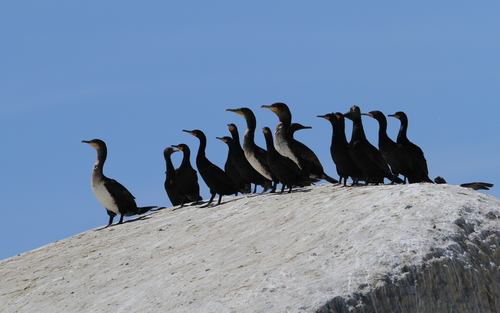 キノドハナグロウ
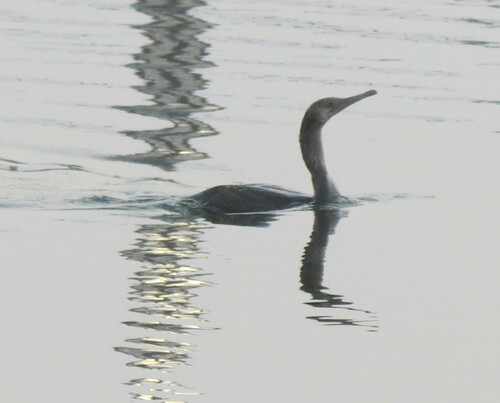 ペルシャウ
要点
The most reliable way to separate Cape Cormorant from Socotra Cormorant is by range: Cape is strictly confined to the southwestern coast of Africa, while Socotra is endemic to the Persian Gulf and southeast Arabian Peninsula. For field marks, Cape Cormorant adults show a glossy blue-black plumage with a deep yellow-orange gular pouch and turquoise eyes, whereas Socotra Cormorant lacks these specific color highlights in the available descriptions. Juvenile and immature Cape Cormorants are browner with a variable gular pouch and grey eyes, which may help if you see a mixed-age group. Both species are similar in overall cormorant shape and size, so focus on plumage and bare-part color, especially the gular pouch and eye color, along with location.
識別のコツ
- Geographic range is the first check: Cape Cormorant is only found along the southwestern African coast; Socotra Cormorant is limited to the Persian Gulf and southeast Arabian Peninsula. If you are outside these areas, reconsider your ID.
- Adult Cape Cormorant shows a deep yellow-orange gular pouch—a strong field mark. Socotra Cormorant is not described as having this feature.
- Cape Cormorant adults have turquoise eyes with a greenish eye-ring. Socotra Cormorant's eye color is not specified, but the striking turquoise is unique to Cape among these two.
- Glossy blue-black plumage in adult Cape Cormorant is distinctive, especially in good light. Socotra Cormorant is described only as dark, with no mention of gloss or bottle-green wing shine.
- Juvenile and immature Cape Cormorants are browner overall, with a brown throat and variable gular pouch color (black, white, or speckled), and grey eyes. If you see a brownish cormorant with these features in southern Africa, it's likely a Cape.
- Non-breeding and immature Cape Cormorants are duller than breeding adults, but still show the overall blue-black tone and may retain some gular pouch color.
- No distinctive juvenile or immature plumage is described for Socotra Cormorant—if you see a cormorant with the Cape's age-related features outside Africa, reconsider your ID.
- Both species are similar in size and shape, so do not rely on bulk or length for separation.
- Bill color is dark grey-black in Cape Cormorant; Socotra's bill color is not specified but likely similar, so not a reliable mark.
- Courtship calls in Cape Cormorant are sex-specific: males cluck, females respond with 'gra-gra-gra'. If you hear these, you are likely dealing with Cape.
- Both species are marine and coastal, so habitat alone is not diagnostic unless combined with range.
- No mention of distinctive flight or wing pattern for either species; focus on perched or close-up views for ID.
- If you see a cormorant with a bright yellow-orange throat pouch and turquoise eyes, it is Cape Cormorant—this combination is not described for Socotra.
- If uncertain, prioritize range and gular pouch color over subtle plumage tones.
- In mixed-age flocks, look for the brownish juveniles and turquoise-eyed adults to confirm Cape Cormorant; Socotra is not known to show these features.
大きさ
Cape Cormorant adults weigh around 1.2 kg (1217 g) and measure 61–64 cm in length, with a wingspan of about 260 mm. No direct size data is available for Socotra Cormorant, but both are medium-large cormorants and likely similar in bulk and proportions. Size alone is not reliable for separation.
羽色
Juvenile and immature Cape Cormorants are distinctly browner than adults, with a brown throat and a variable gular pouch (black, white, or speckled), and grey eyes. Non-breeding and immature adults are duller overall. In contrast, Socotra Cormorant's age-related plumage details are not described in the sources, but it lacks mention of the Cape's glossy blue-black adult coloration, yellow-orange gular pouch, or turquoise eyes. Adult Cape Cormorants in breeding condition have a bottle-green gloss to the wings, while Socotra's adult plumage is not specified beyond being a dark cormorant. Therefore, focus on the Cape's glossy blue-black body, colorful gular pouch, and eye color for separation, especially in adults.
行動
Both species are typical cormorants in behavior, often seen perched in groups or flying low over water. There are no distinctive behavioral differences noted in the sources that would reliably separate them in the field.
生息環境
Cape Cormorant is strictly coastal, found only along the southwestern coast of Africa. Socotra Cormorant is restricted to the Persian Gulf and southeast Arabian Peninsula, occasionally reaching the Red Sea. Their ranges do not overlap, so location is a primary clue. Both species inhabit marine coasts and islands.
声
Cape Cormorant has a variety of calls, with both sexes giving similar sounds except during courtship: males produce a repeated low-pitch cluck, and females respond with a 'gra-gra-gra' call. Socotra Cormorant's vocalizations are not described in the sources, so voice is not a reliable separator unless Cape's courtship calls are heard.