

アトリ 対 ノドグロアオジ
Fringilla montifringilla 対 Emberiza cirlus
アトリとノドグロアオジのクイズ
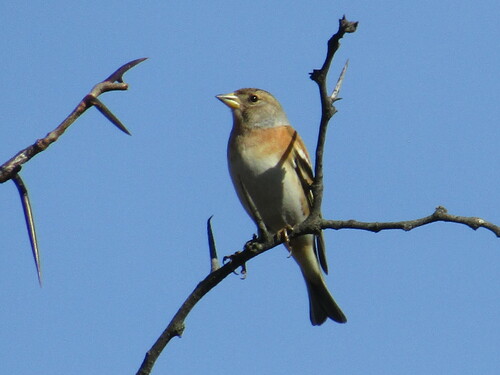 アトリ
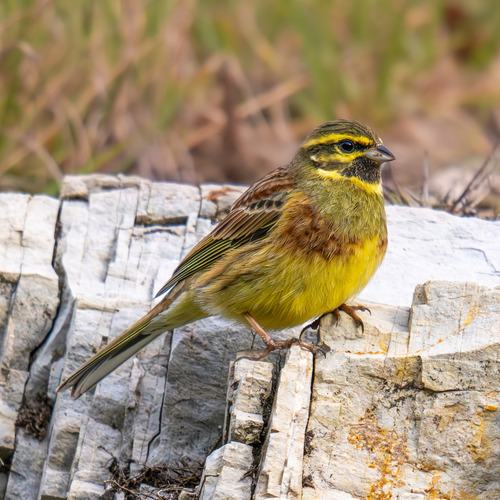 ノドグロアオジ
要点
The most reliable field mark to separate Brambling from Cirl Bunting is the Brambling’s white rump (all ages), which contrasts with the Cirl Bunting’s streaked grey-brown rump. In flight or perched, Bramblings show a bold orange breast and white belly, while Cirl Buntings (especially males) have a yellow head with black markings and a greenish breast band. Bill color is also useful: Bramblings have a yellow bill (except breeding males, which have black), while Cirl Buntings have a typical seed-eater’s bill. Juvenile and female Bramblings can be confused with buntings, but careful attention to rump color, underpart pattern, and head markings will separate them. Both species are similar in size, but their structure and color patterns are quite distinct.
識別のコツ
- White rump (Brambling, all ages): In flight, look for a clean white rump on Brambling; Cirl Bunting’s rump is streaked grey-brown. This is the single most reliable field mark.
- Underpart pattern: Brambling shows a bright orange breast with a sharply contrasting white belly and dark-spotted flanks. Cirl Bunting (especially males) has yellow underparts with a greenish breast band; females are duller but never show the Brambling’s orange-white contrast.
- Head pattern (males): Male Brambling in breeding plumage has a black head and back. Male Cirl Bunting has a bright yellow head with black crown, eyestripe, and throat. Female Cirl Bunting has a plain face with streaked upperparts.
- Scapular color: Brambling has orange scapulars; Cirl Bunting has chestnut shoulders (females) or brownish upperparts (males).
- Bill color: Brambling has a yellow bill in most plumages (black in breeding males); Cirl Bunting has a pale, thick seed-eater’s bill.
- Tail pattern: Bramblings lack white outer tail feathers, but so do Cirl Buntings; this feature is not helpful here.
- Flank pattern: Brambling has dark-spotted flanks; Cirl Bunting’s flanks are plain or lightly streaked.
- Breast band: Cirl Bunting males have a greenish breast band; Brambling never shows this.
- Group size: Large flocks suggest Brambling, especially in winter; Cirl Buntings are rarely seen in large groups.
- Habitat: Bramblings are widespread in winter, often in woodlands and farmland; Cirl Buntings are tied to traditional farmland with hedgerows and rough grass.
- Song: If heard, a rattling trill indicates Cirl Bunting; Brambling’s song is not described here.
- Geographic range: Cirl Buntings are resident in southern Europe and rare in the UK; Bramblings are widespread winter visitors.
- Season: Bramblings are most likely in autumn and winter; Cirl Buntings are present year-round but breed in spring/summer.
- Sex/age pitfalls: Female and juvenile Bramblings are the most likely to be confused with buntings; always check rump and underpart pattern.
- Perched vs. flight views: In flight, focus on rump color and underpart contrast; perched, check head pattern and bill color.
大きさ
Both species are small passerines of similar size and bulk. The Brambling averages 22g in body mass [wikidata], while the Cirl Bunting is around 15.5 cm in length with a wingspan of 22–25.5 cm [wikipedia]. In the field, neither species is notably larger or bulkier than the other, and size alone is not a reliable separator.
羽色
Juvenile and female Bramblings can look superficially like buntings, but several features are diagnostic. All ages of Brambling show a white rump in flight, while Cirl Buntings have a streaked grey-brown rump. Bramblings have an orange breast with a sharp contrast to a white belly, and dark-spotted flanks; Cirl Buntings (especially males) have yellow underparts with a greenish breast band and lack the sharp orange-white contrast. Male Bramblings in breeding plumage have a striking black head and back, while male Cirl Buntings have a bright yellow head with black crown, eyestripe, and throat. Female Cirl Buntings are duller, with chestnut shoulders and streaked upperparts, but still lack the Brambling’s orange scapulars and white rump. Bill color differs: Bramblings have a yellow bill (except breeding males, which have black), while Cirl Buntings have a typical pale seed-eater’s bill. Bramblings lack the white outer tail feathers seen in some other finches, and Cirl Buntings do not show this feature either.
行動
Bramblings are often seen in large, sometimes massive, flocks during migration and winter, feeding on the ground or in trees. Cirl Buntings are more often seen in pairs or small groups, foraging on or near the ground, especially in farmland and grassy margins. Flight style is not notably different, but Brambling flocks can be conspicuous in open areas, while Cirl Buntings are more localized and less gregarious.
生息環境
Bramblings are migratory and can be found in a wide range of habitats during winter, including woodlands, farmland, and gardens, often in large flocks. Cirl Buntings are residents of southern Europe and the Mediterranean, preferring farmland with hedgerows, rough grassland, and field margins. They are closely tied to traditional agricultural landscapes and are unlikely to be found far from these habitats. In the UK, Cirl Buntings are highly localized and rare, while Bramblings are widespread winter visitors.
声
The Cirl Bunting male’s song is a monotonous rattling trill, reminiscent of an Arctic Warbler or the terminal rattle of a Lesser Whitethroat [wikipedia]. Brambling vocalizations are not described in the provided notes, so song is not a reliable separator unless the bunting’s trill is heard.