

クロキョウジョシギ 対 コオバシギ
Arenaria melanocephala 対 Calidris canutus
クロキョウジョシギとコオバシギのクイズ
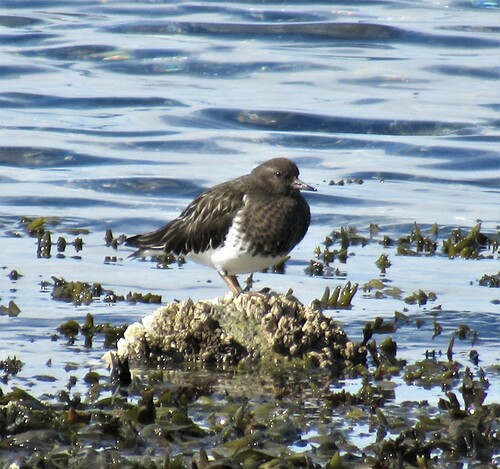 クロキョウジョシギ
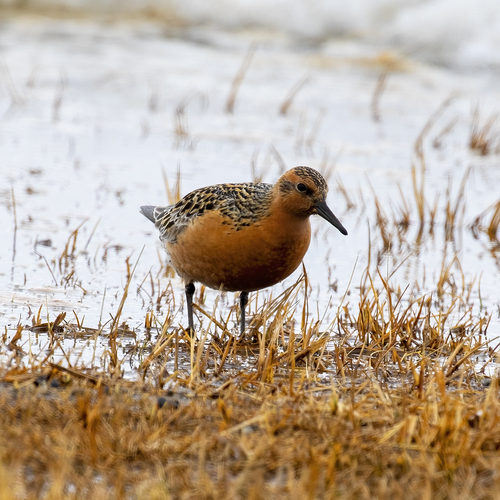 コオバシギ
要点
The most reliable field mark to separate Black Turnstone from Red Knot is the bold, contrasting black-and-white wing and tail pattern of the Black Turnstone in flight, visible in all ages, versus the Red Knot’s much plainer upperwing and grey rump/tail. Juvenile and nonbreeding birds are especially prone to confusion, but the Turnstone always shows a white wingbar, white shoulder patch, and a white tail with a broad black subterminal band—features never present on Red Knot. Structurally, Black Turnstone is chunkier with a shorter, slightly upturned bill and darker, duller legs, while Red Knot is longer-bodied, longer-winged, and has a straight, medium-length dark bill and short greenish legs. Both species can occur on the Pacific coast in winter, but Turnstone prefers rocky shorelines, while Red Knot is found on open mudflats and sandy beaches.
識別のコツ
- Flight pattern is key: In all ages and seasons, Black Turnstone shows a bold white wingbar, white shoulder patch, and a white tail with a broad black subterminal band. Red Knot lacks the white shoulder patch and has a plain grey rump and tail with no black band.
- Juvenile confusion: Juvenile Black Turnstone is browner with buff fringes on the wing-coverts and scapulars, but still shows the diagnostic flight pattern. Juvenile Red Knot has brown coverts with submarginal lines, but never shows black-and-white contrast on the upperparts or tail.
- Bill shape: Black Turnstone has a short, slightly upturned black bill; Red Knot’s bill is straight, medium-length, and tapers gently. This is visible at close range or in good photos.
- Leg color: Black Turnstone has dark, blackish-brown legs with a reddish tinge, while Red Knot’s legs are short and dark greenish. Both are dark, but Turnstone’s are never greenish.
- Body shape: Black Turnstone is compact and chunky, with a short neck and broad chest. Red Knot is longer-bodied and longer-winged, with a more streamlined look and a 'low-slung' feeding posture.
- Breeding plumage: Black Turnstone has a black head and breast with a white spot between the eye and bill and a white supercilium; Red Knot is mottled grey above with a cinnamon face, throat, and breast. The red tones of the Knot are unique in breeding season.
- Nonbreeding plumage: Black Turnstone remains dark brown above and below, with little white on the head or breast. Red Knot becomes pale grey overall, with no strong patterning.
- Tail pattern when perched: Black Turnstone’s white tail with a broad black band can sometimes be glimpsed when perched or preening; Red Knot’s tail is plain grey.
- Habitat: In winter, Turnstone is almost always on rocky coasts, jetties, or breakwaters; Red Knot is on open mudflats or sandy beaches. If you see a bird on rocks, Turnstone is much more likely.
- Feeding behavior: Turnstone flips stones and debris with its bill; Red Knot probes mud or sand. Watch for this behavior if the bird is actively feeding.
- Group size: Red Knot often forages in larger, tighter flocks; Turnstone is more solitary or in small groups.
- Vocalizations: If heard, Turnstone’s call is a higher, less harsh trill; Red Knot’s flight calls are low and monosyllabic or disyllabic.
- Geographic context: Black Turnstone is a Pacific coast specialist; Red Knot is more widespread but only overlaps with Turnstone on the Pacific coast in winter.
- Sex and age: Breeding male Red Knot has more even, extensive red underparts; females are slightly paler with a less distinct eye-line, but this is subtle and not reliable for separation from Turnstone.
- Beware overlap: In dull winter plumage, both can appear plain and dark at a distance, but the Turnstone’s flight pattern and chunkier jizz remain distinctive. Always try to see the bird in flight or from behind to check the tail and wing pattern.
大きさ
Red Knot is slightly larger overall, measuring 23–26 cm in length and averaging 137 g in mass [wikidata], while Black Turnstone is 22–25 cm long and weighs 100–170 g [wikipedia]. However, the difference is subtle in the field. Red Knot appears longer-bodied and longer-winged, with a more streamlined profile, whereas Black Turnstone is more compact and chunky. Bill length is similar, but Turnstone’s bill is stubbier and slightly upturned, while Red Knot’s is straight and tapers gently.
羽色
Juvenile and nonbreeding Black Turnstones are mostly dark brown above with buff fringes, but in all ages and seasons, the flight view is diagnostic: Black Turnstone shows a strong white wingbar, a white shoulder patch, and a white tail with a broad black subterminal band. There is also a white area from the lower back to the upper tail-coverts, interrupted by a dark bar across the rump. In contrast, Red Knot (all ages) in flight shows a plain grey upperwing with a white wingbar, but lacks the bold white shoulder patch and the black-banded tail; its rump and tail are grey, not white with a black band. On the ground, breeding Black Turnstone has a black head and breast with a white spot between the eye and bill, and a white supercilium, while Red Knot in breeding plumage is mottled grey above with a cinnamon face, throat, and breast. In nonbreeding (winter) plumage, both are duller, but Turnstone remains darker and more patterned, while Red Knot is pale grey overall. Juvenile Red Knot shows brown coverts with submarginal lines, but lacks any black-and-white contrast on the upperparts or tail.
行動
Black Turnstone is often seen actively flipping stones, algae, or debris with its bill, foraging along rocky shorelines or man-made structures. It tends to move in small groups or pairs and is more likely to be seen on rocks or jetties. Red Knot forages by probing in mud or sand, often in larger flocks, and moves with a more deliberate, low-slung gait. In flight, Red Knot flocks are tight and fast-moving, while Black Turnstone flocks are looser and may show more erratic, low flights over rocks.
生息環境
Black Turnstone is strongly associated with rocky Pacific coastlines, jetties, and breakwaters in winter, and breeds in wet meadows or sedge marshes near the coast in Alaska. Red Knot is found on open tidal mudflats, sandy beaches, and estuaries during migration and winter, and breeds in high Arctic tundra. Overlap is possible on Pacific mudflats, but Black Turnstone avoids open beaches and mudflats unless rocks are present, while Red Knot avoids rocky habitats.
声
Black Turnstone gives a higher, less harsh rattling trill than the Red Knot, as well as a loud screeching alarm and a soft purring call to chicks. Red Knot is mostly silent when feeding, but in flight flocks gives a low monosyllabic 'knutt' or disyllabic 'knuup-knuup.' Display songs are not likely to be heard outside the breeding grounds. Calls are not usually diagnostic unless heard well and compared directly.