

ユリカモメ 対 ニシズグロカモメ
Chroicocephalus ridibundus 対 Ichthyaetus melanocephalus
ユリカモメとニシズグロカモメのクイズ
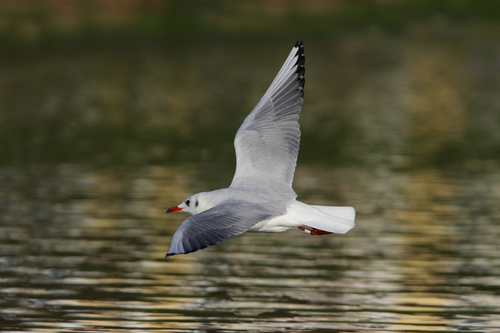 ユリカモメ
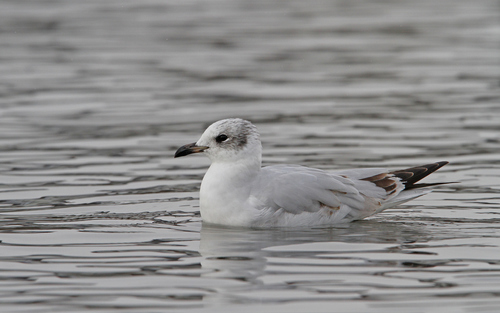 ニシズグロカモメ
要点
The most reliable field mark to separate Black-headed Gull from Mediterranean Gull is the wing pattern in flight, especially in immature birds: Black-headed Gull (all ages) shows black wingtips with a clear white leading edge, while Mediterranean Gull adults have all-white primaries and first-years show more extensive black in the upperwing and pale underwings. Adults in breeding plumage differ in head pattern: Black-headed Gull has a chocolate-brown hood that stops above the nape, while Mediterranean Gull's black hood extends onto the nape and features striking white eye crescents. Mediterranean Gull is slightly larger and bulkier, with a heavier, parallel-sided bill and longer, darker legs. Bill color and pattern, as well as the extent and shade of the hood, are useful in close views, but the flight pattern and wing markings are the most consistent clues, especially for immatures.
識別のコツ
- Immature wing pattern in flight: First-year Black-headed Gulls have a brown carpal bar, blackish secondaries, and a black tail band, with a white leading edge to the wing and black wingtips; the underside of the inner primaries is dark. Mediterranean Gull first-years have a more extensive black in the upperwing and pale underwings, lacking the dark inner primaries of Black-headed Gull. Use this for all non-adult birds in flight.
- Adult wing pattern: Adult Mediterranean Gulls have pure white wings with no black tips on the primaries, while Black-headed Gulls always show black-tipped primaries and a white leading edge. This is most obvious in flight.
- Head pattern (breeding): Black-headed Gull has a chocolate-brown hood (never truly black) that stops above the nape, while Mediterranean Gull's hood is jet black, extends down the nape, and is offset by bold white eye crescents. Look for this from March to July.
- Head pattern (non-breeding): Black-headed Gull loses the hood, showing only two small dark spots near the eyes. Mediterranean Gull in non-breeding plumage shows a broad dusky mask through the eye, more extensive than the spots of Black-headed Gull.
- Bill shape and color: Mediterranean Gull has a heavier, parallel-sided, dark red bill with a black subterminal band (especially in adults). Black-headed Gull's bill is thinner, shorter, and plain red, lacking the black band.
- Leg color and length: Mediterranean Gull has longer, darker red legs compared to the shorter, paler red legs of Black-headed Gull. This is subtle and best used when birds are side by side.
- Body structure: Mediterranean Gull is bulkier and slightly larger overall, with a heavier build and longer legs, while Black-headed Gull is more delicate and lightly built. This is most useful with direct comparison.
- Mantle and back color: Mediterranean Gull has a very pale grey mantle and back, almost white, while Black-headed Gull's mantle is a slightly darker pale grey. This difference is subtle and may be hard to judge in isolation.
- Tail pattern (immatures): Both species' juveniles have a black tail band, but Mediterranean Gull's is often broader and more sharply defined. Use with caution, as overlap occurs.
- Eye crescents: In breeding plumage, Mediterranean Gull shows prominent white crescents around the eye, which Black-headed Gull lacks.
- Seasonal timing: Black-headed Gull's hood appears from March to July (sometimes earlier/later); Mediterranean Gull's hood is present in the same period but is blacker and more extensive.
- Plumage transition: First-summer Black-headed Gulls may show a partial brown hood, highly variable, while Mediterranean Gulls at this age may show a more distinct mask or hood with white crescents.
- Habitat context: Black-headed Gull is much more numerous and widespread, especially in urban and inland habitats; Mediterranean Gull is more localized and less likely away from coasts or breeding colonies.
- Pitfalls: Beware distant or backlit views—Black-headed Gull's brown hood can look black, and Mediterranean Gull's white wingtips may be hard to see in poor light. Always try to see the wing pattern in flight and the bill shape/color for confirmation.
- No song/voice separator: No distinctive vocal differences are noted in the sources for field separation.
大きさ
Black-headed Gull averages about 280.5 g in body mass, making it a small gull. Mediterranean Gull is slightly larger and bulkier overall, though exact mass is not provided. Mediterranean Gull also has a heavier, more parallel-sided bill and longer, darker legs, giving it a more robust appearance compared to the relatively daintier Black-headed Gull. These size and structure differences are subtle and best appreciated with direct comparison or experience.
羽色
Immature/first-year birds: Black-headed Gull juveniles and first-winters show a brown carpal bar on the inner wing, blackish secondaries, and a black tail band, with mottled brown on the body. In flight, the upperwing has a distinct white leading edge and black wingtips, while the underside of the inner primaries is dark. Mediterranean Gull first-years have a black terminal tail band as well, but their upperwings show more extensive black and their underwings are notably pale, lacking the dark inner primaries of Black-headed Gull. Adults in breeding plumage: Black-headed Gull has a chocolate-brown hood (not truly black), which stops above the nape, with white neck, underparts, and tail, pale grey upperwings with black-tipped primaries, and red bill and legs. Mediterranean Gull adults have a true black hood that extends onto the nape, with prominent white crescents around the eye, a very pale grey mantle, and pure white wings with no black tips on the primaries. The bill is dark red with a black subterminal band. In non-breeding plumage, Black-headed Gull loses the hood, retaining only two dark spots near the eye, while Mediterranean Gull shows a broad dusky 'bandit' mask through the eye. Both species take two years to reach maturity.
行動
Both species are gregarious, especially outside the breeding season. Black-headed Gull is noted for both head-bobbing and non-bobbing walking, but this is not a reliable field mark for separation from Mediterranean Gull. Both species feed in similar ways and form large flocks, especially in winter. No distinctive behavioral difference is highlighted for field identification.
生息環境
Both species breed in colonies near water, such as reed beds, marshes, or islands in lakes. Black-headed Gull is widespread across Europe and Asia, and is abundant in much of its range, wintering further south or in milder regions. Mediterranean Gull has a more restricted range and is less abundant. Both may be found together in coastal or inland wetlands, but Black-headed Gull is more likely to be encountered in a wider variety of habitats, including urban areas. Habitat alone is not a reliable separator where ranges overlap.