

Motmot

ヒゲガラ 対 ハシボソヨシキリ

Panurus biarmicus 対 Acrocephalus paludicola

ヒゲガラとハシボソヨシキリのクイズ
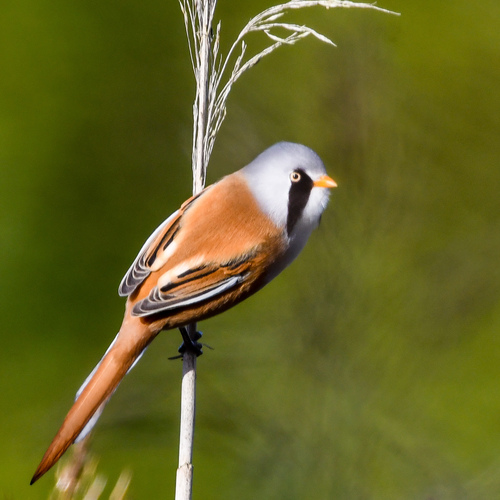
ヒゲガラ (Panurus biarmicus) ヒゲガラ
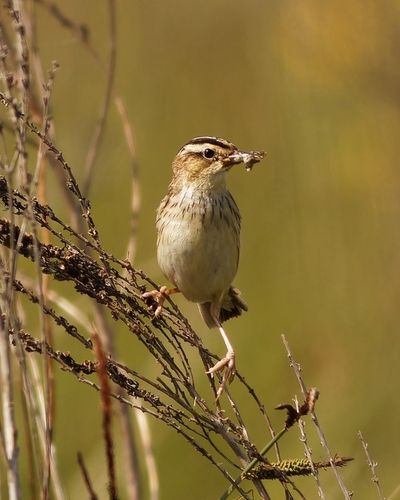
ハシボソヨシキリ (Acrocephalus paludicola) ハシボソヨシキリ

メディア

読み込み中…

要点

The most reliable field mark between Bearded Tit and Aquatic Warbler is the Bearded Tit's long tail and, in adult males, the striking black 'moustaches' and grey head—features never shown by Aquatic Warbler. Juvenile Bearded Tits have a bold black back patch and black in the tail, while Aquatic Warbler juveniles lack these and instead show a prominent pale crown stripe and supercilium. In flight, Bearded Tits appear more orange-brown and long-tailed, while Aquatic Warblers are smaller, spiky-tailed, and heavily streaked above. Both can be found in wetland habitats, but Bearded Tits are reedbed specialists, whereas Aquatic Warblers prefer sedge beds with shorter vegetation. Vocalizations differ markedly: Bearded Tits give a metallic 'ping', while Aquatic Warblers have a fast, chattering song.

識別のコツ

  1. Juvenile Bearded Tit shows a bold black rectangular back patch and extensive black in the tail—diagnostic in fresh juveniles, never matched by Aquatic Warbler of any age.
  2. Adult male Bearded Tit has a grey head and black 'moustaches'; Aquatic Warbler never shows any facial black or grey.
  3. Adult female Bearded Tit is paler, with a brownish head and lacks black facial marks, but still has a long tail and orange-brown tones, unlike Aquatic Warbler.
  4. Aquatic Warbler (all ages) shows a strong pale crown stripe and supercilium, and is heavily streaked above; Bearded Tit never has a crown stripe or such heavy streaking.
  5. Juvenile Aquatic Warbler is unstreaked below and lacks the black back patch; check for pale underparts and streaked upperparts.
  6. Tail structure is key: Bearded Tit's tail is long and rounded with white edges (adults), while Aquatic Warbler's is shorter, spiky, and lacks white edges.
  7. Bill color in Bearded Tit juveniles is sex-linked: bright orange-yellow in males, duller in females; Aquatic Warbler's bill is always strong and pointed, without such color variation.
  8. In flight, Bearded Tit shows contrasting black and white in the wings and white tail edges; Aquatic Warbler lacks these patterns and appears more uniform and streaky.
  9. Bearded Tit is more orange-brown overall, with a whitish throat and chest; Aquatic Warbler is brown and streaky above, pale below.
  10. Bearded Tit's eye color changes with age (juveniles dark brown, adults yellow/orange), but this is rarely visible in the field.
  11. Bearded Tit is often seen in flocks, especially outside breeding season, and perches high on reeds; Aquatic Warbler is solitary or in loose groups and stays low in sedge beds.
  12. Habitat is a strong clue: Bearded Tit in tall, dense reedbeds; Aquatic Warbler in open, short sedge marshes.
  13. Voice is distinctive: listen for Bearded Tit's metallic 'ping' versus Aquatic Warbler's fast, chattering song.
  14. Size and structure: Bearded Tit is larger and heavier, with a longer tail and bulkier build; Aquatic Warbler is smaller, lighter, and more delicate.
  15. Seasonal context: Bearded Tit is resident in suitable reedbeds year-round; Aquatic Warbler is a passage migrant or breeder in specific sedge marshes, never resident in tall reedbeds.

大きさ

Bearded Tit is noticeably larger and heavier (body mass ~15.3g) than Aquatic Warbler (~10.5g). The Bearded Tit is also longer (14.5–17 cm), with a much longer tail, giving it a distinctly different silhouette both perched and in flight. Aquatic Warbler is a medium-sized warbler but appears smaller and more delicate, with a spiky, shorter tail and a more compact build.

羽色

Juvenile Bearded Tits are unique among these two: they show a bold, roughly rectangular black patch on the back and extensive black in the tail feathers, which is never present in Aquatic Warbler of any age. Juvenile Bearded Tits also have a buffier overall tone and a contrasting loreal patch (large and black in males, smaller and dusky in females), with bill color differences between sexes. Adult male Bearded Tits are unmistakable with a grey head, black 'moustaches', and black undertail coverts; females are paler, with a brownish head and lack the black facial marks. Adult Aquatic Warblers (and juveniles) are heavily streaked brown above, with a strong pale crown stripe and supercilium, pale underparts (juveniles unstreaked below), and never show black facial markings or a grey head. Aquatic Warbler always lacks the orange-brown overall tone and white-edged tail of Bearded Tit. In flight, Bearded Tits show contrasting black and white in the wings and white tail edges; Aquatic Warblers appear paler, spiky-tailed, and streaky, with no wing or tail patterning.

行動

Bearded Tits are highly social outside the breeding season, often seen in noisy flocks moving through reeds, with undulating, whirring flights and frequent tail flicking. They often perch high on reed stems. Aquatic Warblers are more secretive, moving low through sedge beds and rarely forming large groups. Their flight is less undulating and more direct, with a spiky-tailed appearance. Bearded Tits are more likely to be seen in pairs or family groups during breeding, while Aquatic Warblers are solitary or in loose association during migration.

生息環境

Bearded Tits are reedbed specialists, almost always found in extensive stands of tall reeds (Phragmites) near water. Aquatic Warblers breed and forage in wet sedge beds with shorter vegetation (less than 30 cm), avoiding dense reedbeds. While both occur in wetland habitats, the structure and height of the vegetation are key: Bearded Tits in tall, dense reeds; Aquatic Warblers in shorter, open sedge or grass-dominated marshes.

声

Bearded Tits have a distinctive metallic 'ping' call, often given in flight or to maintain contact within flocks, and the male's song is a tuneful 'tschin-schik-schra'. Aquatic Warbler's song is a fast, chattering 'ja-ja-ja' interspersed with acrocephaline whistles. The calls and songs are very different and, with experience, easily separated.

より良い説明を送る

比較と同じ項目を使ってください。文章はすぐに公開されます。

The most reliable field mark between Bearded Tit and Aquatic Warbler is the Bearded Tit's long tail and, in adult males, the striking black 'moustaches' and grey head—features never shown by Aquatic Warbler. Juvenile Bearded Tits have a bold black back patch and black in the tail, while Aquatic Warbler juveniles lack these and instead show a prominent pale crown stripe and supercilium. In flight, Bearded Tits appear more orange-brown and long-tailed, while Aquatic Warblers are smaller, spiky-tailed, and heavily streaked above. Both can be found in wetland habitats, but Bearded Tits are reedbed specialists, whereas Aquatic Warblers prefer sedge beds with shorter vegetation. Vocalizations differ markedly: Bearded Tits give a metallic 'ping', while Aquatic Warblers have a fast, chattering song.

  1. Juvenile Bearded Tit shows a bold black rectangular back patch and extensive black in the tail—diagnostic in fresh juveniles, never matched by Aquatic Warbler of any age.
  2. Adult male Bearded Tit has a grey head and black 'moustaches'; Aquatic Warbler never shows any facial black or grey.
  3. Adult female Bearded Tit is paler, with a brownish head and lacks black facial marks, but still has a long tail and orange-brown tones, unlike Aquatic Warbler.
  4. Aquatic Warbler (all ages) shows a strong pale crown stripe and supercilium, and is heavily streaked above; Bearded Tit never has a crown stripe or such heavy streaking.
  5. Juvenile Aquatic Warbler is unstreaked below and lacks the black back patch; check for pale underparts and streaked upperparts.
  6. Tail structure is key: Bearded Tit's tail is long and rounded with white edges (adults), while Aquatic Warbler's is shorter, spiky, and lacks white edges.
  7. Bill color in Bearded Tit juveniles is sex-linked: bright orange-yellow in males, duller in females; Aquatic Warbler's bill is always strong and pointed, without such color variation.
  8. In flight, Bearded Tit shows contrasting black and white in the wings and white tail edges; Aquatic Warbler lacks these patterns and appears more uniform and streaky.
  9. Bearded Tit is more orange-brown overall, with a whitish throat and chest; Aquatic Warbler is brown and streaky above, pale below.
  10. Bearded Tit's eye color changes with age (juveniles dark brown, adults yellow/orange), but this is rarely visible in the field.
  11. Bearded Tit is often seen in flocks, especially outside breeding season, and perches high on reeds; Aquatic Warbler is solitary or in loose groups and stays low in sedge beds.
  12. Habitat is a strong clue: Bearded Tit in tall, dense reedbeds; Aquatic Warbler in open, short sedge marshes.
  13. Voice is distinctive: listen for Bearded Tit's metallic 'ping' versus Aquatic Warbler's fast, chattering song.
  14. Size and structure: Bearded Tit is larger and heavier, with a longer tail and bulkier build; Aquatic Warbler is smaller, lighter, and more delicate.
  15. Seasonal context: Bearded Tit is resident in suitable reedbeds year-round; Aquatic Warbler is a passage migrant or breeder in specific sedge marshes, never resident in tall reedbeds.

Bearded Tit is noticeably larger and heavier (body mass ~15.3g) than Aquatic Warbler (~10.5g). The Bearded Tit is also longer (14.5–17 cm), with a much longer tail, giving it a distinctly different silhouette both perched and in flight. Aquatic Warbler is a medium-sized warbler but appears smaller and more delicate, with a spiky, shorter tail and a more compact build.

Juvenile Bearded Tits are unique among these two: they show a bold, roughly rectangular black patch on the back and extensive black in the tail feathers, which is never present in Aquatic Warbler of any age. Juvenile Bearded Tits also have a buffier overall tone and a contrasting loreal patch (large and black in males, smaller and dusky in females), with bill color differences between sexes. Adult male Bearded Tits are unmistakable with a grey head, black 'moustaches', and black undertail coverts; females are paler, with a brownish head and lack the black facial marks. Adult Aquatic Warblers (and juveniles) are heavily streaked brown above, with a strong pale crown stripe and supercilium, pale underparts (juveniles unstreaked below), and never show black facial markings or a grey head. Aquatic Warbler always lacks the orange-brown overall tone and white-edged tail of Bearded Tit. In flight, Bearded Tits show contrasting black and white in the wings and white tail edges; Aquatic Warblers appear paler, spiky-tailed, and streaky, with no wing or tail patterning.

Bearded Tits are highly social outside the breeding season, often seen in noisy flocks moving through reeds, with undulating, whirring flights and frequent tail flicking. They often perch high on reed stems. Aquatic Warblers are more secretive, moving low through sedge beds and rarely forming large groups. Their flight is less undulating and more direct, with a spiky-tailed appearance. Bearded Tits are more likely to be seen in pairs or family groups during breeding, while Aquatic Warblers are solitary or in loose association during migration.

Bearded Tits are reedbed specialists, almost always found in extensive stands of tall reeds (Phragmites) near water. Aquatic Warblers breed and forage in wet sedge beds with shorter vegetation (less than 30 cm), avoiding dense reedbeds. While both occur in wetland habitats, the structure and height of the vegetation are key: Bearded Tits in tall, dense reeds; Aquatic Warblers in shorter, open sedge or grass-dominated marshes.

Bearded Tits have a distinctive metallic 'ping' call, often given in flight or to maintain contact within flocks, and the male's song is a tuneful 'tschin-schik-schra'. Aquatic Warbler's song is a fast, chattering 'ja-ja-ja' interspersed with acrocephaline whistles. The calls and songs are very different and, with experience, easily separated.

変更を破棄しますか?

保存していない編集があります。今離れると失われます。

ヒゲガラ · ハシボソヨシキリ · 苦手な鳥