

オトメシギダチョウ 対 ハシナガシギダチョウ
Crypturellus bartletti 対 Nothoprocta taczanowskii
オトメシギダチョウとハシナガシギダチョウのクイズ
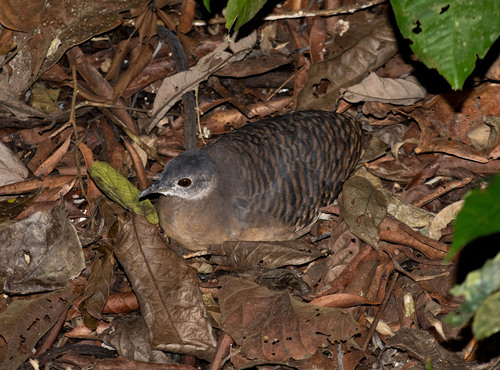 オトメシギダチョウ
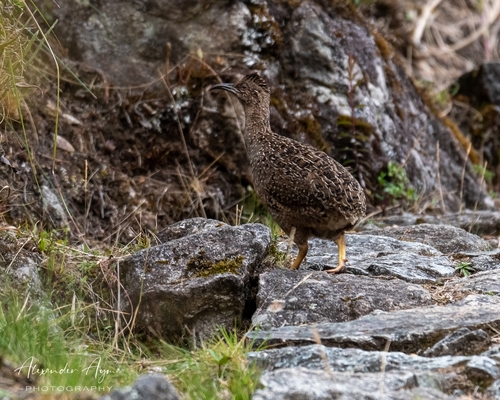 ハシナガシギダチョウ
要点
The most reliable field separation between Bartlett's Tinamou and Taczanowski's Tinamou is their overall plumage pattern and habitat context. Taczanowski's is a larger, dark, and finely-marked tinamou with distinctive grey and black facial markings, buffy and barred underparts, and a long, blackish, curved bill—features not seen in Bartlett's. Bartlett's Tinamou is smaller, plainer, and found in lowland forests, while Taczanowski's is restricted to the high Andes. Immature Taczanowski's are richer brown but still show the characteristic patterning. If you see a tinamou in dense lowland forest, it is almost certainly Bartlett's; in high Andean grassland or scrub, it is Taczanowski's.
識別のコツ
- Habitat is often decisive: Bartlett's Tinamou is a lowland forest specialist, while Taczanowski's is found only in high Andean grasslands and slopes. Always check your elevation and habitat first.
- Size and structure: Taczanowski's is much larger and bulkier than Bartlett's, with a noticeably longer and more curved blackish bill. Bartlett's is smaller and more compact.
- Facial pattern: Taczanowski's has a striking grey head and neck with blackish crown and face markings and a pale greyish-buff throat. Bartlett's lacks these strong facial contrasts and is overall plainer.
- Upperparts and wing-coverts: Taczanowski's shows dusky upperparts with thin buff stripes, brown barring, and black and buff mottling on the wing-coverts. Bartlett's is much less patterned above.
- Flight feathers: Taczanowski's has tawny flight feathers barred blackish, visible in flight or when the wing is spread. Bartlett's lacks such strong barring.
- Underparts: Taczanowski's breast is grey with buffy spots bordered black, and the rest of the underparts are buff, barred dusky. Bartlett's underparts are not described as barred or spotted.
- Juvenile/immature birds: Young Taczanowski's are richer brown but still show the species' fine barring and mottling, especially on the wing-coverts. Bartlett's young are not described as distinctive, so expect them to be plain.
- Bill shape: Taczanowski's has a long, blackish, curved bill, which is a strong structural clue. Bartlett's has a shorter, less curved bill.
- Tail: Both genera are named for their 'hidden tail'—do not rely on tail length or shape for separation.
- Behavior in context: Taczanowski's may be seen in the open, walking upright in grassland or on Andean slopes. Bartlett's is more likely to be seen skulking in dense forest cover.
- No strong seasonal or sexual dimorphism: No seasonal or sex-based plumage differences are noted for either species, so these marks are reliable year-round.
- No known vocal differences: No vocalizations are described in the sources, so do not rely on voice for separation.
- Range overlap is minimal: These species are not likely to be confused except in captivity or in a quiz, as their ranges and habitats do not overlap in the wild.
- When in doubt, trust the pattern: Taczanowski's is always more barred, mottled, and marked than Bartlett's, which is plain and uniform.
大きさ
Bartlett's Tinamou is significantly smaller, with a body mass around 241 g [wikidata], compared to Taczanowski's Tinamou, which averages about 36 cm in length and is visibly bulkier in the field [wikipedia]. Taczanowski's also has a noticeably longer and more curved bill. If you have a direct comparison or are familiar with tinamou sizes, Taczanowski's will appear much larger and heavier-bodied.
羽色
- Juvenile/Immature: Young Taczanowski's Tinamou are generally richer brown overall but still show the species' characteristic fine barring and mottling, especially on the wing-coverts. Bartlett's Tinamou lacks any mention of distinctive juvenile patterning and is overall much plainer at all ages.
- Adult: Taczanowski's Tinamou is dark and finely marked: the head and neck are grey with blackish crown and face markings, a pale greyish-buff throat, and the upperparts are dusky with thin buff stripes and inconspicuous brown barring. The wing-coverts are black and buff mottled, and the flight feathers are tawny barred blackish. The breast is grey with buffy spots bordered black, and the rest of the underparts are buff, barred dusky. Bartlett's Tinamou, by contrast, is much plainer and lacks the strong barring, mottling, and facial pattern of Taczanowski's. No distinctive wing or flight pattern is noted for Bartlett's.
行動
Both species are ground-dwelling tinamous, but their behavior is shaped by habitat: Bartlett's is a lowland forest bird, likely to be seen walking quietly in dense understory, while Taczanowski's is adapted to open Andean slopes and grasslands, often seen in more open terrain. Taczanowski's may appear more upright and alert in open areas, while Bartlett's is more secretive and hidden.
生息環境
Habitat is a strong separator: Bartlett's Tinamou is found in lowland forests of South America, favoring dense, humid environments. Taczanowski's Tinamou is restricted to the eastern Andes of Peru (Junín, Cuzco, Apurímac, Ayacucho, Puno) and adjacent Bolivia, in high-elevation grassland, scrub, and slopes. If you are in lowland forest, you are almost certainly seeing Bartlett's; in high Andean terrain, it is Taczanowski's.
オトメシギダチョウ · ハシナガシギダチョウ · 苦手な鳥