

Motmot

ハジロムクドリ 対 クロテリムク

Neocichla gutturalis 対 Poeoptera kenricki

ハジロムクドリとクロテリムクのクイズ
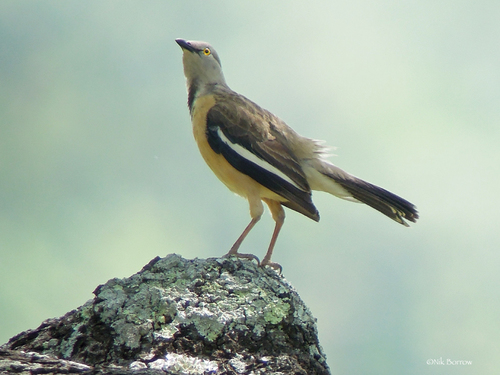
ハジロムクドリ (Neocichla gutturalis) ハジロムクドリ
クロテリムク (Poeoptera kenricki) クロテリムク

メディア

読み込み中…

要点

The most reliable field mark to separate Babbling Starling from Kenrick's Starling is overall plumage: Babbling Starling shows a striking yellow chest with a black wedge and a pale head, while Kenrick's Starling males are glossy black and females are ashy grey with chestnut primaries visible in flight. Both species have yellow eyes, but the Babbling Starling's off-white head and distinct white wing band (on the folded wing) are unique. In flight, look for the chestnut primaries on female Kenrick's Starling and the white wing band on Babbling Starling. Structure and size differ as well, with Babbling Starling being heavier and more robust. Habitat overlap is limited; Babbling Starling is absent from Kenya, while Kenrick's Starling is not found in Angola, Malawi, or Zambia.

識別のコツ

  1. Yellow Chest with Black Wedge (Babbling Starling): Only Babbling Starling shows a bright yellow chest with a central black wedge; Kenrick's Starling never shows this, regardless of age or sex.
  2. Off-white Head (Babbling Starling): Look for the pale, almost white head contrasting with the yellow chest and brown upperparts; Kenrick's Starling lacks this pale head.
  3. White Wing Band (Babbling Starling): On perched birds, Babbling Starling shows a white band across the folded wing, absent in Kenrick's Starling.
  4. Glossy Black Male (Kenrick's Starling): Adult male Kenrick's Starling is uniformly glossy black, with no pale or yellow on the chest or head.
  5. Ashy Grey Female with Chestnut Primaries (Kenrick's Starling): Female Kenrick's Starling is ashy grey with chestnut-colored primary feathers, best seen in flight. Babbling Starling never shows this combination.
  6. Yellow Eyes (Both): Both species have yellow eyes, so this is not a reliable separator, though Stuhlmann's Starling (a potential confusion species) has slaty eyes.
  7. Tail Color: Babbling Starling has a dark brown tail; Kenrick's Starling males have a black tail, and females' tails are not distinctly described but will not match Babbling's brown.
  8. Size and Bulk: Babbling Starling is noticeably larger and heavier (64–72g vs. 38–50g), appearing more robust, especially when perched.
  9. Range: In Kenya, only Kenrick's Starling occurs; in Angola, Malawi, and Zambia, only Babbling Starling. In Tanzania, both are possible.
  10. Sex Differences: Babbling Starling sexes look alike; Kenrick's Starling is strongly sexually dimorphic (black male, grey female).
  11. Flight Marks: In flight, look for chestnut primaries on female Kenrick's Starling and for the white wing band on Babbling Starling (mainly when perched or at rest).
  12. Vocalizations: Babbling Starling gives slurred, squealing, or raspy scolding calls; Kenrick's Starling's call is not described, so a harsh babbling call points to Babbling Starling.
  13. Head and Breast Pattern: Babbling Starling's off-white head and yellow chest are unique; Kenrick's Starling never shows this contrast.
  14. Bill and Structure: No specific bill or structural differences are described, but Babbling Starling is generally more robust.
  15. Plumage Pitfalls: Do not rely on eye color alone; always check for chest color, head color, and wing pattern for a reliable ID.

大きさ

Babbling Starling is larger and heavier, measuring about 17 cm and weighing 64–72 grams. Kenrick's Starling is smaller and lighter, with males at 50g and females at 38g. This size difference is most apparent when seen side by side or with experience, but can be subtle in the field. Babbling Starling also appears bulkier overall, while Kenrick's Starling is a more medium-sized, slimmer starling.

羽色

Juvenile and adult Babbling Starlings of both sexes have a yellow chest with a central black wedge, a pale off-white head, and a light brown mantle fading into dark greyish-brown wings. A white band is visible on the folded wing, and the tail is dark brown. Sexes are alike. In contrast, Kenrick's Starling males are glossy black all over, while females are ashy grey with chestnut-colored primary feathers that are most visible in flight. Both sexes of Kenrick's Starling have yellow eyes, but lack the white wing band and yellow chest of Babbling Starling. The chestnut primaries of female Kenrick's Starling are a key flight mark, while Babbling Starling's white wing band is best seen when perched. No information is available on immature-specific upperwing patterns for either species, but the described marks apply to all ages.

行動

No direct behavioral differences are described in the sources. Both species are typical starlings in general jizz, but Babbling Starling may appear more robust due to its larger size. No flight style or foraging behavior differences are noted.

生息環境

Babbling Starling is found in Angola, Malawi, Tanzania, and Zambia, while Kenrick's Starling is restricted to Kenya and Tanzania. Their ranges overlap only in Tanzania. If seen in Kenya, the bird is Kenrick's Starling; if in Angola, Malawi, or Zambia, it is Babbling Starling. Both species inhabit similar environments within their ranges, so habitat is only weakly diagnostic except by country.

声

Babbling Starling is known for slurred, squealing, or raspy scolding calls. No distinctive vocalizations are described for Kenrick's Starling in the sources. If you hear a harsh, babbling or scolding call, Babbling Starling is more likely.

より良い説明を送る

比較と同じ項目を使ってください。文章はすぐに公開されます。

The most reliable field mark to separate Babbling Starling from Kenrick's Starling is overall plumage: Babbling Starling shows a striking yellow chest with a black wedge and a pale head, while Kenrick's Starling males are glossy black and females are ashy grey with chestnut primaries visible in flight. Both species have yellow eyes, but the Babbling Starling's off-white head and distinct white wing band (on the folded wing) are unique. In flight, look for the chestnut primaries on female Kenrick's Starling and the white wing band on Babbling Starling. Structure and size differ as well, with Babbling Starling being heavier and more robust. Habitat overlap is limited; Babbling Starling is absent from Kenya, while Kenrick's Starling is not found in Angola, Malawi, or Zambia.

  1. Yellow Chest with Black Wedge (Babbling Starling): Only Babbling Starling shows a bright yellow chest with a central black wedge; Kenrick's Starling never shows this, regardless of age or sex.
  2. Off-white Head (Babbling Starling): Look for the pale, almost white head contrasting with the yellow chest and brown upperparts; Kenrick's Starling lacks this pale head.
  3. White Wing Band (Babbling Starling): On perched birds, Babbling Starling shows a white band across the folded wing, absent in Kenrick's Starling.
  4. Glossy Black Male (Kenrick's Starling): Adult male Kenrick's Starling is uniformly glossy black, with no pale or yellow on the chest or head.
  5. Ashy Grey Female with Chestnut Primaries (Kenrick's Starling): Female Kenrick's Starling is ashy grey with chestnut-colored primary feathers, best seen in flight. Babbling Starling never shows this combination.
  6. Yellow Eyes (Both): Both species have yellow eyes, so this is not a reliable separator, though Stuhlmann's Starling (a potential confusion species) has slaty eyes.
  7. Tail Color: Babbling Starling has a dark brown tail; Kenrick's Starling males have a black tail, and females' tails are not distinctly described but will not match Babbling's brown.
  8. Size and Bulk: Babbling Starling is noticeably larger and heavier (64–72g vs. 38–50g), appearing more robust, especially when perched.
  9. Range: In Kenya, only Kenrick's Starling occurs; in Angola, Malawi, and Zambia, only Babbling Starling. In Tanzania, both are possible.
  10. Sex Differences: Babbling Starling sexes look alike; Kenrick's Starling is strongly sexually dimorphic (black male, grey female).
  11. Flight Marks: In flight, look for chestnut primaries on female Kenrick's Starling and for the white wing band on Babbling Starling (mainly when perched or at rest).
  12. Vocalizations: Babbling Starling gives slurred, squealing, or raspy scolding calls; Kenrick's Starling's call is not described, so a harsh babbling call points to Babbling Starling.
  13. Head and Breast Pattern: Babbling Starling's off-white head and yellow chest are unique; Kenrick's Starling never shows this contrast.
  14. Bill and Structure: No specific bill or structural differences are described, but Babbling Starling is generally more robust.
  15. Plumage Pitfalls: Do not rely on eye color alone; always check for chest color, head color, and wing pattern for a reliable ID.

Babbling Starling is larger and heavier, measuring about 17 cm and weighing 64–72 grams. Kenrick's Starling is smaller and lighter, with males at 50g and females at 38g. This size difference is most apparent when seen side by side or with experience, but can be subtle in the field. Babbling Starling also appears bulkier overall, while Kenrick's Starling is a more medium-sized, slimmer starling.

Juvenile and adult Babbling Starlings of both sexes have a yellow chest with a central black wedge, a pale off-white head, and a light brown mantle fading into dark greyish-brown wings. A white band is visible on the folded wing, and the tail is dark brown. Sexes are alike. In contrast, Kenrick's Starling males are glossy black all over, while females are ashy grey with chestnut-colored primary feathers that are most visible in flight. Both sexes of Kenrick's Starling have yellow eyes, but lack the white wing band and yellow chest of Babbling Starling. The chestnut primaries of female Kenrick's Starling are a key flight mark, while Babbling Starling's white wing band is best seen when perched. No information is available on immature-specific upperwing patterns for either species, but the described marks apply to all ages.

No direct behavioral differences are described in the sources. Both species are typical starlings in general jizz, but Babbling Starling may appear more robust due to its larger size. No flight style or foraging behavior differences are noted.

Babbling Starling is found in Angola, Malawi, Tanzania, and Zambia, while Kenrick's Starling is restricted to Kenya and Tanzania. Their ranges overlap only in Tanzania. If seen in Kenya, the bird is Kenrick's Starling; if in Angola, Malawi, or Zambia, it is Babbling Starling. Both species inhabit similar environments within their ranges, so habitat is only weakly diagnostic except by country.

Babbling Starling is known for slurred, squealing, or raspy scolding calls. No distinctive vocalizations are described for Kenrick's Starling in the sources. If you hear a harsh, babbling or scolding call, Babbling Starling is more likely.

変更を破棄しますか?

保存していない編集があります。今離れると失われます。

ハジロムクドリ · クロテリムク · 苦手な鳥