

コハワイミツスイ 対 カウアイミツスイ
Magumma parva 対 Chlorodrepanis stejnegeri
コハワイミツスイとカウアイミツスイのクイズ
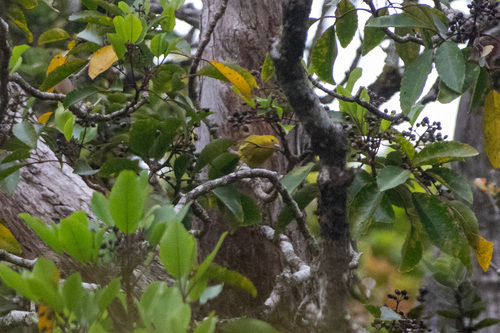 コハワイミツスイ
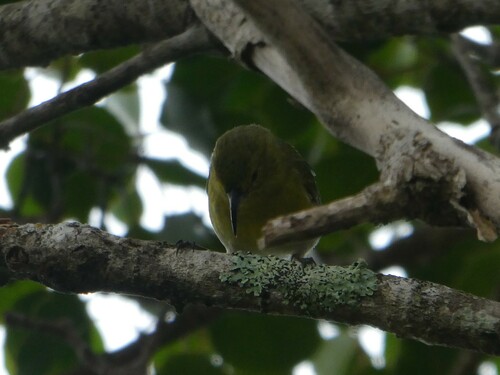 カウアイミツスイ
要点
The most reliable field mark to separate Anianiau from Kauai Amakihi is overall color: adult male Anianiau is a much brighter, more uniform yellow, while Kauai Amakihi is duller yellow-green and less vivid. Anianiau is also noticeably smaller, with a finer, slightly curved bill, compared to the bulkier, more obviously decurved bill of the Kauai Amakihi. Females and immatures of both species are duller, but Anianiau remains smaller and more uniform in color. In the field, focus on size, bill shape, and the intensity and uniformity of yellow in the plumage, especially in good light.
識別のコツ
- Size is a key separator: Anianiau is distinctly smaller and lighter than Kauai Amakihi. If you see a very small, delicate honeycreeper, especially in a mixed flock, suspect Anianiau.
- Bill shape: Anianiau has a slightly curved, fine bill; Kauai Amakihi's bill is longer, heavier, and more obviously decurved. This is most apparent in profile views.
- Adult male color: Male Anianiau is a bright, saturated yellow all over, often strikingly so in good light. Kauai Amakihi is always duller, more olive or yellow-green, never as vivid.
- Female and immature color: Female Anianiau is duller yellow-green but still more uniform and less olive than Kauai Amakihi. Immature birds of both species can be confusing, but Anianiau tends to be more even in tone and smaller.
- Uniformity of plumage: Anianiau (all ages/sexes) is more uniform in color, lacking the contrast between underparts and upperparts sometimes seen in Kauai Amakihi.
- No distinctive wing pattern: Neither species shows strong age-specific upperwing or flight marks, so don't rely on wing panels or trailing edges.
- Jizz and movement: Anianiau often appears more delicate and active, with finer movements, but this is subtle and best used with other marks.
- Perched vs. flight views: Size and color differences are visible both perched and in flight, but bill shape is easiest to judge when perched or feeding.
- Voice: If you hear a clear, paired 'tew-weet' or a repeated 'wee-see' trill, it may indicate Anianiau, but vocalizations overlap and are not diagnostic.
- Habitat overlap: Both species occur together in upper elevation forests on Kauai, so do not use location alone for identification.
- Pitfalls: Duller female and immature Anianiau can be mistaken for Kauai Amakihi, especially in poor light. Always check size and bill shape in addition to color.
- Sex differences: Only the male Anianiau is truly bright yellow; females are duller but still more uniform than Kauai Amakihi.
- No strong seasonal plumage change: Both species retain similar appearance year-round, so seasonal variation is not a major factor.
- Mixed flocks: If you see both species together, the size and color contrast is much easier to appreciate—look for the smallest, brightest yellow bird for Anianiau.
- Uncertainty: In poor light or at a distance, separation can be very difficult, especially for females and immatures. Use a combination of marks and, when in doubt, note the uncertainty in your records.
大きさ
Anianiau is the smallest Hawaiian honeycreeper at about 10 cm in length and around 10 g in mass [wikipedia]. Kauai Amakihi is larger and bulkier, though exact measurements are not given here. In direct comparison, Anianiau will appear noticeably tinier and more delicate, both perched and in flight.
羽色
Adult male Anianiau is a bright, uniform yellow, while the female is duller yellow-green but still more uniform than Kauai Amakihi. Kauai Amakihi of both sexes is generally duller yellow-green, lacking the intense, saturated yellow of male Anianiau. No specific juvenile or immature wing pattern differences are described for either species, so focus on overall color and uniformity. Female and immature Anianiau may be confused with Kauai Amakihi due to their duller color, but Anianiau still tends to be more uniform and less olive-toned. No distinctive upperwing or flight pattern marks are reported for either species.
行動
No major behavioral differences are noted in the sources. Both species are active, foraging in the canopy and subcanopy. In flight or while feeding, both may appear similar, but Anianiau's smaller size and more delicate movements may be noticeable with experience.
生息環境
Both species are endemic to Kauai and occur in upper elevation forests. Habitat alone is not a reliable separator, as their ranges overlap significantly.
声
Anianiau gives a pair of notes, 'tew-weet,' and a trill described as 'wee-see, wee-see, wee-see.' Kauai Amakihi gives a 'distinguishing tweet' when flying or feeding, but no detailed comparison is available. Vocalizations are not reliable for separation based on the current notes.