

アメリカムナグロ 対 ミズカキチドリ
Pluvialis dominica 対 Charadrius semipalmatus
アメリカムナグロとミズカキチドリのクイズ
 アメリカムナグロ
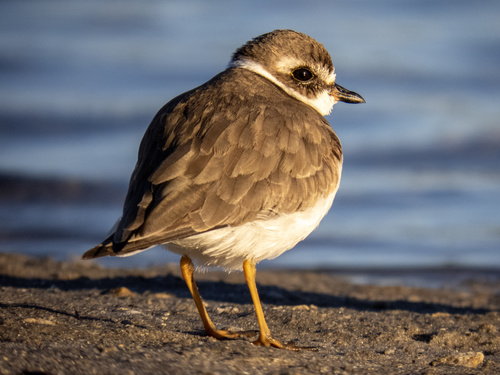 ミズカキチドリ
要点
The most reliable field mark to separate American Golden Plover from Semipalmated Plover is overall structure and plumage pattern: American Golden Plover is much larger and slimmer, with a longer bill and legs, and in breeding plumage shows a striking solid black belly and undertail, while Semipalmated Plover is compact, short-billed, and always has a single black breast band with a white belly. Juvenile and nonbreeding American Golden Plovers can be confused with Semipalmated Plovers at a distance, but the size difference is dramatic and the golden spangling on the upperparts of the plover is unique. In flight, American Golden Plover is long-winged and elegant, while Semipalmated Plover is short-winged and quick. If you see a small plover with a single breast band and orange in the bill, it's a Semipalmated; if the bird is larger, longer-legged, and lacks a breast band, it's an American Golden Plover.
識別のコツ
- Size is a major clue: American Golden Plover is much larger and heavier than Semipalmated Plover. If the bird looks small and compact among shorebirds, it's likely Semipalmated.
- Bill shape and color: Semipalmated Plover has a short, stubby bill with orange at the base and black tip; American Golden Plover has a longer, all-dark bill.
- Leg length: American Golden Plover has noticeably longer legs, giving it a taller, more upright stance. Semipalmated's legs are short and never look stilt-like.
- Breast band vs. solid black belly: Semipalmated Plover always shows a single, complete black breast band on a white belly. American Golden Plover never shows a breast band; in breeding plumage, it has a solid black face, neck, breast, and belly, bordered by white. In nonbreeding plumage, it lacks any breast band and is more uniformly pale below.
- Back pattern: American Golden Plover shows gold-spangled upperparts, especially in breeding plumage, while Semipalmated Plover is plain brown above with no gold or spangling.
- Face pattern: Semipalmated Plover has a white forehead, brown cap, and black mask through the eye, giving a 'bandit' look. American Golden Plover in breeding plumage has a striking white crown and nape, but lacks the mask and cap contrast of Semipalmated.
- Underparts in nonbreeding/immature plumage: American Golden Plover is pale grey-brown below, sometimes with faint mottling, but never shows a breast band. Semipalmated Plover always has a sharp breast band, even in juveniles.
- Flight profile: American Golden Plover is long-winged and slim in flight, with a pointed-wing silhouette. Semipalmated Plover is compact, with shorter, rounded wings.
- Behavior: Semipalmated Plovers are quick, active foragers, often running and pausing. American Golden Plovers walk more deliberately and may be seen alone or in small groups.
- Habitat context: On open tundra or grassy fields, expect American Golden Plover. On beaches, mudflats, and tidal zones, Semipalmated Plover is much more likely.
- Seasonal timing: American Golden Plover molts into nonbreeding plumage later (September–October) than Pacific Golden Plover, but this does not help separate it from Semipalmated. Both species migrate at similar times, but Semipalmated is more widespread and abundant on coasts.
- Juvenile confusion: Juvenile American Golden Plovers can look dull and lack the full black belly, but still lack a breast band and show a longer-legged, slimmer shape than Semipalmated.
- Bill color in the field: If you see orange at the bill base, it's Semipalmated; American Golden's bill is always dark.
- Mixed flocks: If you see both species together, the size and structure difference is immediately apparent—use this to calibrate your eye.
- Common pitfalls: Distant, nonbreeding American Golden Plovers may appear plain-faced and pale below, but the absence of a breast band and longer legs are key. Never rely on back color alone—look for the combination of size, structure, and underpart pattern.
大きさ
American Golden Plover is significantly larger and heavier, with a body mass around 145 g [wikidata], a length of 24–28 cm, and a wingspan of 65–67 cm [wikipedia]. Semipalmated Plover is much smaller, weighing about 46–47 g, with a length of 17–19 cm and a much shorter wingspan (mean wing length 12–13 cm) [wikipedia]. In the field, this size gap is obvious when both species are seen together or compared to familiar shorebirds.
羽色
Juvenile and nonbreeding American Golden Plovers have grey-brown upperparts with pale gold spangling and a whitish eyebrow, lacking any breast band. In contrast, all ages and seasons of Semipalmated Plover show a single, crisp black breast band on a white belly, a brown cap, white forehead, and a black mask around the eyes. In breeding plumage, adult American Golden Plovers are unmistakable with a solid black face, neck, breast, and belly, bordered by a white crown and nape, and gold-spotted back. Semipalmated Plovers never show extensive black below or gold spangling above. In flight, American Golden Plovers appear long-winged and slim, while Semipalmated Plovers are compact with proportionally short wings. No distinctive juvenile upperwing pattern is noted for either species in the sources, so focus on overall structure and underpart pattern.
行動
Semipalmated Plovers are active, quick foragers, often running and pausing on beaches and mudflats, and frequently use a 'broken-wing' display to distract predators from nests. American Golden Plovers are more likely to be seen walking deliberately on tundra or open fields, and are less likely to use distraction displays. Both species forage on the ground, but Semipalmated is more likely to be seen in tight flocks, while American Golden Plovers are often territorial, especially on breeding grounds.
生息環境
Both species breed in northern North America, but American Golden Plovers favor dry, open Arctic tundra, while Semipalmated Plovers nest on open ground on beaches or flats with little vegetation. During migration and winter, Semipalmated Plovers are typically found along coasts, tidal flats, and beaches, while American Golden Plovers migrate through inland fields and prairies as well as coastal areas. In North America, Semipalmated is much more likely on mudflats and sandy shores; American Golden is often found in grassy fields or tundra.