

アフリカマミジロタヒバリ 対 ヤママミジロタヒバリ
Anthus cinnamomeus 対 Anthus hoeschi
アフリカマミジロタヒバリとヤママミジロタヒバリのクイズ
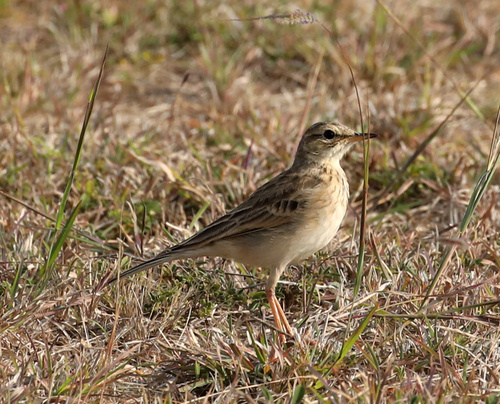 アフリカマミジロタヒバリ
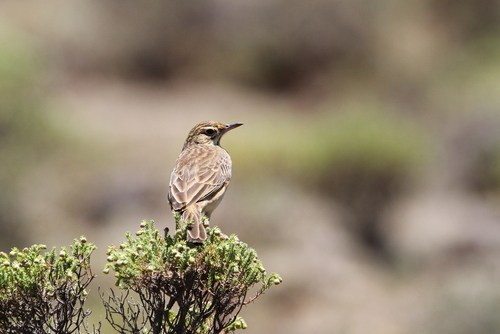 ヤママミジロタヒバリ
要点
The most reliable field mark between African Pipit and Mountain Pipit is the African Pipit's bold facial pattern, with a distinct pale supercilium and dark malar stripe, contrasting with the generally plainer face of Mountain Pipit. Juvenile African Pipits show a blotched breast and scalloped upperparts, while Mountain Pipit juveniles are less well documented but lack such strong markings. Both species are slender, upright pipits of open country, but African Pipit is slightly smaller and more buffy overall. In the field, focus on facial pattern, underpart streaking, and overall coloration, especially in perched birds.
識別のコツ
- Facial Pattern (all ages): African Pipit has a bold pale supercilium and a dark malar stripe, giving a strongly marked face. Mountain Pipit is much plainer-faced, lacking this contrast.
- Juvenile Plumage: Juvenile African Pipits show a blotched breast and scalloped upperparts, with some streaking on the flanks. Mountain Pipit juveniles are not described as having such strong markings, so a heavily blotched, scalloped juvenile is likely African Pipit.
- Underpart Streaking (adults): African Pipit has a streaked breast but plain belly and flanks. Mountain Pipit is generally plainer below, with less contrast between breast and belly.
- Upperparts: African Pipit is buffy-brown above with darker streaks. Mountain Pipit is similar but may appear slightly greyer or duller, and less warm-toned.
- Tail Pattern: Both species have white outer tail feathers, so this is not diagnostic.
- Leg Color: African Pipit has long, pinkish legs. Mountain Pipit is similar, so not a separator.
- Bill: African Pipit has a slender bill, dark with a yellowish base to the lower mandible. Mountain Pipit is not described as differing significantly.
- Structure/Jizz: Both are slender, upright pipits. African Pipit may look slightly smaller and more delicate, but this is subtle.
- Song/Call: African Pipit sings a series of twittering notes in undulating flight or from a perch. Mountain Pipit's song is not described here; do not rely on voice for separation.
- Habitat/Range: African Pipit is widespread in open grassland and savanna. Mountain Pipit is restricted to high-altitude grasslands in Lesotho and adjacent South Africa. Location and altitude can be strong clues.
- Perched vs. In-flight: Both species show white outer tail feathers in flight. Focus on facial pattern and underpart streaking when birds are perched.
- Pitfalls: Immature African Pipits can be confused with Mountain Pipit if facial pattern is overlooked. Always check for the bold supercilium and malar stripe.
- Seasonal Variation: No strong seasonal plumage differences are noted for either species, so use structural and facial marks year-round.
- Sex Differences: No sexual dimorphism is described; all field marks apply to both sexes.
- When in Doubt: If the bird is in lowland grassland and shows a bold face, it's almost certainly African Pipit. In high-altitude grassland with a plain face, Mountain Pipit becomes more likely, but caution is needed due to overlap and subtlety.
大きさ
African Pipit is a fairly small pipit, measuring 15–17 cm in length [wikipedia]. Mountain Pipit is very similar in size, with no reliable size difference noted in the sources. Both are slender, long-legged birds with a similar jizz. Size alone is not a safe separator in the field for these two species.
羽色
Juvenile African Pipits are distinctive with a blotched breast, scalloped upperparts, and some streaking on the flanks. This contrasts with the less well-described juvenile Mountain Pipit, which is not noted for such strong blotching or scalloping. Adult African Pipits have a buffy-brown back with dark streaks, a boldly patterned face (pale supercilium, dark malar stripe), white or pale buff underparts with a streaked breast, and a plain belly and flanks. The outer tail feathers are white. Mountain Pipit adults are less boldly marked on the face and tend to appear plainer below, lacking the strong malar and supercilium contrast of African Pipit. Both species show white outer tail feathers, but the facial pattern and underpart streaking are more pronounced in African Pipit.
行動
Both species are upright, slender pipits often seen walking or running on the ground in open grassland. African Pipit may be slightly more likely to sing from a low perch or in an undulating song-flight, but this is not a strong separator. Their general behavior and movements are very similar and not reliably diagnostic.
生息環境
African Pipit is widespread in open grassland and savanna across much of sub-Saharan Africa. Mountain Pipit breeds in high-altitude grasslands, especially in Lesotho and adjacent South Africa, and is more restricted to montane or upland areas. If you are in lowland grassveld, African Pipit is much more likely; in high-altitude grassland, especially in Lesotho, Mountain Pipit becomes a possibility. However, ranges can overlap in some upland areas.
声
African Pipit gives a repeated series of twittering notes, delivered in an undulating song-flight or from a low perch. There is no detailed description of Mountain Pipit's song in the provided notes, so vocalizations are not a safe separator based on current information.