

White Hawk vs Gray-lined Hawk
Pseudastur albicollis contro Buteo nitidus
Fai un quiz con White Hawk e Gray-lined Hawk
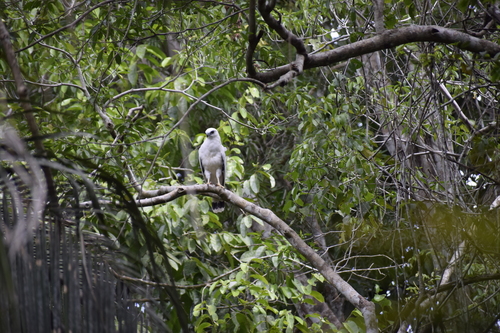 White Hawk
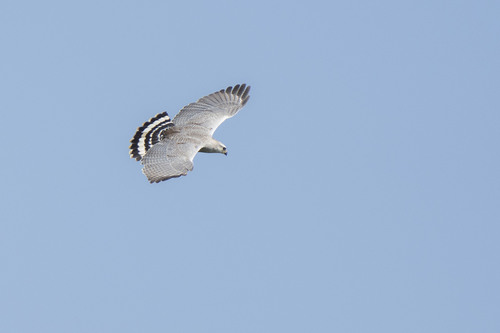 Gray-lined Hawk
In breve
The most reliable field mark to separate White Hawk from Grey-lined Hawk is overall coloration: adult White Hawks are strikingly white below and above, with contrasting black upperwings and a short tail with a single broad black band, while adult Grey-lined Hawks are pale gray above with fine white barring, and have a black tail with three narrow white bands. Immature birds differ strongly: young White Hawks are mostly white with heavy black spotting above and streaked underparts, whereas immature Grey-lined Hawks are brown above with white-spotted underparts and a streaked buff head. Structure and flight style also help: White Hawk is bulkier, with broader wings and a shorter tail, while Grey-lined Hawk is smaller, shorter-winged, and more agile in flight. Both species can overlap in range, but White Hawk is more tied to forest, while Grey-lined Hawk prefers open country and edges.
Consigli di identificazione
- Adult overall color: White Hawk is strikingly white below and above, with black upperwings and a short tail with a single broad black band. Grey-lined Hawk is pale gray above with fine white barring and a black tail with three narrow white bands.
- Immature plumage: Immature White Hawks are mostly white with black spotting above and streaked underparts, while immature Grey-lined Hawks are brown above, with brown-spotted white underparts and a brown-streaked buff head and neck. This difference is especially clear in flight or perched views.
- Tail pattern: White Hawk shows a single broad black band near the tail tip (sometimes extending to the base in some subspecies), while Grey-lined Hawk has three narrow white bands on a black tail (adults) or a pale-banded brown tail (immatures).
- Wing pattern in flight: White Hawk's upperwings are black with white markings (extent varies by subspecies), but all look mainly white from below. Grey-lined Hawk's upperparts are pale gray with fine white barring, and the wings are shorter and less broad.
- Leg color: White Hawk has yellow legs; Grey-lined Hawk has orange legs. This is best seen when perched at close range.
- Eye color: Some White Hawk subspecies have yellow eyes (ghiesbreghti), others brown. Grey-lined Hawk's eye color is not specified, so use with caution.
- Bill color: Both species have black bills, so this is not helpful.
- Body structure: White Hawk is bulkier, with very broad wings and a notably short tail. Grey-lined Hawk is more slender, short-winged, and longer-tailed in proportion to body size.
- Flight style: White Hawk soars with slow, buoyant wingbeats, often high above forest. Grey-lined Hawk is more agile and fast, with quick, direct flights, especially over open country.
- Habitat: White Hawk is most often in or above dense lowland forest; Grey-lined Hawk prefers open country, clearings, and forest edges.
- Perched posture: White Hawk often appears heavy-chested and short-tailed when perched; Grey-lined Hawk is slimmer and longer-tailed.
- Sex differences: Both species are sexually similar in plumage, but female White Hawks are larger and heavier than males. This is not usually useful in the field unless size difference is extreme.
- Vocalizations: Only White Hawk's call ('kerwee') is described; do not rely on voice unless you know Grey-lined Hawk's call from experience.
- Pitfalls: Immature White Hawks with heavy black spotting can look confusingly patterned, but the overall white base color and short tail remain distinctive. Immature Grey-lined Hawks are never as white or as heavily spotted above.
- Subspecies variation: Be aware of regional differences in White Hawk (amount of black on wings, tail band width, eye color), but all are mainly white below and above, unlike any Grey-lined Hawk.
Taglia
White Hawk is the larger and heavier species, with adults measuring 46–56 cm in length and females weighing up to 840 g, compared to Grey-lined Hawk's 46–61 cm length but much lighter average mass of 475 g. White Hawk appears bulkier, with very broad wings and a notably short tail, while Grey-lined Hawk is more slender and short-winged, giving it a more agile and less massive impression in flight or perched.
Piumaggio
- Immature/juvenile birds:
- White Hawk immatures are mostly white below with dark streaks, and have extensive black spotting on the upperparts. The tail shows a broad black subterminal band, and the wings may show black markings depending on subspecies.
- Grey-lined Hawk immatures are dark brown above with pale-banded brown tails, brown-spotted white underparts, and a brown-streaked buff head and neck. The contrast between the dark upperparts and pale underparts is less stark than in White Hawk.
- Adults:
- White Hawk adults are almost entirely white below and on the head, with black upperwings and a very short tail with a single broad black band (sometimes extending to the tail base in some subspecies). From below, all subspecies look mainly white.
- Grey-lined Hawk adults have a pale gray body with fine white barring above, and a black tail with three narrow white bands. The underparts are pale gray, lacking the pure white of White Hawk. Legs are orange (vs. yellow in White Hawk).
Comportamento
White Hawk is often seen soaring above forest, using broad wings for slow, buoyant flight, and is known for spectacular aerial displays. It frequently perches quietly before sallying out to catch prey. Grey-lined Hawk, in contrast, is more agile and fast in flight, reflecting its adaptation to open country and forest edge habitats. It is less likely to be seen soaring high above dense forest and more often patrols open areas or edges with quick, direct flights.
Habitat
White Hawk is a bird of lowland forest and woodland, ranging from southern Mexico to Brazil and the Amazon basin, and is usually found in or near dense forest. Grey-lined Hawk prefers open country and forest edges, and is less tied to dense forest, making it more likely in savannas, clearings, and along forest margins. This habitat difference can help in ambiguous cases, though there is some overlap at forest edges.
Voce
White Hawk gives a plaintive 'kerwee' call. No vocalization details are provided for Grey-lined Hawk in the notes, so voice is not a reliable separator based on current information.