

Wedge-tailed Shearwater vs Short-tailed Shearwater
Ardenna pacifica contro Ardenna tenuirostris
Fai un quiz con Wedge-tailed Shearwater e Short-tailed Shearwater
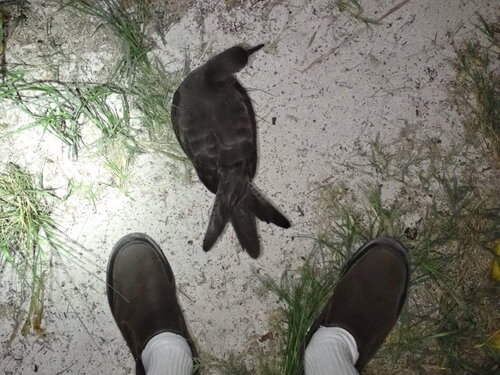 Wedge-tailed Shearwater
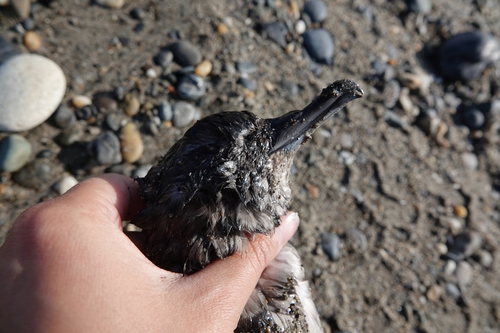 Short-tailed Shearwater
In breve
The most reliable field mark between Wedge-tailed Shearwater and Short-tailed Shearwater is the tail shape: Wedge-tailed shows a distinctly long, pointed, wedge-shaped tail, especially obvious in flight, while Short-tailed has a shorter, more rounded tail. Both species can appear dark overall, but Wedge-tailed comes in both pale and dark morphs, with pale birds showing strong contrast between upperparts and underparts. Short-tailed is uniformly dark brown, lacking a pale morph. Structure is also a clue: Wedge-tailed is slimmer and longer-winged, while Short-tailed is bulkier with a stubbier bill. Both can be seen in large flocks at sea, but their ranges overlap only in certain regions, so context helps. Focus on tail shape and overall structure for the quickest separation.
Consigli di identificazione
- Tail shape is the most reliable field mark: Wedge-tailed Shearwater always shows a long, pointed, wedge-shaped tail, especially obvious in flight or when perched with the tail fanned. Short-tailed Shearwater has a short, rounded tail. This works for all ages and morphs.
- Plumage morphs: Wedge-tailed comes in both pale and dark morphs. Pale morphs show a strong contrast between grey-brown upperparts and white underparts, unique among these two. Short-tailed is always uniformly dark brown, with no pale morph.
- Overall structure: Wedge-tailed is slimmer and longer-winged, with a more graceful, buoyant flight. Short-tailed is bulkier, with a thicker neck and more compact appearance, and flies with faster, more direct wingbeats.
- Bill shape: Wedge-tailed has a longer, slightly heavier bill, while Short-tailed's bill is shorter and more slender. This is subtle and best seen at close range.
- Underwing pattern: Pale morph Wedge-tailed shows contrasting pale underwings; Short-tailed's underwing is uniformly dark. Dark morph Wedge-tailed can look similar to Short-tailed, so use tail shape and structure in those cases.
- Head and upperwing color: Wedge-tailed (pale morph) has a paler face and underwing, while Short-tailed is dark throughout. Dark morph Wedge-tailed and Short-tailed can be very similar, but the tail shape and structure still separate them.
- Flight style: Wedge-tailed often glides for longer periods, using its wedge-shaped tail for control, while Short-tailed is more direct and purposeful in flight.
- Context and abundance: In Australia, Short-tailed is far more common and often seen in huge flocks. In the North Pacific, Wedge-tailed predominates. Use location and season as supporting clues, not primary ID marks.
- Colony behavior: At breeding colonies, Wedge-tailed is noisy and vocal at night, while Short-tailed is much quieter. This is only useful at colonies, not at sea.
- Leg color: Wedge-tailed has salmon-pink legs, but this is rarely visible at sea. Short-tailed's leg color is not described as distinctive.
- Juvenile/fledgling confusion: Both species' chicks can be heavier than adults before fledging, but this is not a field mark for flying birds.
- No strong age-dependent wing pattern: Neither species shows distinctive juvenile or immature upperwing marks that separate them, so focus on tail and structure for all ages.
- No sexual dimorphism: Both sexes look alike in both species; do not use sex as a clue.
- Do not rely on voice at sea: Only Wedge-tailed is notably vocal at colonies; both are silent at sea.
- Avoid confusion with Sooty Shearwater: Both species are sometimes called muttonbirds, but Sooty is larger and has different structure and range.
Taglia
Short-tailed Shearwater is heavier on average (body mass ~544g) than Wedge-tailed Shearwater (~465g) [wikidata]. In the field, Short-tailed often appears more robust and compact, while Wedge-tailed looks longer and more slender, with a proportionally longer tail and wings. This difference is subtle at distance but can be apparent when birds are side by side or in mixed flocks.
Piumaggio
- Juvenile/immature plumage: No specific upperwing or age-dependent marks are described for either species in the sources, so focus on overall coloration and tail shape for all ages.
- Wedge-tailed Shearwater: Comes in two morphs. The pale morph has grey-brown upperparts and upperwings with a contrasting white belly and underwing, while the dark morph is uniformly dark grey-brown above and below. Both morphs can occur together, but pale birds are more common in the North Pacific. The wedge-shaped tail is present in all plumages and ages.
- Short-tailed Shearwater: Uniformly dark brown overall, including underparts and underwing, with no pale morph. Tail is short and rounded, not pointed. Bill is also stubbier and more slender than Wedge-tailed. No strong contrast between upper and lower surfaces at any age.
- Key contrast: Wedge-tailed's pale morph is the only one of the two to show a pale belly and underwing, but even dark morph Wedge-tailed can be separated by its longer, pointed tail and slimmer build.
Comportamento
Both species are pelagic and often seen gliding low over the ocean. Wedge-tailed Shearwater is noted for its long, gliding flights, using its wedge-shaped tail for stability, and often appears more buoyant and languid in flight. Short-tailed Shearwater tends to fly with faster, more direct wingbeats and appears more compact and purposeful. Both species nest in burrows and can be seen in large flocks, but Wedge-tailed is more likely to be seen resting on the water or circling breeding colonies during the day, especially outside the breeding season.
Habitat
Wedge-tailed Shearwater is widespread in tropical and subtropical Pacific and Indian Oceans, breeding on islands from Hawaii to Australia. Short-tailed Shearwater breeds mainly on islands in Bass Strait and Tasmania, migrating to the Northern Hemisphere for the boreal summer. Their ranges overlap in Australian waters, but Short-tailed is much more abundant there. If seen in the North Pacific, Wedge-tailed is far more likely. Both are pelagic away from breeding colonies.
Voce
Wedge-tailed Shearwater is known for its long, moaning calls, especially at colonies at night, with a drawn-out inhaling and exhaling pattern. Short-tailed Shearwater is much quieter at sea and around colonies, rarely vocalizing in flight. Calls are not a reliable field mark at sea, but at breeding sites, Wedge-tailed's distinctive moaning is diagnostic.
Wedge-tailed Shearwater · Short-tailed Shearwater · I miei uccelli difficili