

Spruce Grouse vs Gray Peacock-Pheasant
Canachites canadensis contro Polyplectron bicalcaratum
Fai un quiz con Spruce Grouse e Gray Peacock-Pheasant
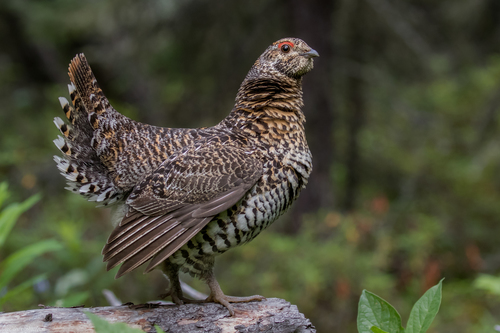 Spruce Grouse
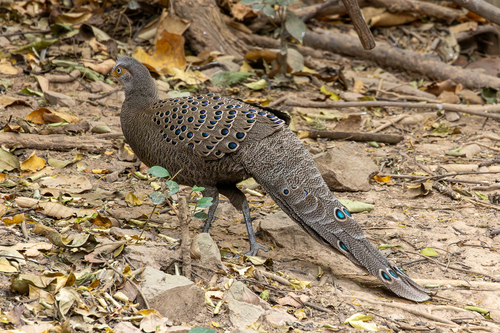 Gray Peacock-Pheasant
In breve
The most reliable field mark to separate Spruce Grouse from Grey Peacock-Pheasant is the presence of bold green eyespots on the wings and tail of the peacock-pheasant, which are entirely absent in Spruce Grouse of any age. In flight or perched, Spruce Grouse show a plain, dark tail with a pale terminal band (especially in females and juveniles), while Grey Peacock-Pheasant always shows a long, broad tail profusely marked with iridescent eyespots. Spruce Grouse are compact, short-tailed, and adapted to coniferous forests of North America, while Grey Peacock-Pheasant is much larger, longer-tailed, and found in Asian forests. Even in poor light or at a distance, the peacock-pheasant’s elongated tail and overall shape are distinctive. Vocalizations are not likely to overlap, but both species are generally quiet.
Consigli di identificazione
- Eyespots on wings and tail: Only Grey Peacock-Pheasant shows bold, iridescent green eyespots on the wings and especially the tail, present in all ages and sexes. Spruce Grouse never shows eyespots.
- Tail shape and length: Grey Peacock-Pheasant has a long, broad, fanned tail with eyespots; Spruce Grouse has a short, rounded tail with a pale terminal band (especially in females/juveniles) and no eyespots.
- Facial features: Spruce Grouse males have a red eyebrow comb (bare skin above the eye); Grey Peacock-Pheasant has bare pink or yellow facial skin but no red comb. Females of both lack the comb, but peacock-pheasant may show colored facial skin.
- Crest: Grey Peacock-Pheasant has an elongated, bushy crest; Spruce Grouse lacks any crest or head ornamentation.
- Body shape: Spruce Grouse is compact, short-tailed, and chunky; Grey Peacock-Pheasant is elongated, with a long neck and tail, and a more pheasant-like silhouette.
- Plumage pattern: Spruce Grouse (female/juvenile) is mottled brown or grey with barred underparts and a plain dark tail with a pale band; Grey Peacock-Pheasant is greyish-brown with fine spotting and iridescent eyespots.
- Sexual dimorphism: Both species show some sexual dimorphism, but in Spruce Grouse, males are darker with a red comb, while in Grey Peacock-Pheasant, males are larger and more ornamented but both sexes have eyespots.
- Flight appearance: In flight, Spruce Grouse shows a compact body, short tail, and no wing or tail spots; Grey Peacock-Pheasant shows a long, trailing, fanned tail with eyespots and broad, rounded wings.
- Behavior: Spruce Grouse may be seen perching in trees; Grey Peacock-Pheasant is almost always on the ground and may fan its tail and wings to display eyespots.
- Habitat: Spruce Grouse is only found in North American coniferous forests; Grey Peacock-Pheasant is only in Asian broadleaf/mixed forests.
- Size: Grey Peacock-Pheasant is much larger and longer-tailed than Spruce Grouse; even a large Spruce Grouse looks small and compact by comparison.
- Voice: Both are quiet, but Spruce Grouse males may produce a wing-clap display; this is not a feature of Grey Peacock-Pheasant.
- Juvenile confusion: Juvenile Spruce Grouse resemble adult females and never show eyespots; juvenile Grey Peacock-Pheasant, though duller, still shows some eyespot patterning.
- Tail band: Spruce Grouse females/juveniles have a dark tail with a pale terminal band; Grey Peacock-Pheasant’s tail is covered in eyespots and lacks a plain pale band.
- Context: If seen in a North American boreal forest, it is a Spruce Grouse; if in Southeast Asian forest, it is a Grey Peacock-Pheasant.
Taglia
Spruce Grouse is a medium-sized grouse, 38–43 cm in length with a wingspan of 55–57 cm and males weighing 550–650 g [wikipedia]. In contrast, Grey Peacock-Pheasant is much larger, reaching up to 76 cm in length, with a proportionally much longer tail and heavier build [wikipedia]. The peacock-pheasant’s size and especially its long, broad tail make it appear much larger and more elongated than the compact, short-tailed Spruce Grouse. Even the largest Spruce Grouse is dwarfed by a Grey Peacock-Pheasant.
Piumaggio
Juvenile and female Spruce Grouse are mottled brown or grey with barred underparts and a dark tail with a pale terminal band; males are grey above and black below with white spotting and a red eyebrow comb. No age or sex of Spruce Grouse ever shows eyespots or iridescent markings. In contrast, Grey Peacock-Pheasant of all ages and sexes is greyish-brown with numerous green iridescent eyespots on the wings and especially the long tail. Males are more ornamented, but even females and juveniles show the eyespot pattern, though less vividly. The peacock-pheasant also has a bushy crest and bare colored facial skin, neither of which is present in Spruce Grouse. The Spruce Grouse’s tail is always plain except for the pale band, while the peacock-pheasant’s tail is broad, long, and profusely marked with eyespots.
Comportamento
Spruce Grouse is highly arboreal for a grouse, often perching and moving about in coniferous trees, and is generally tame and slow-moving on the ground. Its flight is short and direct, with little display except for the wing-clap by territorial males. Grey Peacock-Pheasant is terrestrial, walking with a slow, deliberate gait, and is rarely seen perching in trees. It often fans its tail and wings to display the eyespots, especially when disturbed or displaying. In flight, the peacock-pheasant is heavy and slow, with broad, rounded wings and a trailing, fanned tail. The overall jizz of a peacock-pheasant is pheasant-like and elongated, while Spruce Grouse is compact and grouse-like.
Habitat
Spruce Grouse is strictly associated with coniferous boreal forests (taiga) of North America, especially spruce and pine woods. Grey Peacock-Pheasant is found in broadleaf and mixed forests of Southeast Asia, never in North America or coniferous taiga. If the bird is seen in a North American conifer forest, it is a Spruce Grouse; in Asian broadleaf or mixed forests, especially with bamboo or dense undergrowth, it is likely a Grey Peacock-Pheasant.
Voce
Both species are generally quiet. Spruce Grouse produces a few soft calls, territorial wing-claps (not a vocal sound), and subtle drumming or tail-swish noises, especially from males. Grey Peacock-Pheasant is also quiet, with no distinctive calls noted here. Vocalizations are not likely to be confused in the field, and neither species is likely to be identified by voice alone.
Spruce Grouse · Gray Peacock-Pheasant · I miei uccelli difficili