

Sterpazzola della Sardegna vs Magnanina sarda
Curruca conspicillata contro Curruca sarda
Fai un quiz con Sterpazzola della Sardegna e Magnanina sarda
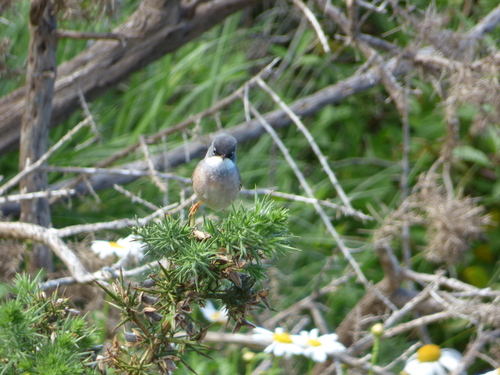 Sterpazzola della Sardegna
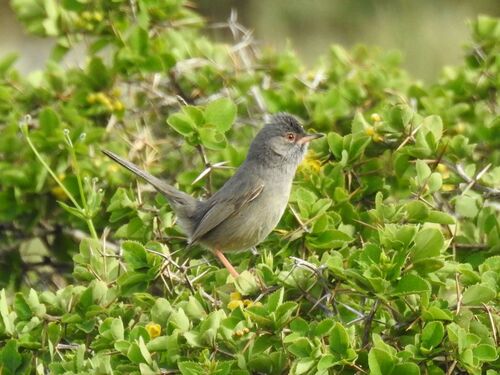 Magnanina sarda
In breve
The most reliable field mark between Spectacled Warbler and Marmora's Warbler is overall coloration: Spectacled Warbler shows brown upperparts and buff underparts with a white throat, while Marmora's Warbler is uniform grey above and below. Adult male Spectacled Warblers have a distinctive white eye ring and a grey head, whereas Marmora's males have a darker face patch and lack the eye ring. Immature Spectacled Warblers can be especially tricky, as they lack the adult's strong head pattern and may resemble Marmora's, but they tend to show warmer brown tones and chestnut in the wings. Both species are small, long-tailed warblers, so shape and size are less helpful than plumage and facial details.
Consigli di identificazione
- Overall coloration: Spectacled Warbler is brown above and buff below, while Marmora's is uniform grey above and below. This is the most consistent field mark for all ages.
- White eye ring: Adult male Spectacled Warblers have a clear white eye ring, lacking in Marmora's. Females and immatures of Spectacled may show a less distinct ring, but it is usually more apparent than in Marmora's.
- Head pattern: Adult male Spectacled Warblers have a grey head; Marmora's males have a darker mask between the eye and bill but no eye ring. Immature Spectacleds have a less contrasting head, which can cause confusion.
- Chestnut wing patch: Spectacled Warbler often shows a chestnut patch in the wing, especially in fresh plumage. Marmora's lacks this feature. Look for it when the bird flicks its wings or in good light.
- Underparts color: Spectacled Warbler is buff below, while Marmora's is grey below. Immature Spectacleds may be paler but rarely as uniformly grey as Marmora's.
- Throat color: Both species have a white throat, but it is more sharply defined in Spectacled Warbler. Marmora's throat is only slightly paler than the rest of the underparts, especially in immatures.
- Iris and leg color: Marmora's adult males have red legs and a red iris, while Spectacled's are less distinctly colored (not specified in the sources). Immature Marmora's have a dark iris.
- Facial mask: Marmora's males show a dark patch between the eye and bill, lacking in Spectacled. This is subtle but can help in close views.
- Song: A fast, high warble points to Spectacled; a fast rattle suggests Marmora's. Use with caution, as these can be hard to distinguish without experience.
- Structure and jizz: Both are small, long-tailed, large-headed warblers. Shape is not a reliable separator.
- Flight views: Neither species has a distinctive wing panel or upperwing pattern in flight, so rely on body and head coloration.
- Age confusion: Immature Spectacled Warblers are the most likely to be confused with Marmora's, as they lack strong head pattern and can appear dull. Look for any warmth in the upperparts or chestnut in the wings to point toward Spectacled.
- Habitat: Both species use similar Mediterranean scrub; habitat is not diagnostic where both occur.
- Pitfalls: Do not rely solely on tail length, overall size, or habitat. Focus on coloration, eye ring, and wing patch.
- Season: Adult male Spectacleds are easiest to separate in spring and summer when plumage is fresh and eye ring is bold. Immatures and females require more careful scrutiny of subtle color differences.
Taglia
Both species are very small warblers, and their size is not a reliable field mark in direct comparison. Marmora's Warbler has a recorded adult body mass of about 10.5 g [wikidata], but there is no comparable mass data for Spectacled Warbler in the sources. In the field, both appear similarly dainty and long-tailed, so rely on plumage and facial features for separation.
Piumaggio
Juvenile and immature Spectacled Warblers can be confused with Marmora's Warbler, but even young Spectacled Warblers tend to show warmer brown upperparts and buff underparts, sometimes with a hint of chestnut in the wing. Marmora's Warbler, by contrast, is much more uniform grey both above and below at all ages, with only a slightly paler throat in immatures. Adult male Spectacled Warblers are diagnostic with a grey head and a conspicuous white eye ring, while Marmora's males have a darker mask between the eye and bill but no eye ring. Both species have white throats, but it is more sharply defined in Spectacled. The chestnut wing patch of Spectacled is a useful mark if seen, especially in fresh plumage. In flight, neither species shows a distinctive wing panel or strong upperwing pattern according to the sources, so focus on overall coloration and head details.
Comportamento
Both species are active, often skulking warblers that can be tricky to see well. They share a tendency to flick their long tails and move through low shrubs. There is no strong behavioral difference noted in the sources that would reliably separate them in the field.
Habitat
Spectacled Warbler breeds in northwest Africa, southwest Europe (Iberia to Italy), and the eastern Mediterranean islands and coasts, typically in dry, open scrub. Marmora's Warbler is not described in detail here, but both are in the same genus and occupy similar Mediterranean-type habitats. Habitat alone is not a safe separator where ranges overlap.
Voce
Spectacled Warbler's song is a fast, high warble, while Marmora's Warbler gives a fast rattle. These differences can be subtle and may overlap to the ear, but if you hear a more rattling, mechanical song, lean toward Marmora's; a more musical, high-pitched warble suggests Spectacled. Use voice as supporting evidence, not the primary field mark.
Sterpazzola della Sardegna · Magnanina sarda · I miei uccelli difficili