

Red-breasted Sapsucker vs Nuttall's Woodpecker
Sphyrapicus ruber contro Dryobates nuttallii
Fai un quiz con Red-breasted Sapsucker e Nuttall's Woodpecker
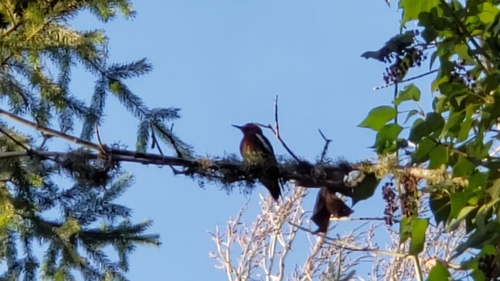 Red-breasted Sapsucker
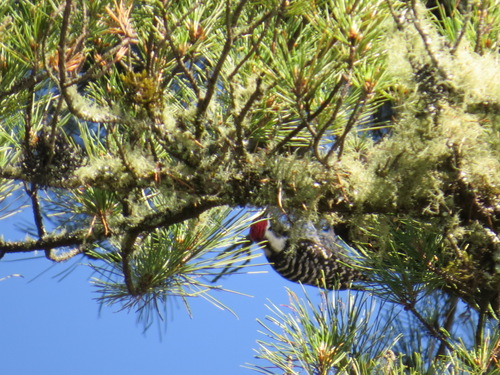 Nuttall's Woodpecker
In breve
The most reliable field mark is the head and upper chest color: Red-breasted Sapsucker of all ages shows a solid red head and upper breast, while Nuttall's Woodpecker has a black-and-white striped head with only a red crown patch (male or juvenile). In flight or perched, Red-breasted Sapsucker shows a large white wing patch and, depending on subspecies, yellow or white barring on the back, while Nuttall's Woodpecker has horizontal black-and-white stripes across the back and wings, lacking any large white wing patch. Nuttall's is distinctly smaller and slimmer, with a lighter build and more active foraging style. Habitat can help: Sapsucker prefers coniferous or mixed forests, Nuttall's is tied to California oak woodlands. If you see a woodpecker with a mostly red head and a big white wing patch, it's a Red-breasted Sapsucker; if the head is mostly black-and-white with a red crown spot and the back is horizontally barred, it's Nuttall's.
Consigli di identificazione
- Head and upper chest color: Red-breasted Sapsucker (all ages and sexes) shows a solid red head and upper chest; Nuttall's Woodpecker has a black-and-white striped head with a red crown patch only in adult males and juveniles.
- Wing pattern in flight/perched: Red-breasted Sapsucker has a large, obvious white wing patch and pale rump visible in flight and when perched; Nuttall's never shows a white wing patch, instead displaying horizontal black-and-white barring across the wings and back.
- Back pattern: Sapsucker's back is black with white or yellowish bars (depending on subspecies), while Nuttall's has horizontal black-and-white stripes across the back and wings, with an unbarred black upper back.
- Underparts: Sapsucker has a white lower belly and rump, sometimes with yellowish wash (northern subspecies); Nuttall's has mostly white underparts with some black spots, but never a yellow wash.
- Bill and structure: Sapsucker is bulkier with a heavier bill; Nuttall's is smaller, slimmer, and more delicate, with a proportionally shorter bill.
- Size: Sapsucker is significantly heavier (58g vs 38g) and appears larger overall; this is most apparent when seen side-by-side or with experience.
- Sex differences: Only male Nuttall's has a red crown patch; female Nuttall's lacks red on the head. All Red-breasted Sapsuckers, regardless of sex, have a red head and upper chest.
- Juvenile confusion: Juvenile Nuttall's can show a red crown patch (like adult male), but still has the black-and-white striped head and horizontal back barring. Juvenile Sapsucker already shows a mostly red head and upper chest.
- Habitat: Sapsucker is found in coniferous/mixed forests (especially old-growth), sometimes in deciduous woods in winter; Nuttall's is tied to California oak woodlands.
- Behavior: Sapsucker often sits quietly near sap wells, sometimes returning to the same tree; Nuttall's is more active, moving quickly along branches and foraging for insects.
- Drilling pattern: Sapsucker drills neat horizontal rows of sap wells; Nuttall's does not create sap wells, instead foraging for insects under bark.
- Voice: Sapsucker's calls are louder and more varied (chatters, squeals, screams); Nuttall's gives soft wheezing calls and less intense rattles, but voice is not a primary separator for most observers.
- Range: If outside California's oak woodlands, Nuttall's is unlikely; if in dense conifers of the Pacific Northwest, Sapsucker is expected.
- Wing patch pitfall: Only Red-breasted Sapsucker shows a large white wing patch; if you see this, it's not Nuttall's.
- Back barring pitfall: If you see horizontal black-and-white stripes across the back and wings, it's Nuttall's; Sapsucker's back barring is vertical or patchy, not horizontal.
Taglia
Red-breasted Sapsucker is noticeably larger and heavier (58.0g) than Nuttall's Woodpecker (38.3g). In the field, Sapsucker appears bulkier and more robust, with a thicker neck and heavier bill. Nuttall's is smaller, more delicate, and often looks more active and agile as it forages. This size difference is usually apparent when both species are seen in similar contexts, but can be subtle if seen alone or at a distance.
Piumaggio
- Juvenile/immature birds: Both species' juveniles resemble adults, but Nuttall's juveniles (both sexes) have some white streaks on the head and a red crown patch, while Red-breasted Sapsucker juveniles already show a mostly red head and upper chest. In flight, Red-breasted Sapsucker (all ages) shows a large, obvious white wing patch and pale rump; Nuttall's never shows a white wing patch, instead displaying horizontal black-and-white barring across the back and wings.
- Adults: Red-breasted Sapsucker has a solid red head and upper chest, black back with white or yellowish bars (depending on subspecies), and a prominent white wing patch. The lower belly and rump are white. Nuttall's Woodpecker has a black forehead with white streaks on the sides, a red crown patch (male/juvenile), and a horizontally barred black-and-white back and wings. The underparts are mostly white with some black spots. Nuttall's lacks any large white wing patch and has an unbarred black upper back. The difference in head pattern and wing markings is the most consistent separation in all plumages.
Comportamento
Red-breasted Sapsucker is often seen perched quietly on tree trunks, especially near sap wells it has drilled in neat horizontal rows. It may return repeatedly to the same tree and can be less active than Nuttall's. Nuttall's Woodpecker is more active and agile, moving quickly along branches and trunks, often foraging for insects by peeling bark or hammering into wood. Nuttall's is more likely to be seen in the outer branches of oaks, while Sapsucker tends to stay on larger trunks or main branches.
Habitat
Red-breasted Sapsucker is found in coniferous and mixed forests of the Pacific Northwest, often in old-growth or mature stands, but can also occur in deciduous woodlands in winter. Nuttall's Woodpecker is restricted to oak woodlands in California and is rarely found outside this habitat. If you are in a dense conifer forest, Sapsucker is more likely; in a California oak woodland, Nuttall's is expected.
Voce
Both species drum and call, but their vocalizations are not the most reliable field marks. Red-breasted Sapsucker gives a variety of chatters, squeals, and scream-like calls, often louder and more varied than Nuttall's. Nuttall's Woodpecker gives soft wheezing calls and a less intense rattle, especially in pair interactions, and drums in a similar fashion to other small woodpeckers. Without experience, voice is not a primary separator.
Red-breasted Sapsucker · Nuttall's Woodpecker · I miei uccelli difficili