
Quail-plover vs Temminck's Courser
Ortyxelos meiffrenii contro Cursorius temminckii
Fai un quiz con Quail-plover e Temminck's Courser
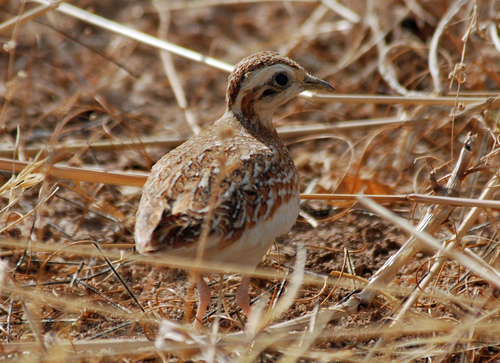 Quail-plover
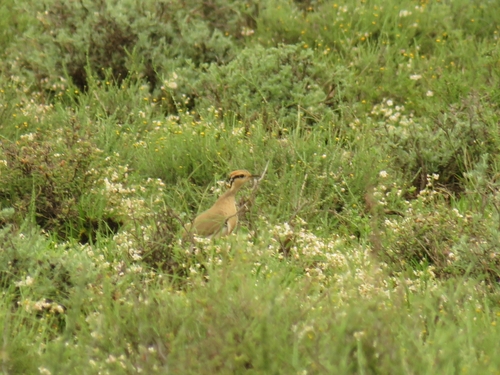 Temminck's Courser
In breve
The most reliable field mark to separate Quail-plover from Temminck's Courser is the distinctive upperwing pattern seen in flight: Quail-plover of all ages shows a bold diagonal band formed by white primary coverts and black remiges with white tips, while Temminck's Courser lacks this feature. On the ground, Quail-plover is noticeably smaller, shorter-tailed, and more lark-like in jizz, whereas Temminck's Courser is larger and more upright. Both species can occur in similar open, dry habitats, but their structure, flight style, and wing pattern are key for separation, especially when viewing immatures or flushed birds.
Consigli di identificazione
- Upperwing pattern in flight (all ages): Quail-plover shows a bold diagonal band on the upperwing, created by white primary coverts and black remiges with white tips. This is visible in both adults and juveniles and is absent in Temminck's Courser.
- Flight style: Quail-plover has a fluttering, lark-like flight, often erratic and low to the ground. Temminck's Courser flies more steadily and directly, lacking the fluttering quality.
- Size and structure: Quail-plover is much smaller and more delicate, with a short tail and lark-like proportions. Temminck's Courser is larger, heavier (71g), longer-legged, and stands more upright.
- Tail length: Quail-plover has a notably short tail, while Temminck's Courser's tail is longer and more proportional to its body size.
- On the ground (jizz): Quail-plover crouches and scurries, resembling a miniature courser or lark, while Temminck's Courser is more upright and walks with a courser's gait.
- Plumage on ground: Quail-plover is sandy-rufous above and whitish below, with females slightly darker and juveniles paler. Temminck's Courser is more uniform and lacks the Quail-plover's contrast.
- Sex and age variation: Female Quail-plovers are slightly darker than males; juveniles are paler, but all ages/sexes retain the diagnostic wing pattern. Temminck's Courser does not show strong age/sex differences in field marks relevant to this comparison.
- Habitat context: While both can be found in open, dry areas, Temminck's Courser is especially associated with recently burnt ground, but this is not a reliable separation point on its own.
- Bill and head: No specific differences are noted in these features for field separation.
- When flushed: Always watch for the Quail-plover's striking diagonal upperwing band; if absent, suspect Temminck's Courser, especially if the bird is larger and flies more directly.
- Pitfalls: Immature Quail-plovers are paler but still show the wing band; Temminck's Courser immatures do not develop a similar pattern.
- Voice: No diagnostic vocal differences are described in the available sources.
- Seasonal variation: No strong seasonal plumage differences are noted for either species in the sources, so rely on structural and wing pattern marks year-round.
- If in doubt: Prioritize the upperwing pattern in flight, then check size and tail length on the ground. These are the most reliable separation points in all seasons and ages.
Taglia
Temminck's Courser is significantly heavier (about 71g) and appears larger and more robust than Quail-plover, which is a notably small, delicate bird (no direct mass given, but described as much smaller and more lark-like). Quail-plover is short-tailed and petite, while Temminck's Courser is longer-legged and more upright in posture.
Piumaggio
The most diagnostic difference is in the upperwing pattern during flight. Quail-plover (adults, juveniles, both sexes) shows a striking diagonal band on the upperwing, created by white primary coverts contrasting with black remiges that have white tips. This pattern is visible in all ages and is unique among similar ground birds. Temminck's Courser does not show this diagonal band; its upperwing is more uniform and lacks strong contrasting panels or bands. On the ground, Quail-plover has sandy-rufous upperparts and whitish underparts, with females slightly darker and juveniles paler. Temminck's Courser is generally more uniform and lacks the Quail-plover's sharp upperwing contrast in flight. Both species are cryptically colored for dry ground, but the Quail-plover's paler, more delicate appearance contrasts with the courser's more robust, upright look.
Comportamento
Quail-plover is highly cursorial, running in a crouched, lark-like manner and often flushes with a fluttering, erratic flight. Its flight is described as lark-like, with the diagnostic wing pattern flashing as it flies. Temminck's Courser is also a ground-dweller but moves with a more upright, courser-like gait and does not exhibit the same fluttering, lark-like flight style. When flushed, Temminck's Courser's flight is steadier and less erratic, and it does not show the strong wing pattern contrast.
Habitat
Both species inhabit open, dry environments in sub-Saharan Africa, such as savannahs and semi-arid grasslands. Quail-plover is found in the Sahel and parts of East Africa, while Temminck's Courser is widespread in sub-Saharan Africa and is especially noted for breeding in recently burnt grassland. Habitat overlap is possible, so context alone is not diagnostic.
Quail-plover · Temminck's Courser · I miei uccelli difficili