

Oriental Magpie-Robin vs Passera mattugia
Copsychus saularis contro Passer montanus
Fai un quiz con Oriental Magpie-Robin e Passera mattugia
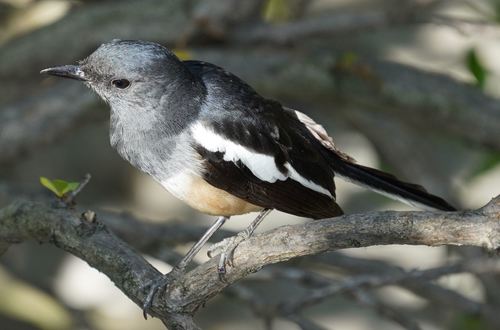 Oriental Magpie-Robin
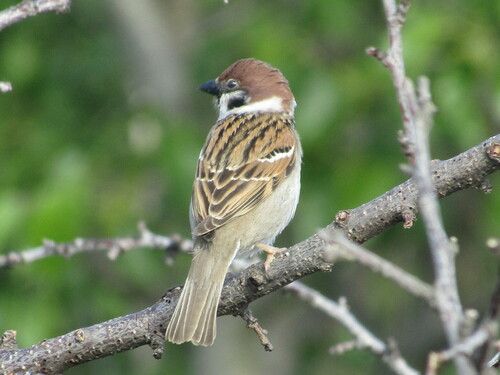 Passera mattugia
In breve
The most reliable field mark to separate Oriental Magpie-Robin from Eurasian Tree Sparrow is overall pattern and structure: the magpie-robin is a boldly black-and-white, long-tailed bird, while the tree sparrow is a compact, brown-backed bird with a rich chestnut crown and a distinctive black cheek spot. Immature magpie-robins are scaly brown above, but still show a longer tail and upright stance, unlike the sparrow's short tail and rounder body. In flight or perched, the magpie-robin’s tail is much longer and often cocked, while the sparrow’s tail is short and never held upright. Both species can occur in gardens and urban areas, but their shape, head pattern, and behavior are strikingly different when seen well.
Consigli di identificazione
- Tail length and carriage: Magpie-robin has a much longer tail, often held cocked upright, especially when foraging or alert. Tree sparrow’s tail is short and never cocked; this is a key structural difference in all ages.
- Head pattern: Tree sparrow always shows a rich chestnut crown and nape, white cheeks with a distinct black cheek spot, and a small black bib. Magpie-robin lacks any chestnut or cheek spot; males have a black head, females greyish-black, and immatures are brownish but plain-headed.
- Overall color and contrast: Magpie-robin (especially males) is sharply black and white, with a white shoulder patch and white underparts. Tree sparrow is brown above with black streaks, and never shows such strong contrast.
- Wing pattern: Tree sparrow has two narrow white wing bars on brown wings; magpie-robin shows a white shoulder patch but no wing bars.
- Juvenile confusion: Young magpie-robins are scaly brown above, but still show the long tail and upright stance. Juvenile tree sparrows are duller but already have the chestnut crown and cheek spot.
- Perched jizz: Magpie-robin stands more upright, often on open perches, with tail cocked. Tree sparrow is rounder, more horizontal, and rarely perches so openly.
- Flight silhouette: Magpie-robin appears longer and slimmer, with a long tail trailing behind. Tree sparrow is compact, with a short tail and quick, bounding flight.
- Bill shape: Magpie-robin has a slender, flycatcher-like bill; tree sparrow’s bill is short and conical, typical of seed-eating sparrows.
- Sex differences: Tree sparrow sexes are identical; magpie-robin shows sexual dimorphism, with males more boldly marked than females (except in some races).
- Social behavior: Tree sparrow is usually in flocks, magpie-robin is solitary or in pairs.
- Habitat context: In dense flocks around buildings or farmland, expect sparrow; a lone, conspicuous bird singing from a high perch is likely magpie-robin.
- Underpart color: Magpie-robin has clean white underparts; tree sparrow is buffy or brownish below.
- Cheek spot: Only tree sparrow has a black cheek spot on a white face; magpie-robin never does.
- Crown color: Chestnut crown is exclusive to tree sparrow; magpie-robin’s head is black (male), greyish-black (female), or brownish (immature).
- Size impression: Magpie-robin is visibly larger and longer than tree sparrow, especially when seen side by side or near common objects.
Taglia
Oriental Magpie-Robin is noticeably larger and heavier (body mass ~36g, length 19cm) than Eurasian Tree Sparrow (~26g, length 12.5–14cm). The magpie-robin appears longer and slimmer, with a proportionally much longer tail. The sparrow is compact and stubby, with a short tail and round body. Even at a distance, the magpie-robin's size and elongated silhouette stand out against the sparrow’s smaller, chunkier profile.
Piumaggio
- Juvenile/immature birds: Young Oriental Magpie-Robins are scaly brown above and on the head, lacking the crisp black-and-white contrast of adults, but still show a long tail and upright stance. Eurasian Tree Sparrow juveniles are duller than adults but already show the key face pattern: chestnut crown, white cheek, and black cheek spot.
- Adults: Male magpie-robins are glossy black above with a white shoulder patch and white underparts; females are greyer but still show a strong black-and-white pattern (except in some races where females approach male coloration). Tree sparrows of all ages and sexes have a rich chestnut crown, white cheeks with a black spot, and brown, streaked upperparts. Their wings show two narrow white bars, unlike the magpie-robin.
- Flight views: Magpie-robins show strong black-and-white contrast and a long, white-edged tail; tree sparrows show brown wings with white bars and lack any long tail or bold black-and-white pattern.
Comportamento
Oriental Magpie-Robin often forages on the ground or low branches, frequently cocking its long tail upright, and perches conspicuously, especially when singing. Males may sing from high perches, puffing up and fanning the tail in display. Eurasian Tree Sparrow is more likely to be seen in small flocks, feeding on the ground or perched in trees and shrubs, but never cocks its tail. Tree sparrows are more social and less conspicuous in display than magpie-robins.
Habitat
Both species can be found in urban gardens, parks, and forest edges, but Oriental Magpie-Robin is more likely to be seen alone or in pairs, often near the ground or in low vegetation. Eurasian Tree Sparrow is usually in small groups, often around buildings, farmland, or open woodland. The magpie-robin’s preference for perching in the open and singing from high points contrasts with the sparrow’s more secretive, flocking habits.
Oriental Magpie-Robin · Passera mattugia · I miei uccelli difficili