

Orchard Oriole vs Baltimore Oriole
Icterus spurius contro Icterus galbula
Fai un quiz con Orchard Oriole e Baltimore Oriole
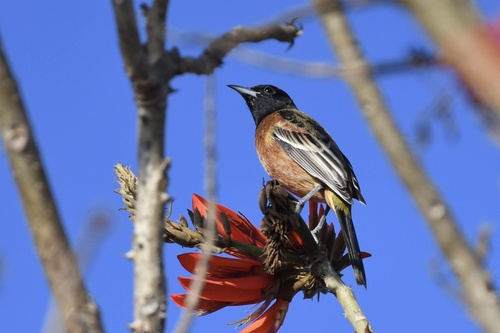 Orchard Oriole
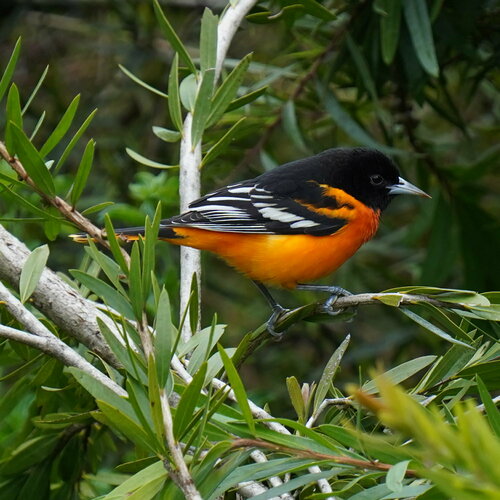 Baltimore Oriole
In breve
The most reliable field mark between Orchard Oriole and Baltimore Oriole is adult male plumage: Orchard males show deep chestnut (not orange) underparts and rump, while Baltimore males are a vivid orange. Females and immatures are trickier: Orchard Oriole females and young are olive-green above and yellowish below, whereas Baltimore Oriole females and young are yellow-brown above with dull orange-yellow below. Orchard Oriole is distinctly smaller and slimmer, with a more delicate, pointed bill. In flight, both show white wing bars, but Baltimore Oriole is bulkier and longer-tailed. Be cautious with first-year males and females, as their colors can overlap, but size and structure help separate them.
Consigli di identificazione
- Adult Male Plumage: Orchard Oriole males are deep chestnut below and on the rump, never orange; Baltimore Oriole males are bright orange in these areas. This is the most reliable field mark in spring and summer.
- Female and Juvenile Plumage: Orchard Oriole females/juveniles are olive-green above and yellowish below, with a clean, lemony tone. Baltimore Oriole females/juveniles are yellow-brown above and dull orange-yellow below, often duskier and more orange-tinged.
- First-year Male Orchard Oriole: Shows yellow-green plumage with black lores and bib; Baltimore Oriole first-year males lack the black bib and are generally more orange-washed below.
- Size and Structure: Orchard Oriole is noticeably smaller and slimmer, with a more delicate, pointed bill. Baltimore Oriole is bulkier, with a thicker bill and longer tail. Use this when birds are side-by-side or when size can be judged against known species.
- Bill Shape: Orchard Oriole's bill is more slender and pointed; Baltimore Oriole's is thicker and more robust. This can be subtle but helps with good views.
- Wing Bars: Both species have white wing bars; these are not diagnostic but confirm the bird is an oriole.
- Flight Style: Orchard Oriole often flies low and swoops near the ground or below treetop level; Baltimore Oriole tends to fly higher and more directly.
- Habitat Context: Orchard Oriole is more likely in open, park-like settings near water, often in groups. Baltimore Oriole is more solitary and can be found in more urban or suburban areas, often at feeders.
- Song: Baltimore Oriole's song is a clear, whistled series of paired notes; Orchard Oriole's song is less described here but is not as loud or vibrant as Baltimore's. Use song as a secondary check.
- Seasonal Timing: Both species overlap in range and season, but Orchard Oriole may arrive and depart slightly earlier in migration.
- Feeding Behavior: Baltimore Oriole is more likely to visit feeders for fruit and jelly, especially in suburban yards. Orchard Oriole is less likely to do so.
- Courtship Displays: Both species bow and flutter wings, but Baltimore Oriole males are more likely to sing from exposed perches.
- Pitfalls: Immature males and females of both species can be confusing; rely on size, structure, and subtle color differences. Avoid relying solely on orange/yellow tones in poor light.
- Geographic Range: If in southern Texas or Mexico, be alert for the ochre subspecies of Orchard Oriole, which replaces chestnut with ochre in adult males.
- Group Association: Orchard Orioles may nest in loose colonies or close proximity; Baltimore Orioles are more solitary nesters.
Taglia
Orchard Oriole is the smallest North American oriole, measuring 15–18 cm (5.9–7.1 in) in length and weighing 16–28 g (0.6–1.0 oz) with a wingspan of about 25 cm (9.8 in) [wikipedia]. Baltimore Oriole is noticeably larger: 17–22 cm (6.7–8.7 in) long, 22.3–42 g (0.79–1.48 oz), and wingspan 23–32 cm (9.1–12.6 in) [wikipedia, avonet]. In the field, Baltimore Oriole looks bulkier, with a stouter body and longer tail, while Orchard Oriole appears slim and delicate.
Piumaggio
- Juvenile and Female Plumage: Orchard Oriole females and juveniles are olive-green above and yellowish below, with white wing bars. Baltimore Oriole females and juveniles are yellow-brown above with darker wings and a dull orange-yellow breast and belly, also with white wing bars. Orchard Oriole's yellow is cleaner and more lemon-toned, while Baltimore's is duskier and more orange-tinged.
- First-year Males: Orchard Oriole first-year males are yellow-greenish overall but show black lores and a small black bib, lacking any orange or chestnut. Baltimore Oriole first-year males resemble females but may show a duller orange wash on the underparts and lack the black bib.
- Adult Males: Orchard Oriole adult males have deep chestnut (not orange) on the underparts, shoulder, and rump, with the rest black. Baltimore Oriole adult males are bright orange on the underparts, shoulder patch, and rump, with the rest black. Orchard Oriole never shows the fiery orange of Baltimore Oriole.
- Wing Pattern: Both species have white wing bars, but no unique juvenile upperwing pattern is described for either; thus, wing bars alone are not diagnostic.
- Bill: Orchard Oriole's bill is pointed and black with some blue-gray at the base of the lower mandible; Baltimore Oriole's bill is thicker and more robust.
Comportamento
Orchard Orioles often fly low, swooping close to the ground or at treetop level, and are more likely to be seen in small groups or loosely associated pairs. Baltimore Orioles are more solitary outside breeding, often seen singly or in pairs, and may be more conspicuous when singing from high perches. Both species display bowing and wing-fluttering in courtship, but Baltimore Oriole males are more likely to sing conspicuously from exposed branches.
Habitat
Both species breed in semi-open areas with deciduous trees in eastern North America, but Orchard Oriole favors more open, park-like settings near water (lakes, streams) and often nests in shaded trees. Baltimore Oriole is also found in open woodlands, parks, and suburban areas but is generally more tolerant of urban environments and may be attracted to feeders. Orchard Oriole's range extends farther south into Mexico and Central America in winter, while Baltimore Oriole winters from Mexico to northern South America.
Voce
Baltimore Oriole males have a clear, whistled, and vibrant song with paired notes repeated several times, lasting 1–2 seconds. Orchard Oriole's song is less described here, but both species chatter and give warning calls. Baltimore Oriole's song is more likely to be noticed due to its volume and clarity. Females of both species can sing, but Baltimore Oriole females give a distinctive screech when defending the nest.
Orchard Oriole · Baltimore Oriole · I miei uccelli difficili