

Motmot

Olive Bee-eater vs Rainbow Bee-eater

Merops superciliosus contro Merops ornatus

Fai un quiz con Olive Bee-eater e Rainbow Bee-eater
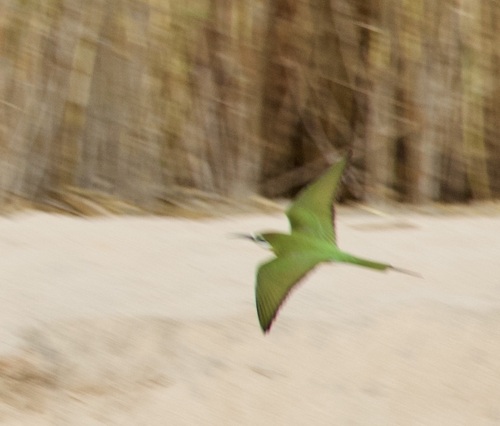
Olive Bee-eater (Merops superciliosus) Olive Bee-eater
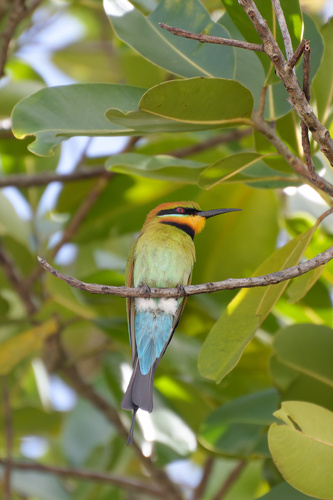
Rainbow Bee-eater (Merops ornatus) Rainbow Bee-eater

Media

Caricamento…

In breve

The most reliable field mark between Olive Bee-eater and Rainbow Bee-eater is the combination of head and throat color: Olive Bee-eater shows an olive cap with white forehead and cheeks, while Rainbow Bee-eater has a yellow-orange crown and throat with a bold black gorget and eye-stripe. In flight, Rainbow Bee-eater’s underwings are rufous-copper with black tips, contrasting with the more uniform bronzy-green of Olive Bee-eater. Juvenile Rainbow Bee-eaters lack throat bands and tail streamers, which can lead to confusion, but their overall duller, greener crown and absence of facial white help separate them. Size and structure also differ, with Olive Bee-eater being noticeably heavier and slightly bulkier. Both species have long tail streamers, but the color and facial patterns are key in most views.

Consigli di identificazione

  1. Head and face pattern: Olive Bee-eater always shows a white forehead, eyebrows, chin, and cheeks, contrasting with its olive cap. Rainbow Bee-eater never shows this much white; instead, it has a yellow-orange crown and throat, with a bold black line through the eye bordered by blue.
  2. Throat and gorget: Rainbow Bee-eater adults have a black crescent-shaped gorget on the throat, which is absent in Olive Bee-eater. Juvenile Rainbows lack the gorget, so check other marks.
  3. Crown color: Olive Bee-eater’s cap is olive, blending into bronzy-green upperparts. Rainbow Bee-eater’s crown is yellow-orange, standing out from the green back.
  4. Underwing color (in flight): Rainbow Bee-eater shows rufous to copper underwings with black tips and green edges, diagnostic in flight. Olive Bee-eater’s underwings are more uniform greenish-bronze.
  5. Tail color and streamers: Both have elongated central tail feathers, but Olive’s tail is blue (except for black streamers), while Rainbow’s is black to deep violet. Male Rainbows have longer streamers than females; Olive sexes are similar.
  6. Eye-stripe: Rainbow Bee-eater’s black eye-stripe is thick and bordered with blue, running through a bright red eye. Olive Bee-eater’s facial pattern is dominated by white, with no strong black eye-stripe.
  7. Breast and belly: Rainbow Bee-eater’s underparts are yellow-orange, blending to green, while Olive Bee-eater’s are bronzy-green, matching the upperparts.
  8. Juvenile confusion: Young Rainbow Bee-eaters lack the black throat band and tail streamers, but still have a greener crown and no white on the face. If you see a bird with a white forehead and cheeks, it is not a Rainbow Bee-eater of any age.
  9. Size and build: Olive Bee-eater is heavier and bulkier; Rainbow Bee-eater is more slender and lighter. This is subtle but can help in direct comparison.
  10. Rump and undertail: Rainbow Bee-eater shows a bright blue lower back and undertail coverts, while Olive Bee-eater’s rump and tail are blue but less vivid, and the undertail is not described as bright blue.
  11. Sex differences: Only Rainbow Bee-eater males have distinctly longer tail streamers; Olive Bee-eater sexes are alike.
  12. Geographic context: If you are in Africa, Olive Bee-eater is expected; in Australia, Rainbow Bee-eater is the default. Out-of-range records should be scrutinized for captive or vagrant status.
  13. Perched vs. flight views: In perched birds, focus on head and face pattern; in flight, underwing color and tail streamer length are most useful.
  14. Behavior: Communal nesting and burrow digging are typical of Rainbow Bee-eater, not Olive. If you see this behavior, it supports Rainbow.
  15. Pitfalls: Juvenile Rainbow Bee-eaters can lack obvious throat bands and tail streamers, but never show the extensive white facial markings of Olive Bee-eater. Always check multiple features.

Taglia

Olive Bee-eater is substantially heavier (43.4g vs. 28g) and appears more robust than the Rainbow Bee-eater, though both are similar in length (23–26 cm for Olive, 23–28 cm for Rainbow, including tail streamers). In the hand or with good views, Olive Bee-eater feels bulkier, while Rainbow Bee-eater is more slender and lightweight. Tail streamer length is variable in both, but Rainbow’s streamers are proportionally longer in males.

Piumaggio

Juvenile Rainbow Bee-eaters are duller overall, with a greener crown and lacking both the black throat band (gorget) and the elongated tail streamers seen in adults. This can make them superficially similar to Olive Bee-eater, but Olive always shows a white forehead, eyebrows, chin, and cheeks, which Rainbow never does at any age. Adult Olive Bee-eaters have bronzy-green upperparts, an olive cap, and blue rump/tail (except for black streamers), while Rainbow Bee-eaters show a bright yellow-orange crown and throat, black eye-stripe bordered with blue, green upperparts, and bright blue lower back and undertail coverts. In flight, Rainbow Bee-eater’s underwings are rufous to copper with black tips, a feature not present in Olive Bee-eater, which has more uniform greenish wings. The tail of Rainbow is black to deep violet, while Olive’s is blue with black streamers. Sexes are similar in Olive, but male Rainbow Bee-eaters have longer tail streamers.

Comportamento

Both species are aerial insectivores and perch conspicuously before sallying for prey. Rainbow Bee-eaters are noted for their communal nesting and may be seen digging burrows or sharing tunnels, especially during the breeding season. Olive Bee-eaters do not have communal nesting mentioned in the notes. Both species hunt flying insects, often returning to the same perch. Rainbow Bee-eaters are known to remove stingers from bees by rubbing them on a perch.

Habitat

Olive Bee-eater is native to the southern half of Africa, found in a wide range of countries and habitats, often near water or open woodland. Rainbow Bee-eater is found in Australia and nearby regions, often in open country, woodlands, and near water, but also in areas suitable for ground nesting. There is no overlap in natural range, so vagrancy or captivity would be the only context for confusion outside their core areas.

Invia una descrizione migliore

Usa le stesse sezioni del confronto. Il testo viene pubblicato subito.

The most reliable field mark between Olive Bee-eater and Rainbow Bee-eater is the combination of head and throat color: Olive Bee-eater shows an olive cap with white forehead and cheeks, while Rainbow Bee-eater has a yellow-orange crown and throat with a bold black gorget and eye-stripe. In flight, Rainbow Bee-eater’s underwings are rufous-copper with black tips, contrasting with the more uniform bronzy-green of Olive Bee-eater. Juvenile Rainbow Bee-eaters lack throat bands and tail streamers, which can lead to confusion, but their overall duller, greener crown and absence of facial white help separate them. Size and structure also differ, with Olive Bee-eater being noticeably heavier and slightly bulkier. Both species have long tail streamers, but the color and facial patterns are key in most views.

  1. Head and face pattern: Olive Bee-eater always shows a white forehead, eyebrows, chin, and cheeks, contrasting with its olive cap. Rainbow Bee-eater never shows this much white; instead, it has a yellow-orange crown and throat, with a bold black line through the eye bordered by blue.
  2. Throat and gorget: Rainbow Bee-eater adults have a black crescent-shaped gorget on the throat, which is absent in Olive Bee-eater. Juvenile Rainbows lack the gorget, so check other marks.
  3. Crown color: Olive Bee-eater’s cap is olive, blending into bronzy-green upperparts. Rainbow Bee-eater’s crown is yellow-orange, standing out from the green back.
  4. Underwing color (in flight): Rainbow Bee-eater shows rufous to copper underwings with black tips and green edges, diagnostic in flight. Olive Bee-eater’s underwings are more uniform greenish-bronze.
  5. Tail color and streamers: Both have elongated central tail feathers, but Olive’s tail is blue (except for black streamers), while Rainbow’s is black to deep violet. Male Rainbows have longer streamers than females; Olive sexes are similar.
  6. Eye-stripe: Rainbow Bee-eater’s black eye-stripe is thick and bordered with blue, running through a bright red eye. Olive Bee-eater’s facial pattern is dominated by white, with no strong black eye-stripe.
  7. Breast and belly: Rainbow Bee-eater’s underparts are yellow-orange, blending to green, while Olive Bee-eater’s are bronzy-green, matching the upperparts.
  8. Juvenile confusion: Young Rainbow Bee-eaters lack the black throat band and tail streamers, but still have a greener crown and no white on the face. If you see a bird with a white forehead and cheeks, it is not a Rainbow Bee-eater of any age.
  9. Size and build: Olive Bee-eater is heavier and bulkier; Rainbow Bee-eater is more slender and lighter. This is subtle but can help in direct comparison.
  10. Rump and undertail: Rainbow Bee-eater shows a bright blue lower back and undertail coverts, while Olive Bee-eater’s rump and tail are blue but less vivid, and the undertail is not described as bright blue.
  11. Sex differences: Only Rainbow Bee-eater males have distinctly longer tail streamers; Olive Bee-eater sexes are alike.
  12. Geographic context: If you are in Africa, Olive Bee-eater is expected; in Australia, Rainbow Bee-eater is the default. Out-of-range records should be scrutinized for captive or vagrant status.
  13. Perched vs. flight views: In perched birds, focus on head and face pattern; in flight, underwing color and tail streamer length are most useful.
  14. Behavior: Communal nesting and burrow digging are typical of Rainbow Bee-eater, not Olive. If you see this behavior, it supports Rainbow.
  15. Pitfalls: Juvenile Rainbow Bee-eaters can lack obvious throat bands and tail streamers, but never show the extensive white facial markings of Olive Bee-eater. Always check multiple features.

Olive Bee-eater is substantially heavier (43.4g vs. 28g) and appears more robust than the Rainbow Bee-eater, though both are similar in length (23–26 cm for Olive, 23–28 cm for Rainbow, including tail streamers). In the hand or with good views, Olive Bee-eater feels bulkier, while Rainbow Bee-eater is more slender and lightweight. Tail streamer length is variable in both, but Rainbow’s streamers are proportionally longer in males.

Juvenile Rainbow Bee-eaters are duller overall, with a greener crown and lacking both the black throat band (gorget) and the elongated tail streamers seen in adults. This can make them superficially similar to Olive Bee-eater, but Olive always shows a white forehead, eyebrows, chin, and cheeks, which Rainbow never does at any age. Adult Olive Bee-eaters have bronzy-green upperparts, an olive cap, and blue rump/tail (except for black streamers), while Rainbow Bee-eaters show a bright yellow-orange crown and throat, black eye-stripe bordered with blue, green upperparts, and bright blue lower back and undertail coverts. In flight, Rainbow Bee-eater’s underwings are rufous to copper with black tips, a feature not present in Olive Bee-eater, which has more uniform greenish wings. The tail of Rainbow is black to deep violet, while Olive’s is blue with black streamers. Sexes are similar in Olive, but male Rainbow Bee-eaters have longer tail streamers.

Both species are aerial insectivores and perch conspicuously before sallying for prey. Rainbow Bee-eaters are noted for their communal nesting and may be seen digging burrows or sharing tunnels, especially during the breeding season. Olive Bee-eaters do not have communal nesting mentioned in the notes. Both species hunt flying insects, often returning to the same perch. Rainbow Bee-eaters are known to remove stingers from bees by rubbing them on a perch.

Olive Bee-eater is native to the southern half of Africa, found in a wide range of countries and habitats, often near water or open woodland. Rainbow Bee-eater is found in Australia and nearby regions, often in open country, woodlands, and near water, but also in areas suitable for ground nesting. There is no overlap in natural range, so vagrancy or captivity would be the only context for confusion outside their core areas.

Scartare le modifiche?

Hai modifiche non salvate. Se esci ora, andranno perse.

Olive Bee-eater · Rainbow Bee-eater · I miei uccelli difficili