

Albastrello vs Labbo
Tringa stagnatilis contro Stercorarius parasiticus
Fai un quiz con Albastrello e Labbo
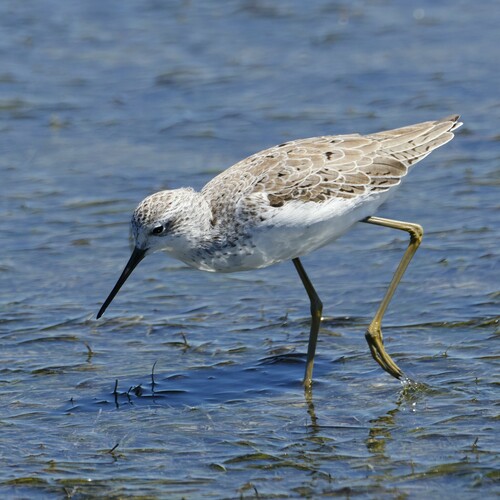 Albastrello
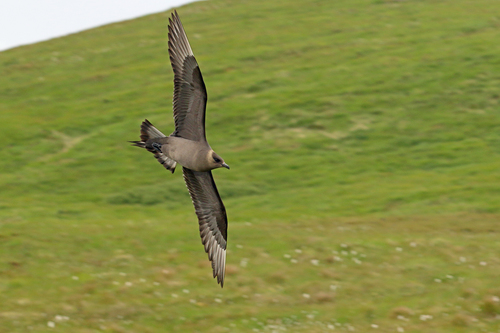 Labbo
In breve
The most reliable way to separate Marsh Sandpiper from Arctic Skua is by overall structure and flight style: Marsh Sandpiper is a slender, long-legged wader with a fine bill, while Arctic Skua is a robust, predatory seabird with pointed wings and, in adults, elongated central tail feathers. In flight, Marsh Sandpiper shows a white wedge up the back, while all morphs of Arctic Skua display a bold white wing flash. Juvenile and dark-morph Arctic Skuas can be especially confusing at a distance, but the skua's bulk, wing shape, and aggressive flight are distinctive. Habitat is also a strong clue: Marsh Sandpiper is seen in freshwater wetlands, Arctic Skua over open sea or tundra.
Consigli di identificazione
- White wing flash (Arctic Skua): All ages and morphs of Arctic Skua show a bold white flash on the primaries in flight, absent in Marsh Sandpiper. This is the single most reliable flight mark.
- White wedge up back (Marsh Sandpiper): In flight, Marsh Sandpiper shows a white wedge up the back, not present in Arctic Skua.
- Tail shape: Adult Arctic Skuas in breeding plumage have long, pointed central tail streamers (about 7 cm), lacking in Marsh Sandpiper. Juvenile skuas lack streamers but still have a short, square or slightly pointed tail, unlike the sandpiper's short, straight tail.
- Leg color and length: Marsh Sandpiper has very long, yellowish legs that project well beyond the tail in flight and are obvious when perched. Arctic Skua's legs are much shorter and dark, barely visible in flight.
- Bill shape: Marsh Sandpiper has a long, fine, straight bill suited for probing. Arctic Skua has a heavy, hooked bill for predation and kleptoparasitism.
- Overall structure: Marsh Sandpiper is slender, delicate, and elegant, with a small head and long neck. Arctic Skua is robust, broad-winged, and deep-chested, with a predatory jizz.
- Flight style: Marsh Sandpiper flies with rapid, shallow wingbeats and a buoyant, agile motion. Arctic Skua is powerful and falcon-like, often chasing other birds or gliding on stiff wings.
- Plumage color: Marsh Sandpiper is greyish-brown above with paler underparts and some breast spotting in breeding season. Arctic Skua varies from brown (light morph) to all dark brown (dark morph), but always with the white wing flash.
- Head pattern: Adult light-morph Arctic Skua has a yellowish-white head and neck with a black cap, unlike the sandpiper's plain head.
- Habitat: Marsh Sandpiper is almost always in freshwater wetlands or marshes. Arctic Skua is found over open sea, coastal areas, or tundra.
- Size: Marsh Sandpiper is much smaller and lighter than Arctic Skua. If seen together, the size difference is striking.
- Behavior: Marsh Sandpiper feeds quietly in shallow water. Arctic Skua is often seen chasing other birds or flying aggressively.
- Voice: If heard, Arctic Skua's nasal mewing or wailing calls (on breeding grounds) are unlike anything from Marsh Sandpiper, which is mostly silent.
- Confusion risk: Juvenile Arctic Skuas can be mistaken for large waders at a distance, but the white wing flash and bulkier shape are key. Marsh Sandpiper never shows a white wing flash or skua-like flight.
- Seasonal context: In Europe, Marsh Sandpiper is a rare migrant; Arctic Skua is most often seen on migration along coasts or offshore.
Taglia
Marsh Sandpiper is much smaller and lighter (body mass ~72g, length 22–26 cm, wingspan 55–59 cm) than Arctic Skua, which is a medium-sized seabird (length 41–48 cm, wingspan 107–125 cm, mass 300–650g). The skua is nearly twice as long and up to ten times heavier. Even at a distance, the skua's broad wings and powerful build contrast with the sandpiper's delicate, slender shape.
Piumaggio
-
Juvenile/immature birds: Marsh Sandpiper juveniles resemble adults but are generally paler, with diffuse brownish spots on the breast and neck and a white wedge up the back visible in flight. Juvenile Arctic Skuas are highly variable, often brownish overall, and lack the adult's long tail streamers, but always show a strong white wing flash (on the primaries) in flight. This white flash is absent in Marsh Sandpiper.
-
Adult breeding plumage: Marsh Sandpiper is greyish-brown above with some darker mottling, paler below, and shows a white wedge up the back in flight. Arctic Skua adults have three morphs: light (brown back, white underparts, yellowish-white head and neck with black cap, white wing flash), dark (dark brown overall, white wing flash), and intermediate (dark with paler head/neck, white wing flash). All skua morphs have the white wing flash, and breeding adults have pointed central tail projections.
-
Nonbreeding/winter: Marsh Sandpiper becomes paler overall. Arctic Skua retains its morph differences but may appear duller. The white wing flash remains diagnostic for skua at all ages and seasons.
Comportamento
Marsh Sandpiper feeds by probing and picking in shallow water, moving delicately on very long legs. Its flight is swift and buoyant but not powerful. Arctic Skua is a bold, aggressive flier, often harassing gulls and terns to steal food (kleptoparasitism). Its flight is strong, direct, and falcon-like, with deep wingbeats and frequent aerial chases. Skuas may also be seen flying at intruders near their nests.
Habitat
Marsh Sandpiper is found in freshwater wetlands, marshes, and flooded grasslands, especially during migration and winter. It breeds in open grassy steppe and taiga wetlands. Arctic Skua breeds on dry tundra, high fells, and islands, and is usually seen over open sea or coastal areas outside the breeding season. Seeing a bird in a freshwater marsh vs. open sea or tundra is a strong clue to its identity.
Voce
Marsh Sandpiper is generally quiet, with no distinctive calls noted in the provided sources. Arctic Skua is also mostly silent except on the breeding grounds, where it gives nasal mewing and wailing calls, and a shorter alarm call when disturbed. These vocalizations are rarely heard away from the nest.