

Falco laggar vs Sacro
Falco jugger contro Falco cherrug
Fai un quiz con Falco laggar e Sacro
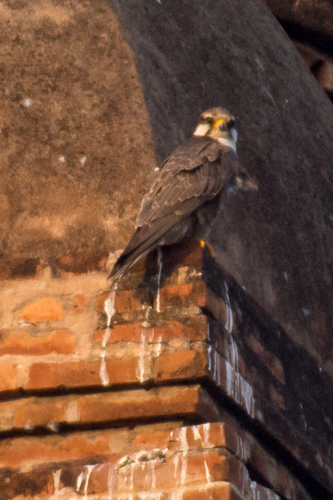 Falco laggar
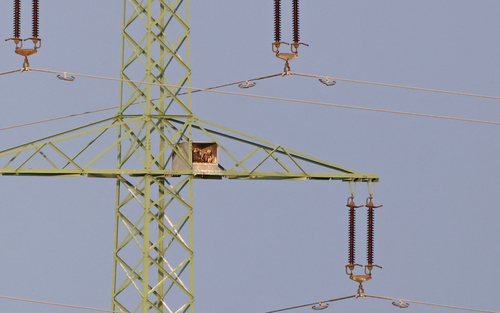 Sacro
In breve
The most reliable field mark between Laggar Falcon and Saker Falcon is size: Saker is distinctly larger and bulkier, with a heavier build visible both perched and in flight. For immatures, Laggar fledglings and subadults show a much darker, almost entirely dark underside, while Saker juveniles are more heavily streaked but not uniformly dark below. Adult Laggar is overall dark with blackish leg feathers, while Saker adults are variable but generally browner and paler below. Both are hierofalcons and can look similar at a distance, but careful attention to size, underpart coloration, and leg feathering will usually separate them.
Consigli di identificazione
- Size is the first check: Saker Falcon is much larger and bulkier than Laggar Falcon. If the bird appears heavy and almost eagle-like, especially in direct comparison, suspect Saker.
- Juvenile underparts: Laggar fledglings and subadults are almost entirely dark below, while Saker juveniles are heavily streaked but not solidly dark. If you see a young falcon with nearly uniform dark underparts, it's likely a Laggar.
- Adult underparts: Adult Laggar is dark overall, with a more uniform, dusky look below. Saker adults are variable but generally paler and browner, with streaked or barred underparts.
- Leg feathering: Check the tibiotarsus (leg) feathers. Laggar adults have blackish leg feathering, giving a dark-legged impression. Saker lacks this feature; its legs are not especially dark-feathered.
- Overall color tone: Laggar is darker and more uniform, especially on the underparts and legs. Saker is browner and paler, with more contrast between upper and underparts.
- Flight jizz: Saker's flight is powerful and heavy, with broad wings and a robust body. Laggar is slimmer and more agile in the air.
- Perched structure: Saker looks large-headed and deep-chested when perched, with a thick-set appearance. Laggar is more slender and less imposing.
- Range and context: In the Indian subcontinent, a large falcon in open country is more likely Laggar if resident, but Saker may appear as a migrant or winter visitor, especially in northern areas.
- Season: Saker is partial migrant; if seen outside the breeding season in South Asia, especially in winter, Saker is more likely. Laggar is resident but now scarce.
- Sex differences: Both species show little sexual dimorphism in plumage; females are larger but otherwise similar.
- Plumage variability: Saker is known for variable plumage, but even pale Sakers are usually browner and less uniform than Laggar.
- Pitfall—hybridization: Both are hierofalcons and can hybridize, leading to intermediate birds. If a bird shows mixed features, consider this possibility, but most field birds can be separated by size and underpart pattern.
- Voice: If heard, a sharp 'kiy-ee' or 'kyak-kyak-kyak' suggests Saker, but Laggar's call is not distinctive in the sources.
- Habitat: Both favor open country, but Saker is more likely in steppe, semi-desert, or during migration; Laggar is more tied to the Indian subcontinent and agricultural areas.
- Use multiple features: No single mark is infallible due to variability and overlap; combine size, underpart pattern, leg feathering, and context for best results.
Taglia
Saker Falcon is substantially larger and heavier than Laggar Falcon. Saker males weigh 730–990 g and females 970–1,300 g, with an average body mass around 1000 g [wikidata]. Laggar Falcon is mid-sized for a falcon and noticeably smaller and less robust than Saker. In the field, Saker's size and bulk are often apparent, especially when seen perched or in direct comparison. Saker's wingspan (97–126 cm) and length (45–57 cm) also exceed Laggar's, though exact Laggar measurements are not provided here.
Piumaggio
For juveniles and first-year birds, Laggar Falcon fledglings are almost entirely dark below, and subadults retain much dark on the belly. This contrasts with Saker juveniles, which are heavily streaked below but not uniformly dark; their underparts show a pattern of streaks rather than solid color. Adult Laggar is dark overall, with especially dark tibiotarsus (leg) feathers, giving a dusky-legged look. Saker adults are variable but tend to be browner, with paler and more streaked underparts, and lack the blackish leg feathering. Both species can show hierofalcon-like patterns, but Saker is generally paler and browner, while Laggar is darker and more uniform, especially on the underparts and legs.
Comportamento
Both species are powerful falcons, but Saker's larger size gives it a more robust, heavy flight style. Saker is known for strong, direct flight and can appear almost eagle-like in bulk and movement. Laggar, being smaller, is more agile and less imposing in flight. Both may soar or hunt low over open country, but Saker's size and power are often evident, especially when hunting or carrying prey.
Habitat
Laggar Falcon is now scarce but was formerly widespread across the Indian subcontinent, favoring open country, agricultural areas, and semi-arid regions. Saker Falcon breeds across Central Europe to Manchuria and winters in regions like the Sahel, passing through the Middle East and South Asia on migration. While their ranges can overlap in parts of Pakistan and northern India, Saker is more likely encountered as a migrant or winter visitor, whereas Laggar is a resident (though declining). Both can be seen in open habitats, but context and season may help: Saker is more likely in migration or winter, Laggar as a local breeder.
Voce
Saker Falcon's call is described as a sharp 'kiy-ee' or repeated 'kyak-kyak-kyak.' No distinctive vocalization is noted for Laggar Falcon in the provided sources, so voice is not a reliable separator in this context.