

Guadeloupe Amazon vs Orange-winged Amazon
Amazona violacea contro Amazona amazonica
Fai un quiz con Guadeloupe Amazon e Orange-winged Amazon
 Guadeloupe Amazon
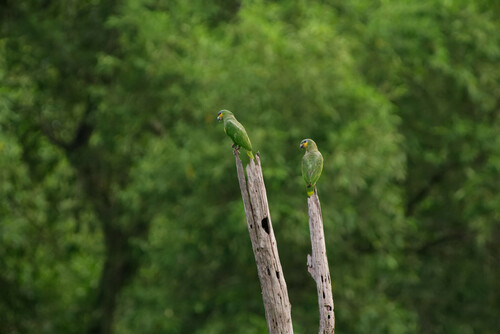 Orange-winged Amazon
In breve
Il segno di campo più affidabile per separare questi due è la distintiva colorazione della testa e delle parti inferiori: Guadeloupe Amazon è stata descritta con una testa, un collo e parti inferiori di colore blu ardesia o blu cenere (a volte viola), mentre l'Orange-winged Amazon mostra sempre un corpo principalmente verde con blu e giallo variabili solo sulla testa. In volo, l'Orange-winged Amazon rivela chiare macchie arancioni nelle ali e nella coda, che non sono descritte per il Guadeloupe Amazon. Il Guadeloupe Amazon è estinto e conosciuto solo attraverso resoconti storici, quindi tutti i confronti si basano su descrizioni scritte e non su osservazioni dirette. Se vedi un pappagallo con un corpo principalmente verde, testa blu/gialla e arancione nelle ali, è un Orange-winged Amazon; un pappagallo con una testa e parti inferiori blu ardesia o viola, dorso verde e senza arancione nelle ali corrisponderebbe al Guadeloupe Amazon, anche se un tale uccello non è estinto.
Consigli di identificazione
- Colore della testa e delle parti inferiori: Guadeloupe Amazon aveva una testa, un collo e parti inferiori blu ardesia, blu cenere o viola; l'Orange-winged Amazon ha sempre un corpo verde con blu e giallo solo sulla testa, mai blu ardesia o viola. Questo è il separatore chiave in tutte le età.
- Dorso e parti superiori: Il dorso del Guadeloupe Amazon era completamente verde; l'Orange-winged Amazon è anche principalmente verde sopra, quindi questo non è un separatore utile.
- Colorazione delle ali (in perching): Le ali del Guadeloupe Amazon sono state descritte come verdi, gialle e rosse, possibilmente con roselline rosse sparse nelle copritrici. L'Orange-winged Amazon ha ali verdi con macchie arancioni, ma l'arancione è più evidente in volo.
- Colorazione delle ali (in volo): L'Orange-winged Amazon mostra chiaro arancione nelle ali e nella coda in volo; le ali del Guadeloupe Amazon avevano verde, giallo e rosso, ma non arancione nella coda. Se vedi arancione nella coda, è un Orange-winged Amazon.
- Motivo della testa: L'Orange-winged Amazon mostra blu e giallo sulla testa, con l'estensione che varia; il Guadeloupe Amazon non è mai stato descritto come avente macchie gialle o blu, ma piuttosto un tono uniforme blu ardesia o viola.
- Colore del becco: L'Orange-winged Amazon ha un mandibola superiore parzialmente color corno, parzialmente grigio scuro. Nessun colore del becco è descritto per il Guadeloupe Amazon.
- Dimorfismo sessuale: Entrambe le specie sono descritte come monomorfiche; maschi e femmine si somigliano.
- Segni giovanili/immaturi: Il Guadeloupe Amazon potrebbe aver mostrato più verde nella testa e nelle parti inferiori da immaturo, ma questo è speculativo. I giovani dell'Orange-winged Amazon somigliano agli adulti.
- Dimensioni: Entrambi sono grandi pappagalli Amazona, ma le dimensioni non sono un separatore affidabile a causa della mancanza di dati per il Guadeloupe Amazon.
- Colore della coda: L'Orange-winged Amazon ha arancione nella coda, specialmente visibile in volo; il Guadeloupe Amazon non è descritto come avente arancione nella coda.
- Comportamento: L'Orange-winged Amazon è rumoroso e sociale; il comportamento del Guadeloupe Amazon è sconosciuto.
- Habitat e distribuzione: Se visto al di fuori della Guadalupa, è un Orange-winged Amazon. Il Guadeloupe Amazon è estinto ed era ristretto alla Guadalupa.
- Voce: Solo la voce dell'Orange-winged Amazon è conosciuta (grida forti e acute); nulla è noto per il Guadeloupe Amazon.
- Trappole di piumaggio: Esiste una certa confusione storica con altri amazoni delle Antille, ma la testa e le parti inferiori blu ardesia/viola sono uniche tra gli amazoni descritti per il Guadeloupe Amazon.
- Incertezze storiche: Tutti i segni di campo per il Guadeloupe Amazon si basano su vecchie descrizioni scritte, quindi rimane un certo grado di incertezza. Se un uccello si adatta al modello dell'Orange-winged Amazon, specialmente con arancione nelle ali/coda e blu/giallo sulla testa, non è un Guadeloupe Amazon.
Taglia
Il Guadeloupe Amazon è stato descritto come leggermente più piccolo dei Macaws, ma non esistono misurazioni precise. L'Orange-winged Amazon è lungo circa 33 cm e pesa circa 340 g [wikipedia]. Entrambi sono grandi pappagalli Amazona, ma l'Orange-winged Amazon è ben all'interno dell'intervallo di dimensioni tipico per il genere. Le dimensioni da sole non sono un separatore affidabile data la mancanza di dati concreti per il Guadeloupe Amazon.
Piumaggio
- Piumaggio giovanile/immaturo: Per il Guadeloupe Amazon, i resoconti storici suggeriscono che il verde nella testa e nelle parti inferiori possa indicare immaturità, simile ai giovani Amazona di Saint Vincent, ma i dettagli sono scarsi e speculativi. Nessun modello specifico di ali giovanili è descritto per entrambe le specie.
- Piumaggio adulto: Guadeloupe Amazon: testa, collo e parti inferiori blu ardesia o blu cenere (a volte viola); dorso completamente verde; ali con verde, giallo e rosso (possibilmente come 'rosette' rosse sparse nelle copritrici); possibili bordi neri delle piume. Orange-winged Amazon: corpo principalmente verde; blu e giallo sulla testa (la quantità varia tra gli individui); piume arancioni nelle ali e nella coda, specialmente visibili in volo; nessun tono blu ardesia o viola sulla testa o sulle parti inferiori. Entrambi i sessi si somigliano nell'Orange-winged Amazon.
- In volo: L'Orange-winged Amazon mostra arancione evidente nelle ali e nella coda; il modello di volo del Guadeloupe Amazon non è descritto, ma non si menziona arancione nella coda, e la colorazione delle ali è principalmente verde, giallo e rosso.
Comportamento
L'Orange-winged Amazon è rumoroso, spesso visto in grandi dormitori comuni, ed è una vista regolare sia nelle popolazioni selvatiche che in quelle ferali. Il comportamento del Guadeloupe Amazon è sconosciuto oltre alle note storiche, ma essendo un endemico dell'isola, potrebbe essere stato meno gregario. Le differenze comportamentali non sono affidabili per la separazione sul campo.
Habitat
Il Guadeloupe Amazon era endemico delle foreste della Guadalupa nelle Piccole Antille ed è ora estinto. L'Orange-winged Amazon abita una vasta gamma di foreste e paesaggi semi-aperti nella parte tropicale del Sud America, e ha stabilito popolazioni ferali in diversi luoghi. Se visto al di fuori della Guadalupa, qualsiasi pappagallo selvatico è quasi certamente un Orange-winged Amazon.
Voce
L'Orange-winged Amazon è noto per grida forti e acute. Nessuna descrizione vocale esiste per il Guadeloupe Amazon, quindi la voce non è un separatore affidabile.
Guadeloupe Amazon · Orange-winged Amazon · I miei uccelli difficili