

Grayish Eagle-Owl vs Verreaux's Eagle-Owl
Bubo cinerascens contro Ketupa lactea
Fai un quiz con Grayish Eagle-Owl e Verreaux's Eagle-Owl
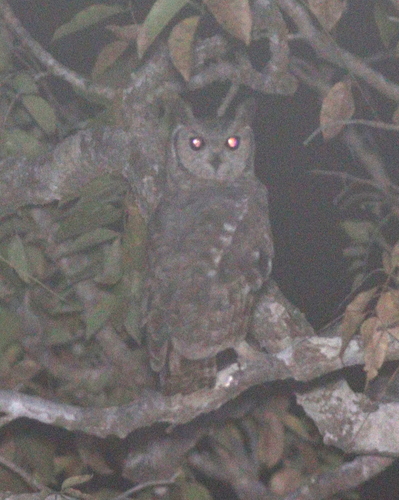 Grayish Eagle-Owl
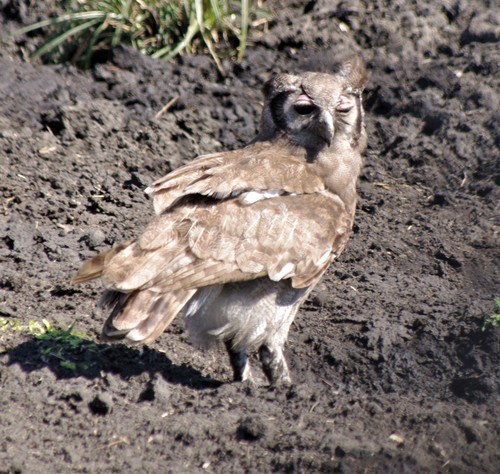 Verreaux's Eagle-Owl
In breve
The most reliable field mark between Greyish Eagle Owl and Verreaux's Eagle Owl is size: Verreaux's is by far the largest African owl, noticeably bulkier and longer than Greyish Eagle Owl. In the field, Verreaux's Eagle Owl also stands out for its massive proportions and often paler, 'milky' facial disc, while Greyish Eagle Owl is smaller, more compact, and lacks the extreme size and pale face. If you see the bird in flight or perched, check for overall size, facial coloration, and bulk. Vocalizations are quite different, but not always easy to hear. Habitat overlap is possible, but Verreaux's prefers dry, wooded savanna, while Greyish Eagle Owl is more often in rocky or bushy areas.
Consigli di identificazione
- Size is the most immediate clue: Verreaux's Eagle Owl is massive, up to 66 cm, and will look much larger and bulkier than Greyish Eagle Owl in any context. If the bird appears truly giant, especially compared to crows or other owls, favor Verreaux's.
- Facial disc coloration: Verreaux's has a pale, almost white ('milky') facial disc that stands out in low light, while Greyish Eagle Owl's face is more uniformly greyish and less contrasting.
- Bulk and proportions: Verreaux's is not just longer but much heavier-bodied, with a thick neck and a big head. Greyish Eagle Owl is large but more compact and less massive.
- Bill and feet: Verreaux's has a larger, heavier bill and more powerful feet, though this may be hard to judge unless seen very close or in photos.
- Habitat context: In dry, open savanna with large trees, especially in southern or central Africa, Verreaux's is more likely. In rocky, bushy, or cliffy areas in the north, Greyish Eagle Owl is more probable.
- Roosting site: A bird roosting in a cliff crevice, boulder, or dense bush is more likely Greyish Eagle Owl; in a large, open tree in savanna, favor Verreaux's.
- Voice: If you hear a two-note 'koo-whoo' repeated every few seconds, it's Greyish Eagle Owl. Deep, single hoots point to Verreaux's.
- Prey size (if observed hunting or feeding): Verreaux's may be seen with very large prey (even monkeys or hyraxes); Greyish Eagle Owl takes smaller vertebrates and large insects.
- Facial contrast in poor light: At dusk or dawn, Verreaux's pale face can appear to 'glow' compared to the more muted face of Greyish Eagle Owl.
- No strong age-specific flight marks: Neither species has a described juvenile or immature upperwing pattern that is diagnostic, so do not rely on wing pattern in flight for separation.
- Overlap with Spotted Eagle Owl: Be aware that Greyish Eagle Owl was formerly lumped with Spotted Eagle Owl; their calls differ, but confusion is possible in range overlap zones.
- Perched posture: Verreaux's often appears more upright and imposing when perched, due to its size and bulk.
- Man-made structures: Greyish Eagle Owl may use buildings or ruins for roosting, a habit less typical of Verreaux's.
- Geographic context: In northern sub-Saharan Africa, especially near the Sahel, Greyish Eagle Owl is expected; Verreaux's is more widespread in southern and central Africa.
- If in doubt, prioritize size and facial disc color: When all else fails, the combination of sheer size and pale face is the best field separation.
Taglia
Verreaux's Eagle Owl is the largest owl in Africa, reaching up to 66 cm (26 in) in length [wikipedia]. It is distinctly larger and bulkier than Greyish Eagle Owl, which is still large but not in the same league. In direct comparison, Verreaux's is much more imposing, with a heavier build and a larger head and bill. Greyish Eagle Owl is large for an owl, but will look medium-sized next to Verreaux's. If seen together or with a size reference, the difference is striking.
Piumaggio
No detailed age-specific upperwing or flight pattern marks are described for either species in the sources, so focus is on overall coloration and facial features. Verreaux's Eagle Owl is noted for its pale, 'milky' facial disc, which contrasts with its dark eyes and gives it a ghostly look, especially in low light. Greyish Eagle Owl lacks this very pale face and is generally more uniformly greyish, with less contrast. Both species are cryptically marked for camouflage, but Verreaux's tends to look paler overall, especially around the face. Juvenile or immature-specific wing patterns are not described, so adults and immatures should be separated mainly by size and facial coloration.
Comportamento
Both species are nocturnal and roost during the day, but Greyish Eagle Owl often chooses rocky crevices, boulders, or dense bushes, while Verreaux's Eagle Owl prefers large trees in dry, wooded savanna. Both hunt from perches using a sit-and-wait technique, but Verreaux's Eagle Owl takes a much wider range of large prey, including mammals up to the size of monkeys and hyraxes, reflecting its greater size and power. Greyish Eagle Owl's diet includes large insects and smaller vertebrates, and it may hawk insects or bats in flight. Both may use old nests or ground scrapes for breeding, but Verreaux's is more likely to be seen in open, savanna-like habitats.
Habitat
Verreaux's Eagle Owl is a resident of dry, wooded savanna across sub-Saharan Africa, often in large trees. Greyish Eagle Owl is found in the northern part of sub-Saharan Africa and is more likely to be encountered in rocky areas, cliffs, boulders, and dense bush, sometimes using man-made structures. While some habitat overlap is possible, especially in transition zones, Verreaux's is much more tied to open savanna with scattered trees, and Greyish Eagle Owl is more often in rocky or bushy terrain.
Voce
Greyish Eagle Owl's call is a two-syllable 'koo-whoo', with the first note explosive and the second lower-pitched and drawn out. This is repeated every few seconds and is not similar to the call of the closely related Spotted Eagle Owl. Verreaux's Eagle Owl's vocalizations are not described in the provided sources, but are known to be deep, hooting, and quite different from the 'koo-whoo' of Greyish Eagle Owl. In practice, if you hear a two-syllable, explosive call, think Greyish Eagle Owl; if the call is a deep, single hoot, it is more likely Verreaux's.
Grayish Eagle-Owl · Verreaux's Eagle-Owl · I miei uccelli difficili