

Gray-faced Buzzard vs Chinese Sparrowhawk
Butastur indicus contro Tachyspiza soloensis
Fai un quiz con Gray-faced Buzzard e Chinese Sparrowhawk
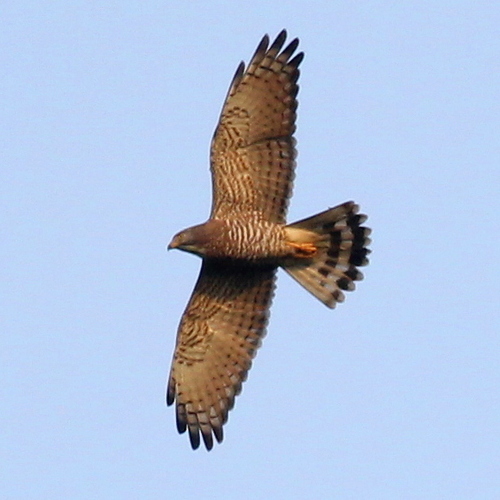 Gray-faced Buzzard
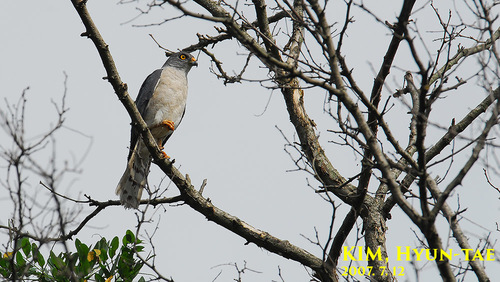 Chinese Sparrowhawk
In breve
The most reliable field mark between Grey-faced Buzzard and Chinese Sparrowhawk is the underwing pattern and wing shape in flight, especially in juveniles. Juvenile Grey-faced Buzzards show brown streaks below with a broad white supercilium and brown face, while juvenile Chinese Sparrowhawks have streaked underparts, barred thighs, and less prominent black wing tips. Adults are best separated by overall structure: Grey-faced Buzzard is larger, with pointed, narrow wings and a grey head, while Chinese Sparrowhawk is more compact, with prominent black wing tips (adult male) and different iris color by sex. Both species can show brown and grey tones, but the combination of wing shape, underwing pattern, and facial features is key.
Consigli di identificazione
- Juvenile underparts: Juvenile Grey-faced Buzzard has pale underparts with brown streaks and a broad white supercilium; juvenile Chinese Sparrowhawk has streaked underparts and barred thighs, with less prominent black wing tips. Focus on the face pattern and thigh barring in young birds.
- Adult underwing pattern: Adult Chinese Sparrowhawk male shows prominent black wing tips in flight, while Grey-faced Buzzard has more uniformly barred underwings with thin, translucent flight feathers. This is most obvious in good light.
- Head and face: Adult Grey-faced Buzzard has a grey head, white throat, and black moustachial stripes; Chinese Sparrowhawk male is grey-headed but lacks the strong moustachial pattern, and the female has a rufous-tinged breast and underwing coverts.
- Eye color: Grey-faced Buzzard has a bright yellow iris in adults; Chinese Sparrowhawk males have red eyes, females and juveniles have yellow eyes. This can be tricky at distance but is useful at close range.
- Size and structure: Grey-faced Buzzard is larger and longer-winged, with pointed, narrow wings and a longer tail. Chinese Sparrowhawk is smaller, more compact, and has a typical sparrowhawk jizz with shorter, rounded wings.
- Flight style: Buzzard soars with buoyant, harrier-like flight and often glides with wings held in a shallow V. Sparrowhawk has quick, snappy wingbeats and rarely soars for long.
- Tail pattern: Grey-faced Buzzard has an ashy brown tail with horizontal bars; Chinese Sparrowhawk's tail is less distinctly barred and appears shorter relative to body length.
- Sex differences: Female Chinese Sparrowhawk is larger than the male and has rufous on breast and underwing coverts, while Grey-faced Buzzard shows little sexual dimorphism in plumage.
- Juvenile face: Juvenile buzzard has a brown face with a broad white supercilium; juvenile sparrowhawk has a grey face and yellow eyes, lacking the strong supercilium.
- Upperparts: Both can appear brown above in juvenile plumage, but the buzzard is more mottled, while the sparrowhawk is more uniformly brown.
- Context: If seen in dense forest or perched in deep cover, more likely sparrowhawk; if soaring over open country, more likely buzzard.
- Plumage pitfalls: Both can show brown and grey, especially in immature plumages, so rely on structure, underwing pattern, and face details rather than overall color.
- Iris color in juveniles: Both can show yellow eyes as juveniles, but the buzzard's iris is brighter yellow and the face is browner.
- Perched posture: Buzzard appears longer and more upright; sparrowhawk is more compact and horizontal.
- Barred thighs: Only juvenile Chinese Sparrowhawk shows barred thighs; Grey-faced Buzzard does not.
Taglia
Grey-faced Buzzard is noticeably larger, at 41–46 cm in length, compared to the Chinese Sparrowhawk's 30–36 cm. This size difference is often apparent in the field, especially when seen perched or in direct comparison. The buzzard also appears longer-winged and more slender in flight, while the sparrowhawk is more compact and Accipiter-like. Female Chinese Sparrowhawks are larger than males but still smaller than any Grey-faced Buzzard.
Piumaggio
- Juvenile/immature: Juvenile Grey-faced Buzzard is brown and mottled above, pale below with brown streaks, a broad white supercilium, and a brown face. Juvenile Chinese Sparrowhawk has a grey face, brown upperparts, yellow eyes, streaked underparts, and barred thighs; the black wing tips are less prominent than in adults, and underwings are streaked except for coverts.
- Adult: Adult Grey-faced Buzzard has a grey head, breast, and neck, white throat, black moustaches and mesial stripes, brown back and upperwings, and brown bars on white underparts and underwings. Adult Chinese Sparrowhawk male is grey above, white below, with red eyes and prominent black wing tips; female has rufous on breast and underwing coverts, yellow eyes. The buzzard's underwings look thin and almost translucent in flight, while the sparrowhawk's adult male shows a strong contrast at the black wing tips.
- Both species can show brown tones, but the buzzard is more likely to show a combination of grey head and brown barred underparts, while the sparrowhawk is cleaner below (male) or rufous-tinged (female).
Comportamento
Grey-faced Buzzard often soars with pointed, narrow wings and a buoyant flight style, sometimes appearing almost harrier-like. Chinese Sparrowhawk typically shows more rapid, direct flight with quick wingbeats, more reminiscent of other sparrowhawks. When perched, the buzzard looks longer-winged and longer-tailed, while the sparrowhawk is more compact and upright.
Habitat
Both species can overlap in migration and wintering grounds in Southeast Asia, but Grey-faced Buzzard breeds in more open woodlands and forest edges in Northeast Asia, while Chinese Sparrowhawk is more often found in forested areas and edges. Habitat alone is not diagnostic, but context can help if one is seen in dense forest (more likely sparrowhawk) versus open country (more likely buzzard).
Gray-faced Buzzard · Chinese Sparrowhawk · I miei uccelli difficili