

Green Shrike-Vireo vs Lesser Greenlet
Vireolanius pulchellus contro Pachysylvia decurtata
Fai un quiz con Green Shrike-Vireo e Lesser Greenlet
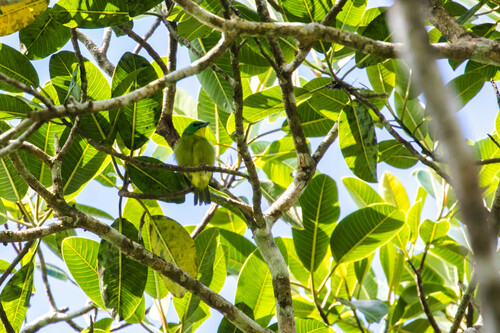 Green Shrike-Vireo
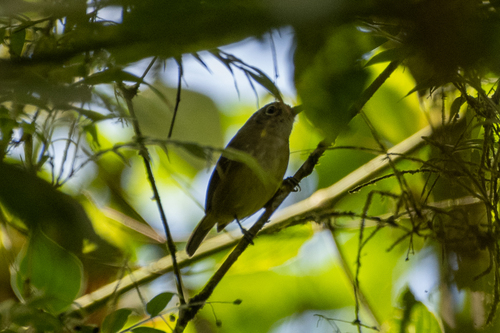 Lesser Greenlet
In breve
The most reliable field mark between Green Shrike-Vireo and Lesser Greenlet is size and bulk: Green Shrike-Vireo is much larger and heavier, with a noticeably more robust body and bill. In adults, Green Shrike-Vireo shows a bright cerulean blue crown and nape (with some green), while Lesser Greenlet has a gray-blue crown and a much smaller, more delicate appearance. Juvenile Green Shrike-Vireos are olive-green above with bold yellow wing bars, which Lesser Greenlet never shows. Both species share green upperparts and yellowish underparts, but careful attention to head color, wing bars in young birds, and overall structure will separate them in the field.
Consigli di identificazione
- Size and bulk: Green Shrike-Vireo is much larger and heavier than Lesser Greenlet. If the bird looks chunky and big-headed, suspect shrike-vireo; if it is small and delicate, it's likely a greenlet. This is reliable at all ages and seasons.
- Bill size and shape: Green Shrike-Vireo has a thick, strong bill, while Lesser Greenlet's bill is proportionally smaller and finer. Use this when the head is visible.
- Juvenile wing bars: Juvenile Green Shrike-Vireo shows two bold yellow wing bars and a yellow supercilium. Lesser Greenlet juveniles lack wing bars entirely. This is a key mark for young birds, especially in flight or when perched with wings spread.
- Adult crown color: Adult Green Shrike-Vireo has a cerulean blue crown and nape (with some green in the center), while Lesser Greenlet has a gray-blue crown and upper face. The blue on shrike-vireo is more vivid and extensive.
- Head pattern: Lesser Greenlet shows a whitish eye-ring and often a pale stripe above the lores, with grayish lores. Green Shrike-Vireo lacks a distinct eye-ring and instead has a more uniform green face (except for the blue crown/nape).
- Upperparts: Both are green above, but Green Shrike-Vireo's green is brighter and more saturated, especially on the sides of the head and upperparts. Lesser Greenlet's green is more olive and lighter on the rump.
- Underparts: Green Shrike-Vireo has a yellow chin and throat with light yellowish green underparts, deeper green on the flanks, and greenish yellow undertail coverts. Lesser Greenlet's underparts are pale lemon-yellow on the breast, whitish on the belly, and greenish yellow on the flanks and vent.
- Underwing coverts: Lesser Greenlet has yellow underwing coverts, which can sometimes be glimpsed in flight or when preening. Green Shrike-Vireo's underwing color is not specified as distinctive.
- Iris color: Both have brown irises, so this is not a separator.
- Leg color: Both have gray to blue-gray legs and feet, not useful for separation.
- Behavior: Green Shrike-Vireo is more likely to sit still and be difficult to spot, while Lesser Greenlet is active and often joins mixed flocks. If the bird is moving quickly through the canopy, greenlet is more likely.
- Flight style: Green Shrike-Vireo flies with heavy, direct movements; Lesser Greenlet is quick and agile.
- Subspecies variation: Some Green Shrike-Vireo subspecies have more or less blue on the head, but all are larger and bulkier than any greenlet. Lesser Greenlet subspecies vary in crown and flank color, but never approach the blue or size of shrike-vireo.
- Range: If in Colombia, Ecuador, or Peru, only Lesser Greenlet is expected. In Mexico and Central America, both occur—so use plumage and structure.
- Pitfalls: Beware of distant or backlit views where size is hard to judge; in such cases, look for the presence or absence of wing bars (juveniles) and head color pattern (adults).
Taglia
Green Shrike-Vireo is significantly larger and bulkier than Lesser Greenlet. Green Shrike-Vireo measures 12–15 cm in length and weighs 22–30 g (average 26 g), making it one of the largest vireos in the region. Lesser Greenlet is much smaller at 9.4–10.2 cm and 6.6–10.3 g. In the field, this size difference is striking: Green Shrike-Vireo appears chunky and heavyset, while Lesser Greenlet is dainty and sparrow-sized. Bill size and head proportions also reflect this difference, with Green Shrike-Vireo having a more powerful, thick bill and a larger head relative to body.
Piumaggio
Juvenile Green Shrike-Vireo is olive-green above and dull yellowish below, with a bold yellow supercilium and two yellow wing bars—these wing bars are absent in all ages of Lesser Greenlet. Adult Green Shrike-Vireo shows a bright cerulean blue crown and nape (with some green in the center), bright green upperparts, yellow chin and throat, and light yellowish green underparts, with deeper green on the flanks and undertail. Lesser Greenlet adults have a gray-blue crown and upper face, grayish lores, a whitish eye-ring, olive-green upperparts (lighter on the rump), and a pale yellow to whitish belly with greenish yellow flanks. The underwing coverts are yellow. Subspecies variation in both species can affect head and flank color, but the greenlet never shows the vivid blue crown or bold wing bars of the shrike-vireo. In flight, Lesser Greenlet wings show bright greenish outer webs on the primaries and secondaries, but no wing bars.
Comportamento
Both species are typically found in the forest canopy, but Green Shrike-Vireo often sits motionless and is harder to spot, relying on its bulk and color for camouflage. Lesser Greenlet is more active, frequently moving through foliage and sometimes joining mixed-species flocks. In flight, Green Shrike-Vireo appears heavy and direct, while Lesser Greenlet is quick and agile, reflecting their size difference.
Habitat
Both species overlap widely in Central America and southern Mexico, occurring in similar forested habitats. However, Lesser Greenlet extends farther south into Colombia, Ecuador, and Peru. Both prefer canopy or subcanopy levels in humid forests, so habitat alone is not a reliable separator where their ranges overlap.
Green Shrike-Vireo · Lesser Greenlet · I miei uccelli difficili