

Oca lombardella vs Germano reale
Anser albifrons contro Anas platyrhynchos
Fai un quiz con Oca lombardella e Germano reale
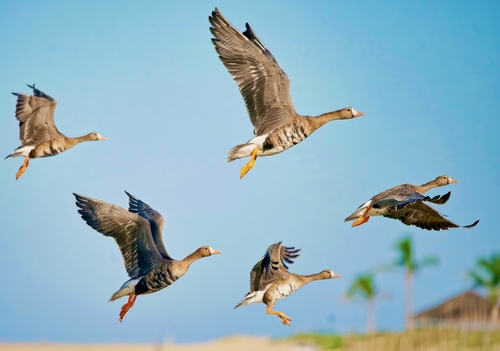 Oca lombardella
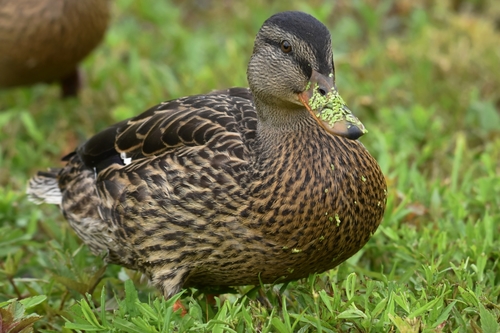 Germano reale
In breve
The most reliable field separation between Greater White-fronted Goose and Mallard, especially in flight or among immatures, is the overall structure and wing pattern: Greater White-fronted Goose (all ages) shows broad, pale-tipped upperwing coverts creating bold wing bars, while Mallard (all ages) lacks these bars and instead has a distinct blue speculum bordered with white. Geese are much larger, longer-necked, and fly with steady, direct wingbeats, while Mallards are shorter-necked, more compact, and show rapid, shallow wingbeats. On the ground, the goose’s orange legs and pinkish bill (with white facial blaze) contrast with the Mallard’s yellowish or orange-and-black bill and, in males, a green head. Female Mallards are mottled brown and lack any white on the face. Voice and flocking behavior also differ markedly.
Consigli di identificazione
- Wing pattern in flight (all ages): Greater White-fronted Goose shows broad, pale-tipped upperwing coverts forming a bold wing bar; Mallard lacks this, instead showing a blue speculum bordered with white but no pale bar across the coverts.
- Size and structure: Geese are much larger, with a long neck and hefty body; Mallards are smaller, with a short neck and compact shape. Use flock context for scale.
- Bill shape and color: Goose has a pinkish (sometimes orange-yellow) bill, relatively short and stout; Mallard has a longer, flatter bill—yellowish in males, orange-and-black in females.
- Leg color: Goose legs are bright orange; Mallard legs are orange but often duller and less striking, especially in females.
- Facial pattern: Adult geese show a white blaze at the bill base; Mallards never have white on the face. Female Mallards have a dark eye-stripe and mottled face.
- Plumage details: Male Mallard in breeding plumage is unmistakable with a green head and white neck ring; female is mottled brown with a dark crown and eye-stripe, no white blaze.
- Tail pattern: Goose has a broad white tip and sides to the tail; Mallard’s tail is dark with no white tip or sides.
- Belly markings: Both species can show some dark barring, but this is variable and not reliable for separation.
- Posture and jizz: Geese stand and walk more upright, with a longer neck; Mallards are more horizontal and squat.
- Flock behavior: Geese form tight, organized flocks and often fly in V-formation; Mallards are looser and more scattered in flight.
- Feeding behavior: Geese graze in fields and rarely dabble; Mallards are classic dabblers, tipping up in shallow water.
- Vocalizations: Listen for high-pitched cackling in geese vs. quacking in Mallards.
- Habitat context: Large flocks in open fields suggest geese; small groups on ponds or rivers are likely Mallards.
- Juvenile confusion: Young Mallards are streaky brown, never showing a white facial blaze or wing bar; juvenile geese already show the pale wing covert tips.
- Seasonal changes: Male Mallards in eclipse or juvenile plumage may lose their green head but still lack the goose’s white face and wing bars.
Taglia
Greater White-fronted Goose is substantially larger: 64–81 cm in length, 130–165 cm wingspan, and 1.93–3.31 kg in weight [wikipedia][avonet]. Mallard is 50–65 cm long, with an 81–98 cm wingspan, and weighs 0.7–1.6 kg. The goose is bulkier, with a longer neck and larger body, easily out-sizing even the largest Mallard drake. In mixed flocks or at a distance, size and neck length are immediate clues.
Piumaggio
Juvenile and adult Greater White-fronted Geese (especially the European subspecies A. a. albifrons) show prominent, broad white tips to the greater upperwing coverts in flight, forming a bold, pale wing bar. This is visible in all ages and is absent in Mallard. Mallard of any age instead shows a blue (sometimes purple) speculum bordered with white, but no pale wing bar across the coverts. On the ground, adult geese have a white facial blaze at the bill base, orange legs, and a pinkish bill, while Mallard males have a green head, white neck ring, and yellowish bill, and females are mottled brown with orange-and-black bills. Juvenile Mallards are streaky brown, lacking any white on the face or wing coverts. Belly barring in geese is variable and not reliable for separation. The goose’s tail has a broad white tip and sides (especially in A. a. albifrons), while Mallard’s tail is darker with no such white. In eclipse or juvenile plumage, Mallard males may resemble females but never show the goose’s white face or wing bars.
Comportamento
Greater White-fronted Geese are typically seen in larger, more cohesive flocks, often grazing in fields or flying in V-formations with steady, powerful wingbeats. They walk with a more upright, long-necked posture. Mallards are more often seen in pairs or loose groups, dabbling in shallow water, and have a more horizontal stance. In flight, Mallards are faster, with rapid wingbeats and more erratic flock shapes. Geese rarely dabble like Mallards.
Habitat
Both species can occur in wetlands, but Greater White-fronted Geese are more likely to be found in open fields, lakeshores, and large marshes, especially outside the breeding season, and often graze far from water. Mallards are highly adaptable but are most often seen on ponds, rivers, and marshes, rarely straying far from water. If you see a large flock grazing in a dry field, geese are more likely; a few birds dabbling in a city pond are almost always Mallards.
Voce
Greater White-fronted Goose gives a distinctive high-pitched cackling call, often described as 'he-he', with a clear break between notes. Mallard produces the familiar quack (female) or quieter, raspier calls (male), never cackling. If you hear cackling overhead, think goose; if you hear quacking, it’s almost certainly a Mallard.