

Canapiglia vs Smergo maggiore
Mareca strepera contro Mergus merganser
Fai un quiz con Canapiglia e Smergo maggiore
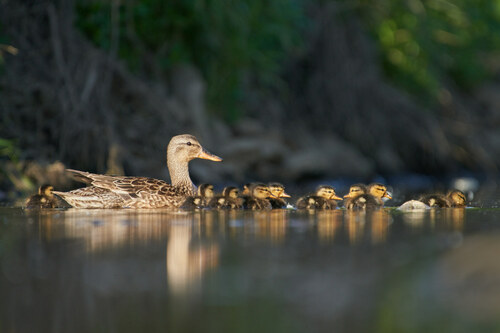 Canapiglia
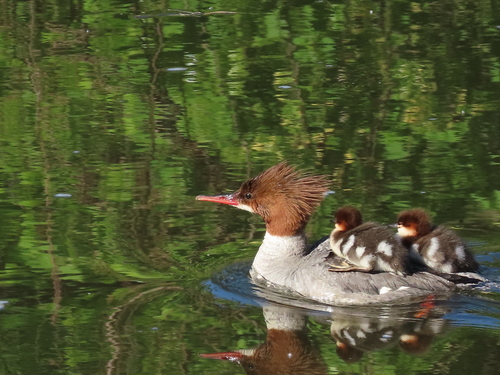 Smergo maggiore
In breve
The most reliable field mark to separate Gadwall from Goosander is the bill: Gadwall has a plain, flat, duck-like bill, while Goosander shows a long, narrow, red bill with a hooked tip and visible serrations ("sawbills"). In flight or at rest, Gadwall of any age shows a white wing speculum, while Goosander (especially females and juveniles) shows a broad white patch on the inner wing but otherwise very different overall plumage. Gadwall is a subtly patterned dabbling duck, usually grey or brown, while Goosander is much larger, sleek, and long-necked, with sharp contrasts and a distinctive head shape. If you see a crested, reddish-headed duck with a long red bill and white chin, it's a female or immature Goosander; Gadwall never shows this combination. Both species can be found on lakes and rivers, but Goosander is more likely on fast-flowing water and often sits on rocks or ice.
Consigli di identificazione
- Bill shape and color: Gadwall has a flat, duck-like bill (female: dark with orange edges; male: mostly dark), while Goosander has a long, narrow, red bill with a hooked tip and visible serrations. This is the most reliable mark at any distance or age.
- Head and crest: Goosander (female and juvenile) has a smooth, reddish-brown head with a white chin and sometimes a slight crest; Gadwall never shows a crest or a sharply contrasting head and body.
- Wing pattern in flight: Gadwall of all ages shows a white speculum (secondary patch) bordered by chestnut and black (male), visible in flight and often at rest. Goosander shows a broad white panel on the inner wing (secondaries) but otherwise has black or grey on the wing; never bordered by chestnut.
- Juvenile Goosander face: Juvenile Goosander shows a short black-edged white stripe between the eye and bill, absent in Gadwall of any age.
- Body shape and posture: Goosander is long-necked, sleek, and sits low in the water, often with a sloping forehead and upright stance on land. Gadwall is compact, short-necked, and sits higher on the water.
- Plumage (male breeding): Male Gadwall is patterned grey with a black rear and chestnut wing coverts; male Goosander is white-bodied with a dark green-black head and salmon-pink tinge, never patterned grey.
- Plumage (female): Female Gadwall is mottled brown with a white belly and orange-edged bill; female Goosander is grey-bodied with a rich reddish-brown head, white chin, and long white wing patch.
- Plumage (eclipse/non-breeding): Male Gadwall in eclipse resembles the female but keeps the male wing pattern; male Goosander in eclipse is similar to the female but remains larger and keeps the distinctive bill and head shape.
- Leg color: Goosander has red to brownish-red legs, brightest in adult males; Gadwall's legs are duller and not red.
- Feeding behavior: Gadwall dabbles and tips up for plant food, rarely diving; Goosander dives for fish and may fish in groups.
- Perching and loafing: Goosander often perches on rocks or ice in the middle of water bodies, sometimes with wings half-open; Gadwall typically remains in the water or on muddy/vegetated shores.
- Flight style: Goosander takes off by running along the water and flies fast and direct; Gadwall takes off more directly and flies with shallower wingbeats.
- Habitat: Gadwall prefers marshes, lakes, and wetlands with dense vegetation; Goosander favors clear rivers, lakes, and forested uplands, often on faster water.
- Voice: Gadwall's calls are higher-pitched and more duck-like; Goosander's are harsh croaks or soft whistles, never true quacks.
- Size impression: Goosander is much larger and bulkier than Gadwall, with a longer neck and body; if the bird seems goose-sized, it's likely Goosander.
Taglia
Goosander is substantially larger and heavier than Gadwall. Goosander averages about 1470 g in body mass [wikidata], compared to Gadwall's 850–990 g (female-male) [wikipedia]. In length, Goosander measures 58–72 cm, while Gadwall is 47–58 cm. The wingspan overlaps but Goosander can reach up to 97 cm, compared to Gadwall's maximum of 85 cm. In the field, Goosander appears longer, bulkier, and more elongated, especially in neck and body, while Gadwall is more compact and typical of dabbling ducks.
Piumaggio
For all ages, Gadwall shows a white speculum (secondary patch) on the wing, visible in flight and often at rest; this is bordered by chestnut and black in males. Goosander, in all plumages, shows a large white inner wing panel (from the secondaries), but the rest of the wing is black (outer) or grey (rump/tail). Juvenile Goosander resembles the adult female but adds a short black-edged white stripe between the eye and bill, which Gadwall never shows. Adult male Gadwall is mostly patterned grey with a black rear and chestnut wing coverts, while male Goosander is strikingly white-bodied with a dark green-black head. Female Gadwall is mottled brown with a dark orange-edged bill and white belly; female Goosander is grey-bodied with a rich reddish-brown head, white chin, and long white wing patch. Gadwall never shows a crest or a sharply contrasting head and body. In eclipse (non-breeding) plumage, male Gadwall becomes browner but keeps the wing pattern; male Goosander resembles the female but remains larger and keeps the bill and head shape.
Comportamento
Gadwall typically feeds by dabbling at the surface, often with head submerged, and is less gregarious than other dabbling ducks, forming small flocks. It may dive occasionally but is not specialized for it. Goosander is a diving duck, often seen swimming low in the water, diving for fish, and sometimes fishing cooperatively in groups. Goosander often perches on rocks or ice in the middle of rivers or lakes, sometimes with wings half-open to the sun, and moves clumsily on land. In flight, Goosander is strong and fast, taking off by running along the water; Gadwall takes off more directly. Goosander's upright stance on land and elongated neck are distinctive.
Habitat
Gadwall prefers open wetlands, lakes, marshes, and wet grasslands with dense vegetation, usually in lowland areas. It nests on the ground, often away from water. Goosander favors rivers and lakes in forested or upland areas, especially those with clear water for fishing; it nests in tree holes and is more likely to be seen on fast-flowing rivers or rocky lakeshores. In winter, Goosander may use estuaries or the edge of floating ice, while Gadwall remains on still or slow-moving water.
Voce
Gadwall is generally quiet, but females give a high-pitched quack (gag-ag-ag-ag), and males give a soft grunt (mep) and a whistle during display. Goosander is also quiet, but its normal call is a low, harsh croak; during breeding, males and juveniles give a plaintive, soft whistle. Neither species is highly vocal in most field situations, but Gadwall's calls are more duck-like, while Goosander's are harsher and less quack-like.