

Allodola vs Merlo
Alauda arvensis contro Turdus merula
Fai un quiz con Allodola e Merlo
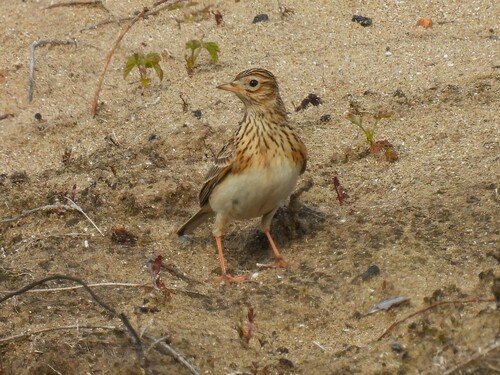 Allodola
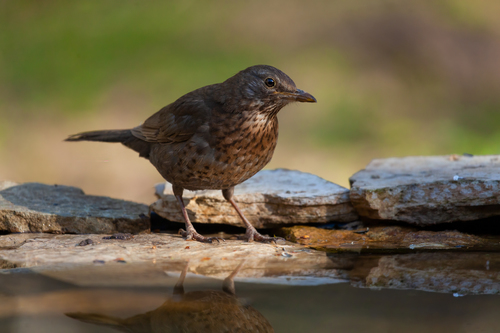 Merlo
In breve
The most reliable field mark to separate Eurasian Skylark from Eurasian Blackbird is overall structure and plumage: Skylark is a small, streaky brown bird with a short crest and white-edged wings and tail in flight, while Blackbird is much larger and either all-black (adult male) or dark brown (female/juvenile) with a plain appearance and no crest. Juvenile Skylarks are streaky and never show the pale spots or strong breast mottling of young Blackbirds. In flight, Skylark’s short, broad wings and white rear edges contrast with Blackbird’s longer, more rounded wings and uniform dark coloration. Blackbird is much bulkier, with a longer tail and a distinctly yellow or orange bill in adult males. Skylark is a bird of open fields and grasslands, often seen singing high in the air, while Blackbird prefers wooded edges, gardens, and parks, usually seen foraging on the ground or perching in shrubs.
Consigli di identificazione
- Size: Blackbird is much larger and bulkier than Skylark; use this when both are seen in the same area.
- Crest: Skylark has a short, blunt crest that can be raised or lowered; Blackbird never shows a crest.
- Bill color: Adult male Blackbird has a bright yellow-orange bill and eye-ring; Skylark’s bill is always dull and brownish.
- Plumage (adult male Blackbird): Glossy black all over, never streaked or mottled; Skylark is brown and streaky.
- Plumage (female/juvenile Blackbird): Sooty brown with weak mottling and a dull bill; juvenile Blackbirds have pale spots on upperparts and a speckled breast, unlike any Skylark.
- Plumage (Skylark): Brown above, pale below, fine streaking throughout, never plain or glossy; always lacks pale spots on upperparts.
- Flight pattern: Skylark has short, broad wings and a short tail, often seen hovering high in the air; Blackbird’s wings are longer and more rounded, flight is direct and never hovering.
- White in wings/tail: Skylark shows white edges to tail and rear wing in flight, visible from behind; Blackbird’s wings and tail are uniformly dark with no white.
- Song: Skylark sings a long, continuous warble in flight; Blackbird sings rich, fluting phrases from a perch.
- Habitat: Skylark in open fields and grasslands; Blackbird in gardens, parks, woodland edges.
- Behavior: Skylark often hovers and sings high above ground; Blackbird forages on ground, runs and pauses upright, never hovers.
- Juvenile confusion: Juvenile Blackbirds have pale spots and a speckled breast; Skylark juveniles are streaky but never spotted.
- Sex differences: Only male Blackbird is glossy black with a yellow bill; female and juvenile are brown, but still much larger and plain compared to Skylark.
- Tail length: Blackbird’s tail is long and obvious; Skylark’s is short.
- Context: If you see a small, streaky bird in open grassland, think Skylark; a larger, plain bird in a garden or hedge is likely Blackbird.
Taglia
Eurasian Skylark is significantly smaller, measuring 18–19 cm in length [wikipedia], while Eurasian Blackbird is much larger at 23.5–29 cm [wikipedia]. Blackbird is also heavier (80–125 g) and appears bulkier with a longer tail. This size difference is obvious in direct comparison or when seen in typical habitats.
Piumaggio
- Juveniles/First-years: Juvenile Skylarks are streaky brown above and below with no pale spots; they never show the pale-spotted upperparts or speckled breast of juvenile Blackbirds. Young Blackbirds are brown with pale spots on the upperparts and a speckled breast, quickly distinguishing them from any Skylark age.
- Adults: Adult Skylarks are brown above, paler below, with fine streaking and a short, sometimes raised crest. In flight, they show white edges to the tail and rear wing, visible from behind. Adult male Blackbirds are glossy black with a yellow-orange bill and eye-ring; females are sooty-brown with a dull bill and weak breast mottling. Blackbirds lack any crest and never show white in the wings or tail.
- Flight: Skylark’s short, broad wings and white trailing edges are visible in flight, especially when flying away. Blackbird’s wings are longer, more rounded, and uniformly dark, with no white edges.
Comportamento
Skylark is famous for its display flight: males hover high above open fields, singing continuously for minutes. On the ground, Skylarks are inconspicuous, often running or crouching in grass. Blackbirds are more often seen foraging on lawns or leaf litter, running and pausing upright, or perching in shrubs and trees. Blackbird flight is direct with bursts of rapid wingbeats and gliding, not hovering. Males may chase each other or perform threat displays, but never hover or sing in the air like Skylark.
Habitat
Skylark is a classic bird of open farmland, grasslands, and heath, rarely venturing into wooded or urban areas. Blackbird is the opposite: it prefers woodland edges, gardens, parks, and hedgerows, and is common in towns and cities. Finding a streaky brown lark in a city park is rare; a black or brown thrush in a field is more likely a Blackbird only near hedges or trees.
Voce
Skylark’s song is a long, bubbling warble delivered during high, hovering flight, often lasting several minutes. The bird is usually a distant dot in the sky while singing. Blackbird’s song is a rich, fluting series of phrases, delivered from a perch, never in flight. Blackbird’s calls are varied but include a sharp 'tchook' or alarm 'chink', quite different from the continuous Skylark warble.