

Eared Pygmy-Tyrant vs Pearly-vented Tody-Tyrant
Myiornis auricularis contro Hemitriccus margaritaceiventer
Fai un quiz con Eared Pygmy-Tyrant e Pearly-vented Tody-Tyrant
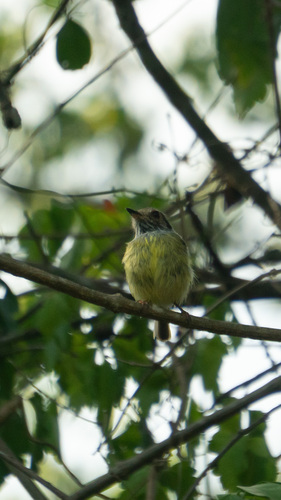 Eared Pygmy-Tyrant
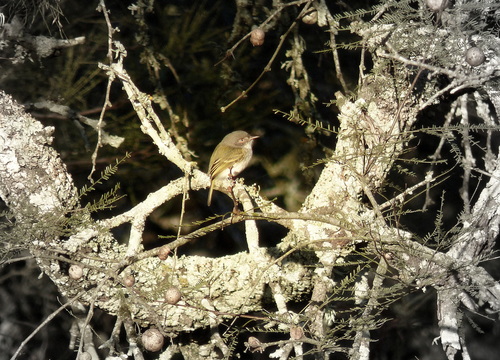 Pearly-vented Tody-Tyrant
In breve
The most reliable field mark to separate Eared Pygmy-Tyrant from Pearly-vented Tody-Tyrant is size and head pattern: Eared Pygmy-Tyrant is noticeably smaller, with a large-headed look and a bold facial pattern featuring a buffy-cinnamon surround to the eye, white ear coverts, and a sharp black crescent behind the ear. Pearly-vented Tody-Tyrant is larger and longer-tailed, with a plain grayish-brown face and only a subtle pale eye-ring. Both have two indistinct wing bars, but the Eared Pygmy-Tyrant’s are less obvious. In perched or flight views, focus on the Eared Pygmy-Tyrant’s tiny, compact structure and dramatic face, versus the Tody-Tyrant’s drab, less contrasting plumage and longer proportions. Both can occur in similar habitats, but the Tody-Tyrant is often found in drier, more open scrub.
Consigli di identificazione
- Size is a key separator: Eared Pygmy-Tyrant is extremely small (7–9 cm), noticeably tinier than Pearly-vented Tody-Tyrant (10–11 cm). If the bird appears minute and large-headed, suspect Eared Pygmy-Tyrant.
- Head and face pattern: Eared Pygmy-Tyrant has a bold, contrasting face with a buffy-cinnamon eye surround, white ear coverts, and a sharp black crescent behind the ear. Pearly-vented Tody-Tyrant has a plain grayish-brown face with only a subtle pale eye-ring and lores—never the dramatic pattern of Eared Pygmy-Tyrant.
- Crown color: Eared Pygmy-Tyrant has a bright olive crown with a brown tinge; Pearly-vented Tody-Tyrant’s crown is gray (nominate) or varies by subspecies but is never bright olive.
- Underparts: Eared Pygmy-Tyrant shows white throat/upper breast with thin black streaks and bright yellow lower underparts with some olive streaks. Pearly-vented Tody-Tyrant is white below with faint grayish streaking, lacking the yellow wash.
- Back and rump: Eared Pygmy-Tyrant’s back and rump are bright olive, contrasting with the grayish brown to brownish olive back/rump of Pearly-vented Tody-Tyrant.
- Wing bars: Both species have two indistinct wing bars, but these are often less obvious in Eared Pygmy-Tyrant. In Pearly-vented Tody-Tyrant, wing bars can be more contrasting in some subspecies, but this is not a strong separator.
- Bill color: Eared Pygmy-Tyrant has a blackish bill; Pearly-vented Tody-Tyrant’s bill is reddish brown to blackish above, pinkish brown to pinkish below—this is subtle and not always visible.
- Iris color: Eared Pygmy-Tyrant has an orange iris; Pearly-vented Tody-Tyrant’s iris is pale. This can be helpful at close range.
- Leg color: Both have pinkish legs and feet, not useful for separation.
- Tail length and shape: Eared Pygmy-Tyrant has a short, stubby tail, enhancing its compact look. Pearly-vented Tody-Tyrant has a longer tail, contributing to a more elongated appearance.
- Behavior and posture: Eared Pygmy-Tyrant is hyperactive, often foraging low and rarely perching in the open. Pearly-vented Tody-Tyrant may perch more openly and is less likely to be so low or hidden.
- Habitat context: In dense, humid forest edge or thick second growth, Eared Pygmy-Tyrant is more likely. In open, dry scrub or woodland edge, Pearly-vented Tody-Tyrant is more expected.
- Subspecies variation: Pearly-vented Tody-Tyrant shows some subspecific variation in crown and underpart color, but none approach the bold facial pattern or yellow underparts of Eared Pygmy-Tyrant.
- Juvenile/immature plumage: No distinctive juvenile or immature upperwing or flight pattern marks are described for either species; age is not a major source of confusion in wing pattern.
- When in doubt: If the bird is extremely small, large-headed, and shows a dramatic face pattern, it is Eared Pygmy-Tyrant. If it is larger, drab-faced, and white below, it is Pearly-vented Tody-Tyrant.
Taglia
Eared Pygmy-Tyrant is one of the smallest passerines in South America, at just 7–9 cm and about 5 g. Pearly-vented Tody-Tyrant is distinctly larger at 10–11 cm and 7–10 g. In the field, Eared Pygmy-Tyrant looks tiny and large-headed, almost wren-like, while Pearly-vented Tody-Tyrant is more typical of small tyrant flycatchers, with a longer tail and less compact shape. If you get a sense of scale—especially when seen near other small birds—the size difference is striking and diagnostic.
Piumaggio
No distinctive age-specific upperwing or flight pattern marks are described for either species; both adults and immatures show similar wing patterns. Eared Pygmy-Tyrant (all ages/sexes) shows a dramatic face: buffy-cinnamon around the eye, white ear coverts with a sharp black crescent behind, and a black patch below the eye. The crown is bright olive with a brown tinge, nape/neck gray, and back/rump bright olive. The wings are dusky with olive-yellow edges and two faint wing bars; underparts are white with thin black streaks on the throat/upper breast, bright yellow below with olive streaks. Pearly-vented Tody-Tyrant (all ages/sexes) is plainer: gray crown, grayish-brown face with a whitish eye-ring and lores, back/rump grayish brown to brownish olive, wings dusky with buff/yellowish edges and two wing bars, underparts white with faint grayish streaks, and a pale iris. Subspecies vary in crown and underpart color, but none show the bold face pattern or yellow underparts of Eared Pygmy-Tyrant. Both species have dusky tails and similar wing bar patterns, but the Tody-Tyrant’s are sometimes more contrasting depending on subspecies.
Comportamento
Eared Pygmy-Tyrant is typically seen foraging low in dense vegetation, often making short upward sallies to pick insects from leaves, and tends to stay below 3 m above ground. Its movements are quick and mouse-like, and it often appears hyperactive. Pearly-vented Tody-Tyrant also forages in low to mid-levels but is more likely to be seen in open, shrubby areas or woodland edge, sometimes perching more conspicuously. Both species sally for insects, but the Tody-Tyrant may be slightly less skulking and more likely to perch in the open.
Habitat
Both species can occur in overlapping regions of southern Brazil, Paraguay, and northern Argentina. Eared Pygmy-Tyrant favors humid or semi-humid forest edges, secondary growth, and dense undergrowth, usually staying low. Pearly-vented Tody-Tyrant is more catholic in habitat, found in a wide range of dry, shrubby, or open woodland environments, including arid scrub, pastures, gallery forest, and forest edge. In drier, more open habitats, Pearly-vented Tody-Tyrant is more expected; in denser, humid forest edge or thick second growth, Eared Pygmy-Tyrant is more likely.
Eared Pygmy-Tyrant · Pearly-vented Tody-Tyrant · I miei uccelli difficili