
Redpoll (Common) vs Crociere comune
Acanthis flammea contro Loxia curvirostra
Fai un quiz con Redpoll (Common) e Crociere comune
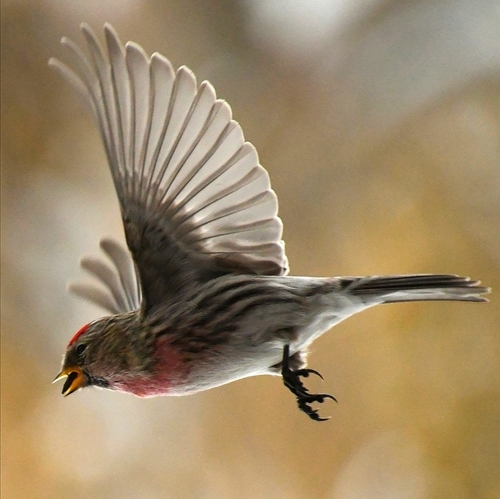 Redpoll (Common)
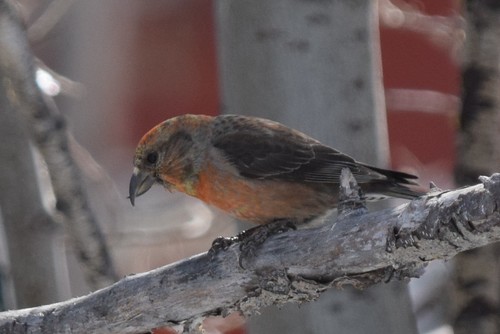 Crociere comune
In breve
The most reliable way to separate Common Redpoll from Common Crossbill in the field is by bill shape: redpolls have a small, conical finch bill, while crossbills have a distinctive, heavy bill with crossed mandibles. In flight or perched, redpolls show two pale wingbars and a red forehead, while crossbills lack wingbars and have a plain, dark wing. Both species can show red tones in males, but redpolls are smaller, streakier, and more delicate overall. Immature birds of both species are streaked, but only redpolls show wingbars and a red poll. Watch for feeding behavior: crossbills pry open conifer cones with their unique bill, while redpolls feed on small seeds, often birch or alder.
Consigli di identificazione
- Bill shape is diagnostic: Redpolls have a small, sharp, conical bill (yellowish with a dark tip), while crossbills have a large, heavy bill with the mandibles crossing at the tip. This is the single most reliable field mark at any age or season.
- Wingbars: Redpolls (all ages) show two pale wingbars; crossbills never show wingbars (their wings are plain, dark brownish-black). This is especially useful for separating streaky immatures in flight or perched.
- Red forehead: Redpolls have a bright red forehead patch, visible in most individuals including many immatures; crossbills never show a red forehead.
- Overall size and structure: Redpolls are small, delicate, and slim, while crossbills are larger, bulkier, and more robust, with a noticeably bigger head and bill.
- Plumage streaking: Redpolls are heavily streaked on the back, flanks, and rump (including a streaked rump and a broad dark brown vent streak). Crossbills are much less streaked, especially adults, which are mostly plain red/orange (males) or green/yellow (females).
- Adult male coloration: Redpoll males show red on the breast and forehead, but retain streaky brownish-grey upperparts. Crossbill males are more uniformly red or orange, lacking streaks and wingbars.
- Adult female coloration: Redpoll females are brownish-grey and streaked, with wingbars and a red forehead; crossbill females are greenish or yellowish, plain, and lack both wingbars and red on the head.
- Juvenile/immature confusion: Both species' immatures are streaky, but only redpolls show wingbars and a red forehead. Crossbill immatures are greyish-green and streaked, but always lack wingbars and red on the head.
- Feeding behavior: Redpolls feed on small seeds, often birch or alder, sometimes acrobatically. Crossbills use their unique bill to pry open conifer cones—if you see this behavior, it's a crossbill.
- Habitat context: In birch or alder stands, especially outside dense coniferous forest, redpoll is more likely. In mature conifer forests, especially with abundant cones, crossbill is expected.
- Flight jizz: Redpolls are quick, agile, and often in tight flocks. Crossbills are heavier, with a more direct, undulating flight.
- Rump and vent: Redpolls have a streaked rump and a broad dark brown vent streak; crossbills do not show these features.
- Leg color: Redpolls have brown legs; leg color is not distinctive for crossbills but is not a primary field mark.
- Irruptive tendencies: Both species can irrupt, but crossbills are more strictly tied to conifer cone crops, while redpolls follow birch and alder seed availability.
- Voice: Not detailed in these notes, but in the field, calls are very different—redpolls give a dry, rattling call, while crossbills have a sharp, metallic "chip"—but rely on structure and plumage first.
Taglia
Common Redpolls are significantly smaller and lighter: adults measure 11.5–14 cm in length, with a wingspan of 19–22 cm and a weight of 12–16 g [wikipedia]. Common Crossbills are larger and bulkier, with a noticeably heavier build (exact measurements not provided here, but they are consistently larger than redpolls and are robust finches). In the field, redpolls look delicate and quick, while crossbills appear chunky and strong-billed.
Piumaggio
- Juvenile/immature birds: Both species can be streaky and lack strong adult colors, but redpolls (all ages) show two pale wingbars and a red forehead patch (even in many immatures), while crossbills never show wingbars and have plain, dark wings. Crossbills' juveniles are greyish-green and streaked, lacking any red on the forehead or wingbars.
- Adult males: Redpoll males have a red breast and red forehead, with brownish-grey streaked upperparts and two pale wingbars. Crossbill males are red or orange overall, with plain, dark wings and no wingbars or forehead patch.
- Adult females: Redpoll females are brownish-grey, streaked, and show the same wingbars and red forehead (though less bright). Crossbill females are greenish or yellowish, plain-winged, and lack any red on the forehead or wingbars.
- Rump and vent: Redpolls have a streaked rump and a broad dark brown streak across the vent. Crossbills do not show these features.
- Bill: Redpolls have a small, pointed, yellowish bill with a dark tip. Crossbills have a large, heavy, crossed bill (mandibles cross at the tip), which is unique among finches.
Comportamento
Redpolls are active, often in flocks, feeding acrobatically on birch or alder catkins, sometimes hanging upside down. They forage mainly in trees but will also feed on the ground. Crossbills are more methodical, using their crossed bills to pry open conifer cones, often seen clambering on cone-laden branches. Crossbills are more likely to be seen in coniferous forests, often in loose groups, and may be less restless than redpolls.
Habitat
Redpolls breed in Arctic and northern boreal forests, especially in areas with birch and alder, and are partial migrants, sometimes irrupting southward in winter [wikipedia]. Crossbills are closely tied to coniferous forests across North America and Eurasia, moving nomadically in response to cone crops. If you see birds feeding in birch or alder, redpoll is more likely; in dense conifer stands, especially feeding on cones, crossbill is expected.
Redpoll (Common) · Crociere comune · I miei uccelli difficili