

Moriglione vs Smergo maggiore
Aythya ferina contro Mergus merganser
Fai un quiz con Moriglione e Smergo maggiore
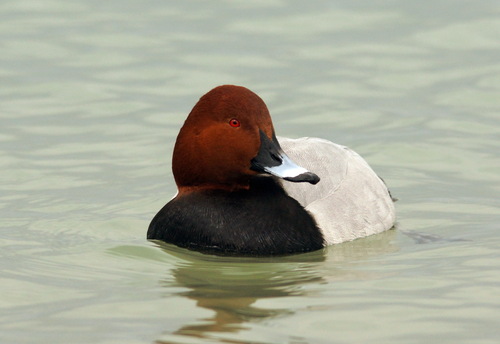 Moriglione
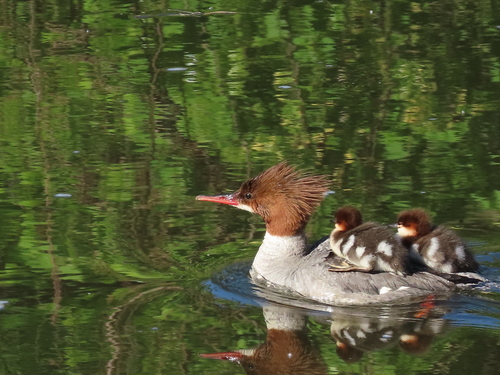 Smergo maggiore
In breve
The most reliable field mark between Common Pochard and Goosander is overall structure and bill shape: Goosander is much larger, longer-bodied, and has a long, narrow, serrated red bill, while Common Pochard is a compact, short-tailed diving duck with a broad, dark bill and blue-grey band. In flight or on water, Goosander’s white body (male) or grey body with white wing panels (female/immature) and sharply contrasting dark head stand out, while Pochard males show a chestnut head and pale grey body, females are brownish with a less contrasting pattern. Juvenile Goosander shows a distinctive white stripe between eye and bill, absent in Pochard. Structure, bill, and overall jizz are usually more reliable than plumage alone, especially for females and immatures.
Consigli di identificazione
- Size and shape: Goosander is much larger and longer-bodied than Common Pochard. If the bird looks goose-sized or towers over nearby ducks, it is almost certainly a Goosander.
- Bill shape and color: Goosander has a long, slender, red (to brownish-red) bill with serrated edges ("sawbills"), while Common Pochard has a broad, dark bill with a wide blue-grey band across the middle. Bill structure is visible even at a distance with good light.
- Head and neck: Goosander’s head is smoothly crested and often appears elongated, especially in profile. Males have a blackish-green sheen, females and juveniles a rich reddish-brown head with a white chin. Pochard males have a rounded, chestnut head; females are brownish, lacking the Goosander’s white chin and eye-stripe.
- Iris color: Adult male Pochard has a yellow-orange to red iris (brightest in breeding season), females brown, juveniles yellow-olive. Goosander’s iris color is not diagnostic for separation.
- Juvenile marks: Juvenile Goosander shows a short, black-edged white stripe between eye and bill, absent in Pochard of any age.
- Wing pattern in flight: Goosander of all ages shows a bold white panel (secondaries) on the inner wing, contrasting with black outer wing (male) or grey (female/immature). Pochard lacks this strong white wing panel; males show pale grey upperwings, females and juveniles are browner and plainer.
- Body color: Male Goosander is white-bodied (with salmon-pink tinge), female/juvenile grey-bodied with a sharp contrast between head and body. Pochard male has a pale grey body with fine vermiculations, female is brownish overall.
- Leg and foot color: Pochard has grey legs and feet in all ages/sexes; Goosander’s are red to brownish-red, brightest in adult males.
- Posture and jizz: Goosander sits low in the water, often with a long, sloping back and neck outstretched. Pochard is compact, short-tailed, and sits higher on the water.
- Behavior: Goosander may be seen resting on rocks or ice, wings half-open, or fishing in groups. Pochard is more often seen diving alone or in loose flocks, rarely on rocks or ice.
- Habitat: Goosander prefers large rivers, lakes, and forested waterways, sometimes on salt water; Pochard is more typical of open lakes and reservoirs.
- Vocalization: If heard, Goosander’s harsh croak or soft whistle (breeding season) is distinctive, but both species are generally quiet.
- Sexual dimorphism: Both species are sexually dimorphic, but male Goosander’s white body and black-green head are unique; male Pochard’s chestnut head and pale body are diagnostic.
- Seasonal changes: Goosander males in eclipse resemble females but retain the white wing panel; Pochard males retain their chestnut head year-round, though colors may dull slightly in eclipse.
- Pitfalls: Female/juvenile Goosander and female/juvenile Pochard can be confused at a distance, but Goosander’s larger size, longer bill, white chin, and white wing panel (in flight) are reliable. Juvenile Goosander’s eye-stripe is never shown by Pochard.
Taglia
Goosander is significantly larger and heavier than Common Pochard. Goosander measures 58–72 cm in length and averages around 1470 g in mass [wikidata], while Common Pochard is much smaller at 42–49 cm and 467–1240 g (with males larger than females) [wikipedia]. Goosander’s wingspan is also greater (78–97 cm vs. 72–82 cm). In the field, Goosander appears long-bodied and imposing, while Pochard is compact and short-tailed.
Piumaggio
Juvenile and female Goosander are largely grey with a reddish-brown head, white chin, and a short black-edged white stripe between eye and bill (juveniles only). Their wing shows a strong white panel (secondaries) in all ages/sexes, especially obvious in flight. Male Goosander in breeding plumage is strikingly white-bodied with a blackish-green head and salmon-pink tinge, while eclipse males resemble females but retain the white wing panel. Common Pochard males have a chestnut head, black breast, pale grey body, and a dark bill with a broad blue-grey band; females are brownish overall, with a less contrasting head and body, and lack the Goosander's white chin and eye-stripe. Pochard juveniles resemble females but have a yellow-olive iris, turning adult-like in first winter. Both sexes of Pochard have grey legs and feet, while Goosander’s are red to brownish-red, brightest in adult males.
Comportamento
Goosander often swims low in the water, sometimes almost submerged like a cormorant, and is frequently seen resting on rocks or ice with wings half-open. They fish in groups, sometimes forming a semicircle to herd fish, and take off by running along the water. On land, they move awkwardly in an upright, penguin-like manner. Common Pochard is a typical diving duck, usually seen floating on open water, diving for food, and moving with a more compact, buoyant posture. Pochard is less likely to be seen perched on rocks or ice.
Habitat
Goosander prefers large rivers and lakes, especially in forested regions, and is often found on both salt and fresh water, sometimes resting on rocks or ice in the middle of water bodies. Common Pochard is more typical of open lakes, reservoirs, and slow-moving waters, and is less likely to be seen on fast-flowing rivers or perched on rocks. Both species may overlap on large lakes in winter, but Goosander’s preference for running water and forested surroundings can be a clue.
Voce
Goosander’s normal call is a low, harsh croak, with males and juveniles giving a soft, plaintive whistle in the breeding season. Common Pochard’s vocalizations are not described here, but are generally less conspicuous and not a primary field mark for separation from Goosander.