
Usignolo vs Pigliamosche pettirosso
Luscinia megarhynchos contro Ficedula parva
Fai un quiz con Usignolo e Pigliamosche pettirosso
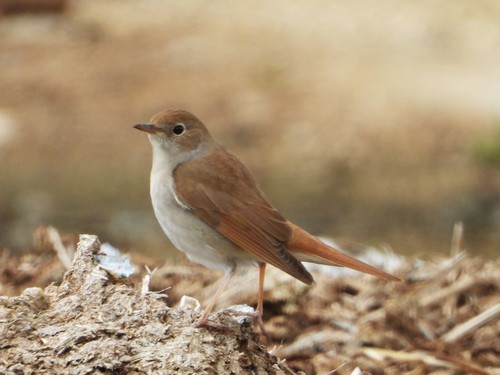 Usignolo
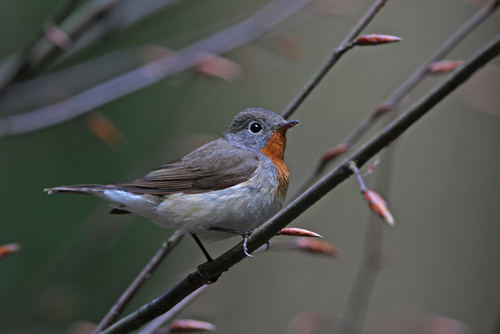 Pigliamosche pettirosso
In breve
The most reliable field mark to separate Common Nightingale from Red-breasted Flycatcher is the tail pattern: Red-breasted Flycatcher of all ages shows a distinctive black tail with white at the base of the outer feathers, while Common Nightingale has a uniformly rufous tail. In addition, Red-breasted Flycatcher is noticeably smaller, with a shorter, more delicate bill and a clear white eyering, especially obvious in immatures and females. Nightingale is larger, plain brown above with a rufous tail, and lacks any white in the tail or eyering. Breeding male Red-breasted Flycatchers show a bright orange throat patch, but females and immatures do not, so structural and tail features are key for all ages. Both species can appear plain and brownish, but careful attention to tail pattern, size, and head details will separate them in the field.
Consigli di identificazione
- Tail pattern (all ages): Red-breasted Flycatcher always shows a black tail with a white base to the outer feathers, visible when the tail is flicked, spread, or in flight. Nightingale’s tail is uniformly rufous with no white, regardless of age or season.
- Eyering: Red-breasted Flycatcher has a clear white eyering in all plumages, most obvious in immatures and females. Nightingale lacks a white eyering, though some eastern subspecies may show a faint pale supercilium, never a full eyering.
- Size and structure: Nightingale is larger and bulkier, with a longer, more robust body and bill. Red-breasted Flycatcher is small, compact, with a fine, pointed bill and a short, neat appearance.
- Bill color: Flycatcher’s bill is black with a pale pinkish base, especially obvious at close range. Nightingale’s bill is plain and lacks this contrast.
- Throat patch (breeding males): Adult male Red-breasted Flycatcher shows a bright orange throat and greyish head, contrasting with brown upperparts. Females and immatures lack the orange but still show the other marks. Nightingale never shows a colored throat.
- Plumage above and below: Both species are brown above and pale below, but Nightingale is plainer overall, with a uniform look. Flycatcher may look warmer-toned and has a more contrasting head pattern (greyish in breeding males, white eyering in all ages).
- Tail flicking and fanning: Flycatcher often flicks and fans its tail, flashing the white bases. Nightingale does not fan its tail in this way and rarely flicks it conspicuously.
- Perching behavior: Flycatcher perches more openly, often higher in trees or on exposed branches, especially when singing. Nightingale is secretive, staying low in dense cover.
- Flight style: Flycatcher has a quick, darting flight, often sallying out for insects. Nightingale’s flight is more direct and less aerial.
- Song: Nightingale’s song is loud, rich, and varied, often from deep cover. Flycatcher’s song is shorter, less melodious, and includes descending whistles and rattling calls.
- Habitat: Nightingale is tied to dense, low vegetation and undergrowth; Flycatcher prefers more open woodland and is less tied to the ground.
- Seasonal context: Red-breasted Flycatcher is a passage migrant in western Europe, often seen in autumn or spring; Nightingale is a summer breeder, present mainly in late spring and early summer.
- Sex and age pitfalls: Female and immature Flycatchers lack the orange throat but retain the tail and eyering marks. Nightingale never shows white in the tail or a strong eyering, regardless of age or sex.
- Confusion risk: In dull light or at a distance, both can appear plain brown and pale below. Always check for tail pattern and eyering before relying on overall color.
- When in doubt: Focus on tail pattern (white in Flycatcher, rufous in Nightingale) and size/structure as your first checks, especially in autumn when both can be drab and silent.
Taglia
Common Nightingale is clearly larger at 15–16.5 cm, about the size of a European Robin, while Red-breasted Flycatcher is much smaller at 11–12 cm, only slightly bigger than a Eurasian Wren. The Nightingale appears bulkier and longer-bodied, with a more robust structure, whereas the Flycatcher is compact, with a finer, shorter bill and a more delicate appearance overall. These differences are most apparent when both species are seen side by side, but even singly, the Flycatcher’s small, neat jizz and short tail stand out compared to the Nightingale’s longer, more rounded form.
Piumaggio
-
Juvenile/immature/first-winter birds: The Red-breasted Flycatcher of all ages has a distinctive tail pattern: black with a white base to the outer tail feathers, which is visible when the tail is flicked or spread. This is a key mark in flight or when perched. Common Nightingale, including juveniles and immatures, always shows a plain, warm rufous tail with no white. Both species are rather plain brown above and pale below, but the Flycatcher has a clear white eyering in all plumages, while the Nightingale does not.
-
Adult breeding plumage: Male Red-breasted Flycatcher develops a bright orange throat patch and a greyish head, contrasting with the brown upperparts and white underparts. Females and immatures lack the orange throat but retain the eyering and tail pattern. Nightingale adults remain plain brown above, with a uniform rufous tail and buff to white underparts, and show no eyering or throat patch. Eastern and Caucasian Nightingale subspecies may show a faint pale supercilium, but never a strong eyering or white in the tail.
Comportamento
Red-breasted Flycatcher is a classic aerial insectivore: it frequently flicks its tail upwards, sometimes fans or spreads the tail to show the white patches, and often sallies out from perches to catch insects in mid-air. It tends to forage higher in the canopy but also drops to shrubs and occasionally to the ground. Nightingale is more terrestrial, spending much time on or near the ground, moving through dense undergrowth or low scrub, and is less likely to be seen flycatching in the open. Nightingale’s movements are more furtive and less active, with less tail flicking and no tail fanning to reveal white patches.
Habitat
Common Nightingale favors dense, low vegetation, especially scrub, thickets, and woodland edges, often near water or in areas with rich undergrowth. It is more likely to be found skulking in brambles, nettles, or coppiced woodland. Red-breasted Flycatcher prefers mature deciduous or mixed woodland, often with a more open structure, and is frequently seen in the canopy or on exposed perches during migration. While both can occur in woodland edge habitats, Nightingale is much more tied to dense, tangled cover, whereas Flycatcher is more arboreal and less secretive.
Voce
Nightingale is famous for its loud, rich, and varied song, delivered from dense cover, often at dawn or dusk; the song is powerful, with whistles, trills, and repeated phrases. Red-breasted Flycatcher’s song is much shorter and less melodious, consisting of sweet, far-carrying whistles and a descending sequence, sometimes preceded by quiet 'zit' notes. The Flycatcher’s call is a short, rattling 'zrrrt', slower than that of Taiga Flycatcher, and it also gives a 'chip-chip-chr-rrr' call. Outside the breeding season, Flycatchers are mostly silent, while Nightingale may sing for longer into the summer.
Usignolo · Pigliamosche pettirosso · I miei uccelli difficili