

Gallinella d'acqua vs Schiribilla
Gallinula chloropus contro Zapornia parva
Fai un quiz con Gallinella d'acqua e Schiribilla
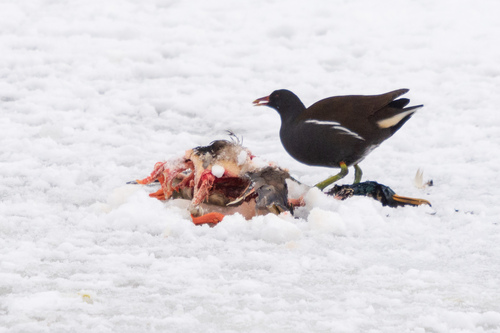 Gallinella d'acqua
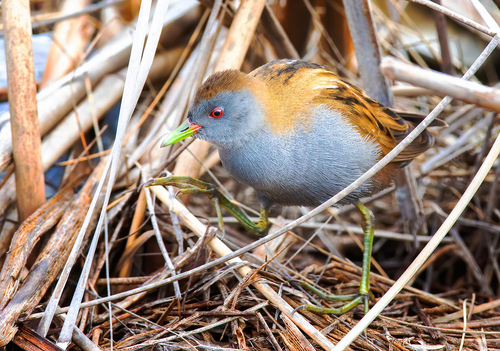 Schiribilla
In breve
The most reliable field mark to separate Common Moorhen from Little Crake is overall size and structure: the moorhen is much larger and bulkier, with a prominent red frontal shield and yellow-tipped red bill, while the Little Crake is tiny, slim, and has a short yellow bill with a red base. Juvenile and immature birds can be confusing, but the moorhen always shows white flank streaks and a white undertail, whereas the Little Crake lacks flank streaks and has a short tail with black-and-white barring underneath. In flight or when flushed, the moorhen appears crow-sized and strong, while the crake is sparrow-sized and flits weakly through reeds. Both species favor wetland habitats, but the Little Crake is much more secretive and rarely seen except on migration.
Consigli di identificazione
- Size is the fastest check: Moorhen is much larger and bulkier than Little Crake; if the bird looks crow-sized, it's a moorhen.
- Bill and shield: Moorhen adults have a thick, red bill with a yellow tip and a rounded red frontal shield above the bill; Little Crake has a short, straight yellow bill with a red base and no shield.
- Flank pattern: Moorhen of all ages shows bold white streaks on the flanks; Little Crake never shows these, instead having plain or lightly marked flanks.
- Undertail: Moorhen has a conspicuous white undertail; Little Crake shows a short tail with black-and-white barring underneath.
- Leg color: Moorhen has yellow legs; Little Crake has green legs with long toes.
- Plumage color (adult): Moorhen is blackish-brown overall; Little Crake males have blue-grey face and underparts, females and immatures have buff underparts and a white face/breast in immatures.
- Juvenile confusion: Juvenile moorhens are browner but still show white flanks and undertail; juvenile Little Crakes resemble females but with a white face and breast, and lack any white flank streaks.
- Flight style: Moorhen flies strongly and directly, often over open water; Little Crake flies weakly, low, and quickly drops into cover.
- Behavior: Moorhen is often seen swimming or walking in the open; Little Crake is secretive, rarely seen except during migration, and sticks to dense reeds.
- Habitat context: Moorhen prefers open water and pond edges; Little Crake is almost always in thick reed beds, especially during breeding.
- Voice: Loud gargling and hissing points to moorhen; a yapping 'kua' call in reeds suggests Little Crake.
- Sexual dimorphism: Only Little Crake shows strong sex differences in plumage; moorhen sexes are alike.
- Bill shape: Moorhen's bill is thicker and more triangular; Little Crake's is shorter and finer.
- Tail length: Moorhen has a longer tail, often flicked up to show white; Little Crake's tail is short and less obvious.
- Seasonal context: Outside migration, Little Crake is very rarely seen except by patient observers in dense reeds, while moorhen is common and conspicuous year-round.
Taglia
Common Moorhen is a large rail (body mass ~348g), measuring 30–38 cm in length and with a wingspan of 50–62 cm. In contrast, the Little Crake is truly small, only 17–19 cm long—barely half the length of a moorhen and much lighter-billed and more delicate overall. In the field, the moorhen is about the size of a small crow or a large pigeon, while the Little Crake is closer to a sparrow or starling in size, easily overlooked among reeds. This size difference is immediately apparent when both are seen together, but even singly, the moorhen's bulk and long-legged gait are distinctive.
Piumaggio
Juvenile and immature Common Moorhens are browner than adults, lacking the red frontal shield, but still show white streaks on the flanks and a white undertail—these marks are present at all ages. The adult moorhen is mostly blackish-brown with a rounded red shield above the bill, yellow-tipped red bill, and yellow legs. In contrast, Little Crake adults show strong sexual dimorphism: males have brown upperparts and blue-grey face and underparts, while females have buff underparts and grey only on the face. Immature Little Crakes resemble females but have a white face and breast. Critically, Little Crakes lack the moorhen's white flank streaks and undertail, instead showing a short tail with black-and-white barring underneath. The Little Crake's bill is short, straight, and yellow with a red base, never as thick or as brightly colored as the moorhen's. Downy chicks of both are black and not separable in the field.
Comportamento
Common Moorhens are often seen swimming in open water, walking boldly at the edge of ponds, and can be quite aggressive, especially during breeding season. They are territorial and will chase other birds. Little Crakes, by contrast, are extremely secretive, rarely venturing far from dense reed cover except during migration. They probe mud and shallow water with their bill, moving quietly and quickly through vegetation. In flight, moorhens are strong and direct, while Little Crakes fly weakly and low, quickly dropping back into cover.
Habitat
Both species are wetland specialists, but their microhabitat preferences differ. Common Moorhen is widespread and found in a variety of well-vegetated marshes, ponds, canals, and wetlands across Europe, Asia, and Africa. Little Crake breeds mainly in eastern European reed beds and just into western Asia, preferring dense reed vegetation and drier nest sites within marshes. The Little Crake is migratory, wintering in Africa, and is much less likely to be seen outside migration periods. Moorhen is much more likely to be found in open water or at the water's edge, while Little Crake sticks to thick cover.
Voce
Common Moorhen gives a wide range of gargling calls and loud hisses, especially when alarmed or defending territory. Little Crake is mostly heard during the breeding season, giving a distinctive yapping 'kua' call. Outside of breeding, Little Crake is generally quiet and secretive. If you hear loud, varied calls and hissing, it's likely a moorhen; a yapping call in dense reeds may indicate Little Crake.